I've got a notable one-off for you tonight. While stopping for beer at my favorite local bottle shop, I came across a bottle of Vikre Distillery's Voyageur Aquavit, a product that I'd heard about but never tried. It's a cognac-finished variant of their standard aquavit, which I tried at Vikre's tasting room a little over one year ago and enjoyed greatly. I knew I had to try this finished variant.
Turns out, the finish just rounds the edges off the base product and blunts the overly herbal notes, which makes this a good choice both for sipping and for mixing. I'll try a stirred cocktail later, but a sour seemed like a pretty easy way to start.
On its own, the aquavit was tasty but a little thin; this drink really came together when I combined it with a robust rum and a couple dashes of bitters.
1 1/2 oz Voyageur Aquavit (another aquavit would be a credible substitution)
1/2 oz Scarlet Ibis rum (yum; again, another assertive amber rum would work)
3/4 oz Velvet Falernum
3/4 oz lime juice
2 dashes cinnamon-orange bitters (a dash each of orange and Angostura would do)
Shake and strain into a chilled cocktail glass. Garnish? Huh?
I didn't take a picture of this one because (obviously) I couldn't be bothered with garnish, and thus it wasn't especially pretty. Perhaps I'll add one in next time I make this, because there will be a next time.
Showing posts with label rum. Show all posts
Showing posts with label rum. Show all posts
Thursday, March 24, 2016

Sunday, December 27, 2015
Tasting #3: Holiday Party Redux
Just about two years to the day after my first tasting menu presentation, I was invited back (in a fit of poor judgment, no doubt) to handle drinks for another holiday party! This was a great experience for me, in that it allowed me to think back on what worked well vs. not so well at the previous event, while reworking the format for a slightly bigger crowd.
Five drinks wound up being a little impractical the last time around, so we shortened to three rounds (I cheated by doing two variations on the same formula for round 2, as you'll see below). To start things off, we added a relatively gentle communal punch, which gave everyone a chance to settle in and grab something to eat while getting into the spirit of the event. The other major difference this year, although it doesn't show in the menu below, is that I recruited volunteers from the crowd to help out with measuring, stirring, and shaking. I've done this with friends at home, and it's a great way to keep everyone engaged while also demonstrating one of the points I try to get across the most fervently: that with a little instruction, anybody can put together a good drink.
(There were a lot of pictures taken as well - I'll try to hunt down some copies and post them up here.)
PRIMER: ROSY CHEEKS PUNCH
1 oz (8 oz) gin (Tanqueray)
½ oz (4 oz) overproof white rum (Wray & Nephew)
½ oz (4 oz) cinnamon syrup*
½ oz (4 oz) Campari (or similar)
½ oz (4 oz) lime juice
3 oz (1 standard 750ml bottle) sparkling wine
4 oz (1 standard 1 liter bottle) soda water
To build: Combine in a large glass, or punch bowl over a large block of ice. Garnish with cranberries, orange slices, rosemary sprigs – whatever you want! (All of the above at the event, which was maybe a bit much, but which got compliments on its appearance!)
Other notes: You can make this as an individual drink, or as a communal punch for 6-8 people (using the amounts in parenthesis).
DRINK #1: OLD-FASHIONED, RUMMY STYLE
2½ oz aged rum (Plantation 5 Year)
¼ oz cinnamon syrup*
¼ oz falernum (John D. Taylor)
3 dashes Angostura bitters
To build: Stir over ice and strain into a chilled glass, or just stir over a large ice cube; garnish with a small strip of lemon peel squeezed over the glass.
Other notes: Don’t skimp on the rum here; you want a smooth operator for this one.
DRINK #2 (A/B): SILVER & GOLD HOLIDAY FIZZES
Silver:
1½ oz gin (Tanqueray)
1 oz falernum (John D. Taylor)
1 oz lemon juice
½ egg white
Gold:
1½ oz gin (Tanqueray)
1 oz apricot liqueur (Rothman & Winter)
1 oz lemon juice
½ egg yolk
To build: Shake once without ice and once with ice, then strain into a highball glass and top with 3-4 oz of soda water to taste.
Other notes: Two different variants on the same basic formula; you can omit the egg for a plain fizz if you’re squeamish, but this way nothing goes to waste.
DRINK #3: FRANKENSTEIN’S ZOMBIE
1½ oz aged rum (Plantation 5 Year)
1 oz overproof white rum (Wray & Nephew)
½ oz apricot liqueur (Rothman & Winter)
½ oz falernum (John D. Taylor)
¼ oz cinnamon syrup*
1 oz pineapple juice
1 oz lime juice
2 dashes Angostura bitters
To build: Shake vigorously and pour unstrained into a highball glass; garnish with flaming rum in a lime shell only if it’s your first drink of the night. (I was asked why I made this point at the event, and it bears repeating: alcohol is flammable, and you don't want to set your bar/home/self on fire.)
Other notes: This is a cobbled-together version of several different Zombies that can be found in the wild; the original goes back to 1934.
*For Cinnamon Syrup: Combine 1 cup each of white sugar and water in a saucepan and add 4 whole cinnamon sticks. Heat and stir until the sugar dissolves, and let stand for at least 1 hour or overnight. Strain, bottle, and keep in an airtight refrigerated container.
I'm sure they'll never read it here, but I'd like to extend my thanks once again to our hosts, both for the aforementioned hosting duties and for inviting me back. Events like this are always a blast, and it was fun to get participants a little more hands-on this time around!
Five drinks wound up being a little impractical the last time around, so we shortened to three rounds (I cheated by doing two variations on the same formula for round 2, as you'll see below). To start things off, we added a relatively gentle communal punch, which gave everyone a chance to settle in and grab something to eat while getting into the spirit of the event. The other major difference this year, although it doesn't show in the menu below, is that I recruited volunteers from the crowd to help out with measuring, stirring, and shaking. I've done this with friends at home, and it's a great way to keep everyone engaged while also demonstrating one of the points I try to get across the most fervently: that with a little instruction, anybody can put together a good drink.
(There were a lot of pictures taken as well - I'll try to hunt down some copies and post them up here.)
PRIMER: ROSY CHEEKS PUNCH
1 oz (8 oz) gin (Tanqueray)
½ oz (4 oz) overproof white rum (Wray & Nephew)
½ oz (4 oz) cinnamon syrup*
½ oz (4 oz) Campari (or similar)
½ oz (4 oz) lime juice
3 oz (1 standard 750ml bottle) sparkling wine
4 oz (1 standard 1 liter bottle) soda water
To build: Combine in a large glass, or punch bowl over a large block of ice. Garnish with cranberries, orange slices, rosemary sprigs – whatever you want! (All of the above at the event, which was maybe a bit much, but which got compliments on its appearance!)
Other notes: You can make this as an individual drink, or as a communal punch for 6-8 people (using the amounts in parenthesis).
DRINK #1: OLD-FASHIONED, RUMMY STYLE
2½ oz aged rum (Plantation 5 Year)
¼ oz cinnamon syrup*
¼ oz falernum (John D. Taylor)
3 dashes Angostura bitters
To build: Stir over ice and strain into a chilled glass, or just stir over a large ice cube; garnish with a small strip of lemon peel squeezed over the glass.
Other notes: Don’t skimp on the rum here; you want a smooth operator for this one.
DRINK #2 (A/B): SILVER & GOLD HOLIDAY FIZZES
Silver:
1½ oz gin (Tanqueray)
1 oz falernum (John D. Taylor)
1 oz lemon juice
½ egg white
Gold:
1½ oz gin (Tanqueray)
1 oz apricot liqueur (Rothman & Winter)
1 oz lemon juice
½ egg yolk
To build: Shake once without ice and once with ice, then strain into a highball glass and top with 3-4 oz of soda water to taste.
Other notes: Two different variants on the same basic formula; you can omit the egg for a plain fizz if you’re squeamish, but this way nothing goes to waste.
DRINK #3: FRANKENSTEIN’S ZOMBIE
1½ oz aged rum (Plantation 5 Year)
1 oz overproof white rum (Wray & Nephew)
½ oz apricot liqueur (Rothman & Winter)
½ oz falernum (John D. Taylor)
¼ oz cinnamon syrup*
1 oz pineapple juice
1 oz lime juice
2 dashes Angostura bitters
To build: Shake vigorously and pour unstrained into a highball glass; garnish with flaming rum in a lime shell only if it’s your first drink of the night. (I was asked why I made this point at the event, and it bears repeating: alcohol is flammable, and you don't want to set your bar/home/self on fire.)
Other notes: This is a cobbled-together version of several different Zombies that can be found in the wild; the original goes back to 1934.
*For Cinnamon Syrup: Combine 1 cup each of white sugar and water in a saucepan and add 4 whole cinnamon sticks. Heat and stir until the sugar dissolves, and let stand for at least 1 hour or overnight. Strain, bottle, and keep in an airtight refrigerated container.
I'm sure they'll never read it here, but I'd like to extend my thanks once again to our hosts, both for the aforementioned hosting duties and for inviting me back. Events like this are always a blast, and it was fun to get participants a little more hands-on this time around!
Monday, November 23, 2015
Spirits: Widely Varied Rums
This is a post that I've been wanting to do for a while, in part because it celebrates a spirit that I think is under-appreciated by the drinking public at large, and in part as a rehearsal. After a year's hiatus, a good friend (most of those reading this will know exactly who, but this is the internet, so let's keep things comfortably anonymous) has invited me back to run another holiday party drink extravaganza! I am wildly excited, given what a blast I've had doing these events to date.
One of the best old-fashioneds I've had in recent memory is a rum variant, and I decided that I'd do my own as part of the lineup for this event. It's a great place to dive in, because it allows for some context around the history and ultimate simplicity of the old-fashioned format. It also provides for a springboard into rum, showing off its historical pedigree, the amazing quality that's available today, and how it can be superbly applied in cocktails. That's what I want to get into with this intro, which will be much longer than what I'd ultimately deliver live (don't worry, Mystery Friend, I'm not planning an extended lecture here) but the written format gives me a chance to structure and lay out my history. Stick with me, we'll get to some tasting soon too.
So: Rum. The origin of the name is unknown and sports many colorful theories (as with so many boozy terms) but the term starts appearing in the 1600s, often alongside the even more delightful "kill-devil". This gives a clue for how it was perceived: rough, fiery, potent, and unsavory, a stigma that clings to it even today.
Rum is, by definition, a distillate made from sugarcane, usually from molasses (we'll talk about exceptions later). As it turns out, since yeast eats sugar, sugarcane will ferment very nicely, and that's been known for thousands of years; a fermented sugarcane drink called brum has been produced by the Malay people for ages. But more relevant to us, the same fact was re-discovered on early American colonial sugar plantations. Somebody noticed that the molasses (produced as a byproduct of sugar refining) fermented nicely if allowed to sit in the tropical heat; somebody else then had the genius idea to distill the resulting alcohol, concentrating and preserving it.
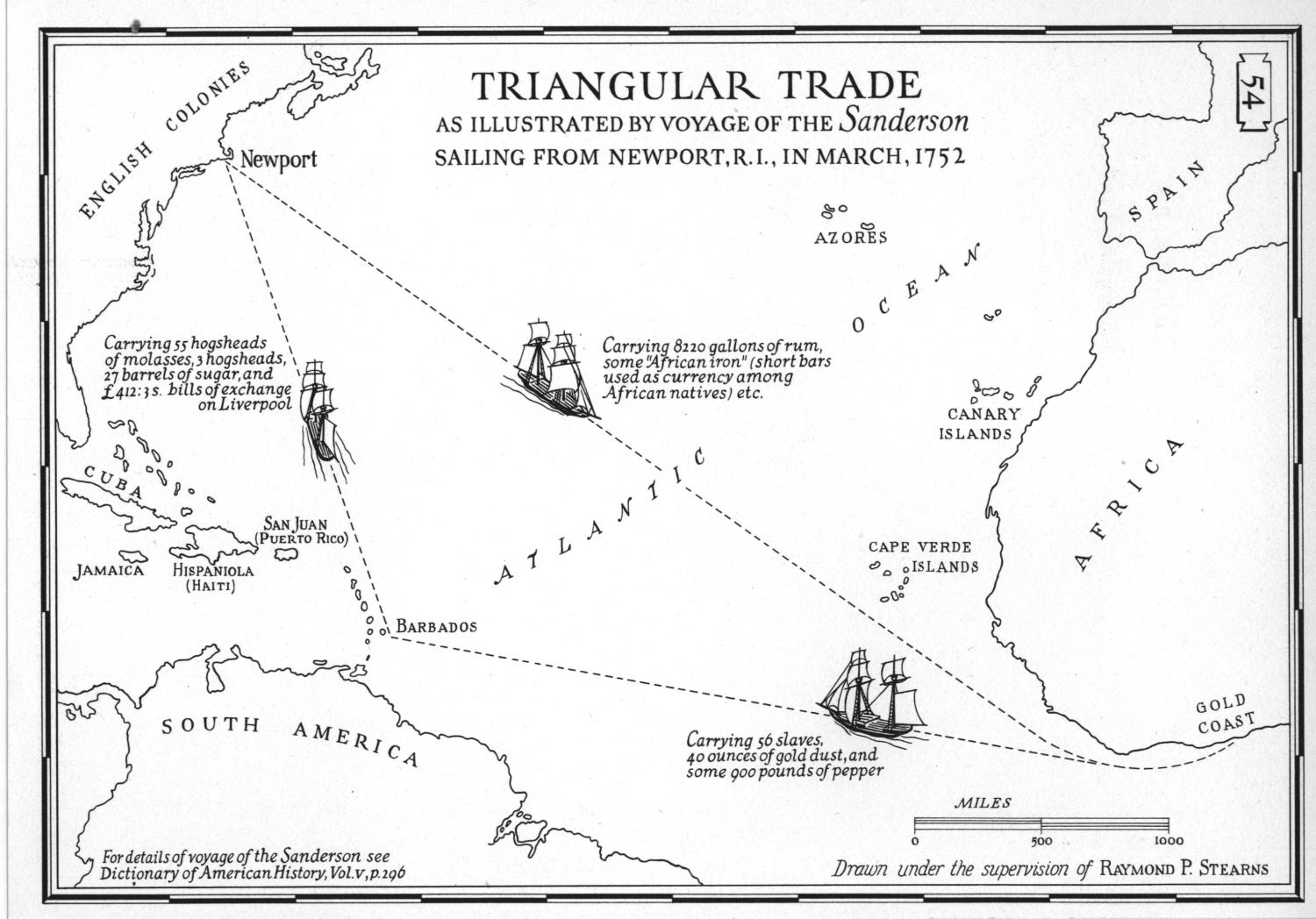 What we now call "rum" was born, and it quickly became associated with the sailors who conducted trade in sugar and slaves during the Colonial period. Rum became a hot commodity in the notorious slave trade that fueled Europe's economic expansion, to the point where the term "rum triangle" became synonymous with the routes. Sugar (along with rum) and other raw materials were shipped to Europe; finished goods like textiles and guns were shipped to Africa; slaves were shipped in horrifying conditions to work the sugar plantations in the Americas, and the whole thing went round again. As the New England colonies grew, a modified route also developed that shipped sugar to New England (to be fermented and distilled), rum and goods to Africa, and slaves back to the West Indies and Caribbean. This isn't exactly the most savory backstory, but it shows you that rum had heft. It was a major export, which together with cotton and tobacco provided an economic engine driving growth in the early American Colonies. Today's world might look very different without it.
Part of the reason for this popularity is that rum was one of the few distillates available at the time. Whiskey was perhaps being produced in small quantities in the rocky Scottish and Irish islands, but in a rough and barely palatable form. The column still used to produce clear spirits like vodka and gin hadn't been invented yet. That left brandy, which was expensive, and more importantly for the British, it was foreign. Rum provided a viable alternative, being made from sugarcane in colonies largely controlled by the British. That in turn provided fuel for a navy full of thirsty sailors.
It seems odd today that a massive military operation could be essentially powered by booze, but it's true. Consider the conditions. Voyages of any kind across the ocean took weeks or months, and you had to bring all your provisions along with enough space left over for cargo. Crewing a ship took dozens of men, which on the ocean meant not only food but hydration. Before the days of effective filtration and storage methods, fresh water could become corrupted and spread disease after a few weeks. Instead, ships carried beer (and wine for the officers) which kept longer due to its alcoholic content, and also provided some nutrition - indeed, a significant portion of the average sailor's daily caloric intake came from beer. But beer was no less bulky than water, and would go off if kept for any length of time in the hot and stuffy hold of a ship.
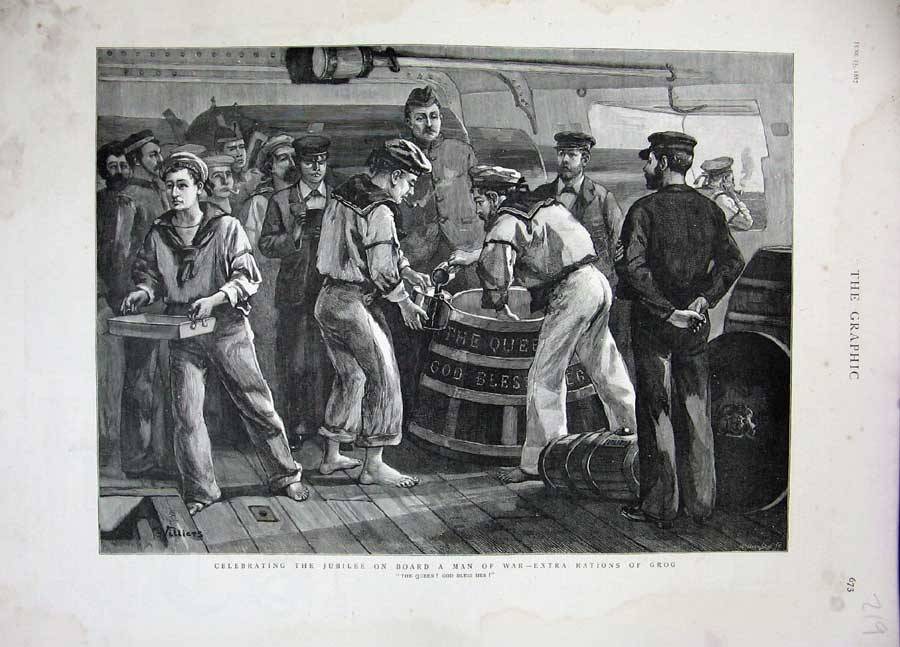 Eventually, British vessels began to carry spirits as well, which took up less cargo space, kept pretty much indefinitely, and which could be used to supplement stocks of fresh water as available. David Wondrich's Punch! makes a pretty compelling case for punch (the original mixed drink!) being born out of spirits mixed with water to cut down their proof, a concoction known as "grog". Often this was spiked with citrus to combat scurvy, and sweetened for taste. At first grog used a Javanese distillate called arrack, but rum provided a close substitute that was much easier to find on voyages to and from the Americas. Eventually ships were supplied with even cheaper gin, but not before rum became firmly entrenched as a sailor's drink. In other words, rum was a sort of military technology, one that kept sailors hydrated, entertained, and scurvy-free when combined with citrus. It helped to power the single greatest navy on the seas, strengthening the British Empire and shaping the history of the Western world. How's that for heft?
But, back to the modern world. Rum is nowadays produced primarily in the Caribbean islands that hosted the sugar plantations where it was born. Some newer US-based micro-distilleries also make rum, but the producers operating in New England during early colonial days have been supplanted by whiskey distillers. With such extensive history, it's perhaps no big surprise that rum styles have diverged and diffused over the centuries, and just about every island has its own take on the concept. Some use column stills to mass-produce a light, airy product; others stick to older pot stills of unique and arcane design. Some carefully blend different varieties for a smooth, sippable product; others like more spice and bite. Most of what we call "rum" is produced from molasses, but there are variations such as rhum agricole (produced on former French colonies, such as Haiti and Martinique) and cachaça (produced in Brazil) are made from fermented whole sugarcane juice instead, which hasn't been processed to refine out the pure sugar. That stuff is a whole different beast in terms of flavor, and less common here in the US anyway.
Just as there's wide variation in style between American, Scottish, Irish (not to mention Canadian and Japanese) whiskeys, there are many different renditions of rum, and it's instructive to taste them next to each other. Or, at least, that's the conceit that I'm operating under. Hence, here are three different rums from three different islands. All three are produced from molasses, moderately aged, and can be found for $25-35 apiece. I consider them all solid, everyday, multi-purpose rums, but they are far from identical, as we'll see.
 Plantation Grande Reserve 5 Year Old
About: Let's start with an easy one, made in the tiny island nation of Barbados. Despite the island's history as a British colony, the rum itself is bottled by Pierre Ferrand, a French cognac producer who also imports one of my favorite white rums and one of my highly prized sipping rums. So I may be biased, but this rum earns points for being a smooth, straightforward product that does very nicely in cocktails while being perfectly enjoyable on its own. It's aged in bourbon barrels in the Caribbean climate, then gets "refined" in French oak casks. The website suggests that the 5 years on the label is all in the bourbon barrels, so I'm not sure what exactly that last part means, but it has a definite impact on the final flavor.
Tasting Notes: Perhaps predictably, this rum has a lot in common with a relatively-young cognac. It's sweet up front, with a solid apple-pie core, but laced with the ineffable haut goût (or "hogo" in rum terms) which is really difficult to define but often sought-after both in older brandies and in rum. There's not a ton here, but it's noticeable, and it opens up the tropical-spicy flavors that begin to dominate the palate. Lots of guava, clove, allspice, vanilla, and a little whiff of coconut too. The finish ends just a little bit spicy, which is enough to draw you in and take another breath of the guava-apple-allspice nose again and start the process all over. This is a bit too smooth for Tiki-style drinks or anything with a lot of citrus, since those are basically designed to compensate for rougher rums, but it's a really good choice for off-beat mixing in stirred drinks (like a rum old-fashioned) and it's a solid sipping rum if you don't want to break the bank.
 Pyrat XO Reserve
About: Pyrat is bottled by Patrón (a company you may have heard of) and is sourced from Guyana. No, not the French one, the other one; did you know there were two Guyanas in South America? The distillate is undoubtedly a modern product, as seen below; the bottle, as seen to the left, is a squat pirate fantasy not designed with bartenders in mind. Also pay no attention to the "XO" on the bottle; the use of such grading terms is traditional for brandy, but totally unregulated outside of the French tradition, perhaps doubly so in a former British colony. So there's a lot of questionable branding going on here, but it's not a bad entry-level product inside.
Tasting Notes: This is a less subtle beast than the Plantation, but it has lots of the same sweetness up front. The nose is somewhere between root beer and ginger ale, with a strong whiff of lime peel. It tastes unsurprisingly of molasses, loaded with nutmeg, star anise, allspice, and ginger, which gets sweeter as it sits on the palate. Gradually this develops into a strong sweet orange quality, reminiscent of orange liqueur, with some tropical fruit (papaya?) and funky hogo in the background. Notice a pattern? The sweetness is really overwhelming by the end, but that actually makes it a decent dessert rum, possibly very nice for a rum cake or other confectionery. Pyrat also fits nicely into a Tiki cocktail blend; I'd definitely like this offset with another dry, overproof rum and plenty of citrus.
 Matusalem Gran Reserva
About: Although this one says "Cuba" on the bottle, it's actually made in the Dominican Republic, Cuban imports being embargoed until recently. As it turns out, a number of Cuban rum producers left the country after the revolution (you've heard of Bacardi, right?) and set up shop in neighboring countries to continue their trade. The "15 years" on the bottle isn't the same minimum age that you'll find on whiskey; it's an estimated average, as this is produced using the solera system. Also used for sherry, madiera, and other dessert wines, this is a method by which the product is fed from barrel to barrel and continuously blended; because the barrels are never fully drained, this means that some fraction of the distillate could be much older than the date on the bottle, though none is exactly as old as stated.
Tasting Notes: My initial impression is that this tastes older than either of the preceding rums. It's restrained, with a noticeable presence of oak, or cigar box maybe. The nose has little bits of coffee, vanilla, raisin, nutmeg, and orange peel, without any one overwhelming the whole. On the palate, it's the driest rum here, with only a little residual raisin and toffee sweetness not quite balancing things out and leaving the texture little thin. The flavor is as complex as the nose; dried orange, allspice, and vanilla start out, with coffee, tobacco, and oak following but not predominating. The allspice builds toward the finish and the bitter toffee quality returns too, leading things out nicely. The only thing really missing is hogo, which makes this less appropriate as a traditional Tiki rum, but the smoothness is great for mixing in simple cocktails. I particularly like a rum Boulevardier variation* which lets the bitter qualities shine while reinforcing with sweetness.
*2 oz aged rum, 1 oz Campari (or similar), 1 oz (good) sweet vermouth, 1 dash orange bitters, assembled over a large ice cube. Let's call this one a Privateer, though I'm sure there are plenty other cocktails with that name.
So: rum is pretty variable stuff! Keep in mind that this is just one moderately-aged subset of rums; there's much more variation between categories than displayed here. I'm looking forward to talking about it, among many other things.
One of the best old-fashioneds I've had in recent memory is a rum variant, and I decided that I'd do my own as part of the lineup for this event. It's a great place to dive in, because it allows for some context around the history and ultimate simplicity of the old-fashioned format. It also provides for a springboard into rum, showing off its historical pedigree, the amazing quality that's available today, and how it can be superbly applied in cocktails. That's what I want to get into with this intro, which will be much longer than what I'd ultimately deliver live (don't worry, Mystery Friend, I'm not planning an extended lecture here) but the written format gives me a chance to structure and lay out my history. Stick with me, we'll get to some tasting soon too.
So: Rum. The origin of the name is unknown and sports many colorful theories (as with so many boozy terms) but the term starts appearing in the 1600s, often alongside the even more delightful "kill-devil". This gives a clue for how it was perceived: rough, fiery, potent, and unsavory, a stigma that clings to it even today.
Rum is, by definition, a distillate made from sugarcane, usually from molasses (we'll talk about exceptions later). As it turns out, since yeast eats sugar, sugarcane will ferment very nicely, and that's been known for thousands of years; a fermented sugarcane drink called brum has been produced by the Malay people for ages. But more relevant to us, the same fact was re-discovered on early American colonial sugar plantations. Somebody noticed that the molasses (produced as a byproduct of sugar refining) fermented nicely if allowed to sit in the tropical heat; somebody else then had the genius idea to distill the resulting alcohol, concentrating and preserving it.
What we now call "rum" was born, and it quickly became associated with the sailors who conducted trade in sugar and slaves during the Colonial period. Rum became a hot commodity in the notorious slave trade that fueled Europe's economic expansion, to the point where the term "rum triangle" became synonymous with the routes. Sugar (along with rum) and other raw materials were shipped to Europe; finished goods like textiles and guns were shipped to Africa; slaves were shipped in horrifying conditions to work the sugar plantations in the Americas, and the whole thing went round again. As the New England colonies grew, a modified route also developed that shipped sugar to New England (to be fermented and distilled), rum and goods to Africa, and slaves back to the West Indies and Caribbean. This isn't exactly the most savory backstory, but it shows you that rum had heft. It was a major export, which together with cotton and tobacco provided an economic engine driving growth in the early American Colonies. Today's world might look very different without it.Part of the reason for this popularity is that rum was one of the few distillates available at the time. Whiskey was perhaps being produced in small quantities in the rocky Scottish and Irish islands, but in a rough and barely palatable form. The column still used to produce clear spirits like vodka and gin hadn't been invented yet. That left brandy, which was expensive, and more importantly for the British, it was foreign. Rum provided a viable alternative, being made from sugarcane in colonies largely controlled by the British. That in turn provided fuel for a navy full of thirsty sailors.
It seems odd today that a massive military operation could be essentially powered by booze, but it's true. Consider the conditions. Voyages of any kind across the ocean took weeks or months, and you had to bring all your provisions along with enough space left over for cargo. Crewing a ship took dozens of men, which on the ocean meant not only food but hydration. Before the days of effective filtration and storage methods, fresh water could become corrupted and spread disease after a few weeks. Instead, ships carried beer (and wine for the officers) which kept longer due to its alcoholic content, and also provided some nutrition - indeed, a significant portion of the average sailor's daily caloric intake came from beer. But beer was no less bulky than water, and would go off if kept for any length of time in the hot and stuffy hold of a ship.
But, back to the modern world. Rum is nowadays produced primarily in the Caribbean islands that hosted the sugar plantations where it was born. Some newer US-based micro-distilleries also make rum, but the producers operating in New England during early colonial days have been supplanted by whiskey distillers. With such extensive history, it's perhaps no big surprise that rum styles have diverged and diffused over the centuries, and just about every island has its own take on the concept. Some use column stills to mass-produce a light, airy product; others stick to older pot stills of unique and arcane design. Some carefully blend different varieties for a smooth, sippable product; others like more spice and bite. Most of what we call "rum" is produced from molasses, but there are variations such as rhum agricole (produced on former French colonies, such as Haiti and Martinique) and cachaça (produced in Brazil) are made from fermented whole sugarcane juice instead, which hasn't been processed to refine out the pure sugar. That stuff is a whole different beast in terms of flavor, and less common here in the US anyway.
Just as there's wide variation in style between American, Scottish, Irish (not to mention Canadian and Japanese) whiskeys, there are many different renditions of rum, and it's instructive to taste them next to each other. Or, at least, that's the conceit that I'm operating under. Hence, here are three different rums from three different islands. All three are produced from molasses, moderately aged, and can be found for $25-35 apiece. I consider them all solid, everyday, multi-purpose rums, but they are far from identical, as we'll see.

About: Let's start with an easy one, made in the tiny island nation of Barbados. Despite the island's history as a British colony, the rum itself is bottled by Pierre Ferrand, a French cognac producer who also imports one of my favorite white rums and one of my highly prized sipping rums. So I may be biased, but this rum earns points for being a smooth, straightforward product that does very nicely in cocktails while being perfectly enjoyable on its own. It's aged in bourbon barrels in the Caribbean climate, then gets "refined" in French oak casks. The website suggests that the 5 years on the label is all in the bourbon barrels, so I'm not sure what exactly that last part means, but it has a definite impact on the final flavor.
Tasting Notes: Perhaps predictably, this rum has a lot in common with a relatively-young cognac. It's sweet up front, with a solid apple-pie core, but laced with the ineffable haut goût (or "hogo" in rum terms) which is really difficult to define but often sought-after both in older brandies and in rum. There's not a ton here, but it's noticeable, and it opens up the tropical-spicy flavors that begin to dominate the palate. Lots of guava, clove, allspice, vanilla, and a little whiff of coconut too. The finish ends just a little bit spicy, which is enough to draw you in and take another breath of the guava-apple-allspice nose again and start the process all over. This is a bit too smooth for Tiki-style drinks or anything with a lot of citrus, since those are basically designed to compensate for rougher rums, but it's a really good choice for off-beat mixing in stirred drinks (like a rum old-fashioned) and it's a solid sipping rum if you don't want to break the bank.

About: Pyrat is bottled by Patrón (a company you may have heard of) and is sourced from Guyana. No, not the French one, the other one; did you know there were two Guyanas in South America? The distillate is undoubtedly a modern product, as seen below; the bottle, as seen to the left, is a squat pirate fantasy not designed with bartenders in mind. Also pay no attention to the "XO" on the bottle; the use of such grading terms is traditional for brandy, but totally unregulated outside of the French tradition, perhaps doubly so in a former British colony. So there's a lot of questionable branding going on here, but it's not a bad entry-level product inside.
Tasting Notes: This is a less subtle beast than the Plantation, but it has lots of the same sweetness up front. The nose is somewhere between root beer and ginger ale, with a strong whiff of lime peel. It tastes unsurprisingly of molasses, loaded with nutmeg, star anise, allspice, and ginger, which gets sweeter as it sits on the palate. Gradually this develops into a strong sweet orange quality, reminiscent of orange liqueur, with some tropical fruit (papaya?) and funky hogo in the background. Notice a pattern? The sweetness is really overwhelming by the end, but that actually makes it a decent dessert rum, possibly very nice for a rum cake or other confectionery. Pyrat also fits nicely into a Tiki cocktail blend; I'd definitely like this offset with another dry, overproof rum and plenty of citrus.

About: Although this one says "Cuba" on the bottle, it's actually made in the Dominican Republic, Cuban imports being embargoed until recently. As it turns out, a number of Cuban rum producers left the country after the revolution (you've heard of Bacardi, right?) and set up shop in neighboring countries to continue their trade. The "15 years" on the bottle isn't the same minimum age that you'll find on whiskey; it's an estimated average, as this is produced using the solera system. Also used for sherry, madiera, and other dessert wines, this is a method by which the product is fed from barrel to barrel and continuously blended; because the barrels are never fully drained, this means that some fraction of the distillate could be much older than the date on the bottle, though none is exactly as old as stated.
Tasting Notes: My initial impression is that this tastes older than either of the preceding rums. It's restrained, with a noticeable presence of oak, or cigar box maybe. The nose has little bits of coffee, vanilla, raisin, nutmeg, and orange peel, without any one overwhelming the whole. On the palate, it's the driest rum here, with only a little residual raisin and toffee sweetness not quite balancing things out and leaving the texture little thin. The flavor is as complex as the nose; dried orange, allspice, and vanilla start out, with coffee, tobacco, and oak following but not predominating. The allspice builds toward the finish and the bitter toffee quality returns too, leading things out nicely. The only thing really missing is hogo, which makes this less appropriate as a traditional Tiki rum, but the smoothness is great for mixing in simple cocktails. I particularly like a rum Boulevardier variation* which lets the bitter qualities shine while reinforcing with sweetness.
*2 oz aged rum, 1 oz Campari (or similar), 1 oz (good) sweet vermouth, 1 dash orange bitters, assembled over a large ice cube. Let's call this one a Privateer, though I'm sure there are plenty other cocktails with that name.
So: rum is pretty variable stuff! Keep in mind that this is just one moderately-aged subset of rums; there's much more variation between categories than displayed here. I'm looking forward to talking about it, among many other things.
Sunday, September 27, 2015
Blood Moon Panic
 This kind of one-off cocktail post is becoming a rarity! Still, tonight's a special occasion: a super-cool lunar eclipse, which as a space nerd I just had to watch. I joked to my wife that I should make a drink to celebrate the occasion, then demurred when she agreed, and rapidly changed my tune again.
I'll list this in slightly weird order, because I made a non-alcoholic version for my wife that excluded the rum:
1 oz lemon juice
3/4 oz sour cherry syrup (made from preserves)
3/4 oz apricot nectar
3 dashes Bitter Truth Jerry Thomas' Own Decanter bitters
3 dashes Peychaud's bitters
(2 oz aged rum, specifically Ron Methusela)
Shake and strain into a large glass over a frozen watermelon cube, then top with 2 oz (with booze) to 4 oz (without booze) soda water and stir gently.
I wanted something with the deep brownish-red color of the lunar eclipse, and in this I succeeded, though in retrospect I might have made this a beer cocktail with a dark stout of some kind. It's pretty tasty as is, though, and I like having a booze-free variant available.
The name, by the way, refers to a particular brand of apocalyptic idiocy that I find entertaining, if completely wrong. The so-called "blood moon" is cool, and rare to see, but an entirely predictable phenomenon!
Saturday, August 15, 2015
Hemingway Variations

After doing some research I was also surprised that my personal version seems to feature a lot more sugar than most published recipes, many of which feature at most 1/2 oz of maraschino for sweetness. Fortunately, when I cracked open Speakeasy, the proportions were a lot closer to those I provide here. Personally, I like nodding to Hemingway with a strong cocktail, but prefer a somewhat sweeter drink.
The other fun thing you can easily do with this recipe is swap out simple syrup (which actually doesn't appear in many recipes) for a flavored syrup. While dicking around a couple weeks ago, I also tried swapping out the normal white rum for other spirits, resulting in the concoctions below.
#1
2 oz aged rum (Scarlet Ibis for me; you want something moderately aged and funky)
1/2 oz maraschino liqueur (Luxardo)
1/2 oz spiced syrup
1/2 oz grapefruit juice
3/4 oz lime juice
#2
2 oz blanco tequila (El Mayor)
1/2 oz maraschino liqueur (Luxardo, obviously)
1/2 oz grenadine
1/2 oz grapefruit juice
3/4 oz lime juice
#3
2 oz pisco (Macchu)
1/2 oz maraschino liqueur (I said Luxardo)
1/2 oz thyme syrup
1/2 oz grapefruit juice
3/4 oz lime juice
For all of the above, shake vigorously and strain into a chilled cocktail glass; garnish if you wish, or do what I did (a move pilfered from the excellent Marvel Bar) and lower in a single cube from the shaker with a barspoon, to keep the drink cool without diluting it much further.
Tuesday, May 26, 2015
Pink Ribbon Punch
Barbecues are among my favorite events to throw. This is thanks primarily to two easy, delicious things: grilled meat, and punch. I like to think that our summer gatherings are becoming known for both.
This particular version was inspired directly by cheap, tasty-looking watermelon, so I garnished it with some frozen into large ice blocks, with watermelon frozen in the middle, you guys! This is something I've always wanted to try but never had the foresight to manage; my wife, however, dubbed it "very Martha Stewart," which I'm pretty sure was derogatory. Whatever! It looked nice.
 The following makes about half of the gargantuan amount seen to the left, which still didn't quite make it to the end of the party. I admit that I may have dumped a bit of it on the table trying to pour the dregs out of the punch bowl.
1 L watermelon juice (well-strained)
750 mL prosecco (something cheap and dry)
500 mL white rum (Bacardi)
500 mL soda water
4 oz lime juice
4 oz lime-coriander cordial
4 oz cranberry grenadine
4 oz Cocchi Americano
Combine in a punch bowl and float some large ice cubes to keep things cool (it helps if everything's well-chilled beforehand).
That's a pretty damn weird mix of metric and imperial units, I know, but it's how I measured, and it turned out really nicely, so I'm recording it verbatim.
This particular version was inspired directly by cheap, tasty-looking watermelon, so I garnished it with some frozen into large ice blocks, with watermelon frozen in the middle, you guys! This is something I've always wanted to try but never had the foresight to manage; my wife, however, dubbed it "very Martha Stewart," which I'm pretty sure was derogatory. Whatever! It looked nice.

1 L watermelon juice (well-strained)
750 mL prosecco (something cheap and dry)
500 mL white rum (Bacardi)
500 mL soda water
4 oz lime juice
4 oz lime-coriander cordial
4 oz cranberry grenadine
4 oz Cocchi Americano
Combine in a punch bowl and float some large ice cubes to keep things cool (it helps if everything's well-chilled beforehand).
That's a pretty damn weird mix of metric and imperial units, I know, but it's how I measured, and it turned out really nicely, so I'm recording it verbatim.
Wednesday, April 29, 2015
Pithy Reply
I've been trying a technique lately in an effort to recycle, wherein after juicing a bunch of citrus, I'll take the spent shells and pour some inexpensive spirit over them in a Mason jar. I'll let this stand for a while, infuse a bit, then strain off to produce a slightly bitter cordial. It's a simple, cheap way to wring a little more flavor out of what would otherwise be waste.
The result is also an easy way to put a twist on an otherwise basic cocktail. Like this one, which became a straightforward response to an unspecified request for "just a drink" (in which case you're getting whatever I have to use up). It was named (terribly) for its various citrus content, combined with a self-referential pun. Fucking meta, man.
2 oz grapefruit-infused white rum
3/4 oz lemon/orange syrup
1/2 oz lime juice
Shake and strain over a fresh large ice cube. Hurl disdainfully at the freeloader who begged it from you. (Or, like, drink it.)
The result is also an easy way to put a twist on an otherwise basic cocktail. Like this one, which became a straightforward response to an unspecified request for "just a drink" (in which case you're getting whatever I have to use up). It was named (terribly) for its various citrus content, combined with a self-referential pun. Fucking meta, man.
2 oz grapefruit-infused white rum
3/4 oz lemon/orange syrup
1/2 oz lime juice
Shake and strain over a fresh large ice cube. Hurl disdainfully at the freeloader who begged it from you. (Or, like, drink it.)
Sunday, February 1, 2015
Peat & Molasses
We had what I'd have to describe as a dinner party last night, and in planning the menu I had a bit of a revelation. Instead of driving myself nuts trying to create individual cocktails for our guests while cooking at the same time, why not use what I learned about creating bottled cocktails and batch something out to keep everybody happy? This worked out as well as I'd hoped, though it was a thirsty bunch, and I had to refill the pitcher with my mystery cocktail and a pitcher-sized Corey Taylor in short order. Still, kept everybody's glasses full and kept me sane. Might be a new party trick!
I'll include both the full bottled proportion and a single-serving recipe below.
16 oz (2 oz) amber rum (Appleton VX)
6 oz (3/4 oz) blended scotch (Famous Grouse)
6 oz (3/4 oz) sweet vermouth (Cocchi Torino)
2 oz (1/4 oz) amontillado sherry
2 oz (1/4 oz) Casoni 1814 (Aperol or Cappelletti would work too)
8 oz water (omit for single-serving)
For the bottled version, combine everything and keep refrigerated until ready to serve, then add to a pitcher with several large ice cubes. For the single-size version, stir and strain over a large cube in an old-fashioned glass.
Friday, October 24, 2014
Very Old Fashioned

1 1/2 oz Plantation 20th Anniversary Rum
1/2 oz Laird's Apple Brandy
1/4 oz mezcal (Vida)
1/4 oz pineapple syrup
3 dashes Bitter Truth Celery Bitters
Stir over a large ice cube in an old-fashioned glass. FUCK GARNISH. That's the kind of mood I'm in. Booze in a glass, dammit, and fast!
Sunday, June 22, 2014
Briny Deep
Okay, fine, I admit it - I wanted a Pitch Black, I was out of vermouth, and I subbed in another amaro instead. So what? It's tasty enough to merit its own name anyway.
1 1/4 oz Cutty Sark Prohibition Edition
1 oz Averna
1 oz Cynar
1/4 oz overproof dark rum (did you know that Gosling's makes a 151-proof version?)
Stir over a large ice cube in an old-fashioned glass; garnish with a small pinch of salt on top of the cube.
This makes for an impressively dark and sultry drink. Worth hunting down the amaros for, if you ask me.
1 1/4 oz Cutty Sark Prohibition Edition
1 oz Averna
1 oz Cynar
1/4 oz overproof dark rum (did you know that Gosling's makes a 151-proof version?)
Stir over a large ice cube in an old-fashioned glass; garnish with a small pinch of salt on top of the cube.
This makes for an impressively dark and sultry drink. Worth hunting down the amaros for, if you ask me.
Saturday, May 17, 2014
Different Drum Drinks
A good friend brought over a bottle of Different Drum, which he'd somehow snapped up in a truly insane rush to order the first 1,500 bottles. After a first tasting, he decided that he wanted to try it in a cocktail. I was happy to oblige!
This is funky stuff - rich, smooth, slightly sweet, redolent of roasted coffee. A lot like a quality coffee liqueur but without that cloying sugar component. I dig it, although I think it really shines when paired with another base. Like so:
Fine Grind:
1 1/4 oz Different Drum rum
1 oz armagnac brandy (I used Tariquet VS Bas-Armagnac; a mild bourbon would work too)
1/2 oz red vermouth (Primitivo Quiles again)
1/4 oz Licor 43 (you could scale this back or omit entirely depending on your taste)
1 dash Fee Brothers Black Walnut bitters
1 dash orange bitters (Regan's No. 6)
Stir and strain into a cocktail glass; garnish with a strip of orange peel.
This wound up being the winner in our small tasting group; it's a Manhattan-esque sipper (or more properly a Saratoga Cocktail) that highlights the flavor of the Drum without letting it dominate everything else. But I also wanted to try something less spirit-forward, resulting in this take on a Dark & Stormy:
Drumming in the Dark:
2 oz Different Drum rum
1/2 oz Mathilde Poire liqueur
1/2 lime juice
2-3 oz ginger beer (Reed's Extra Ginger is my favorite)
Shake the first three ingredients and strain over fresh ice; top with the ginger beer, stir, and garnish with a lime wheel.
Overall, I'm sold. Different Drum seems like a solid and interesting way to bring coffee flavor into cocktails without the added sweetness of coffee liqueurs. I'm not sure about the tagline ("A rum for the bourbon drinker") as it seems more like a rum for the espresso aficionado, but I like both those things so it works out.
Be warned, this clearly isn't a simple substitution for other rums, whiskeys, or what-have-you. This occupies a place in my mind next to quality spiced rums (Sailor Jerry's all the way) and overproof dark rums (like Lemon Hart 151): too potent to use as a base in a simple cocktail, but bringing very unique flavors for which it's tough to substitute. Also, Different Drum only seems to be available direct from the La Colombe distillery, so don't go seeking it out at your local liquor store.
This is funky stuff - rich, smooth, slightly sweet, redolent of roasted coffee. A lot like a quality coffee liqueur but without that cloying sugar component. I dig it, although I think it really shines when paired with another base. Like so:
Fine Grind:
1 1/4 oz Different Drum rum
1 oz armagnac brandy (I used Tariquet VS Bas-Armagnac; a mild bourbon would work too)
1/2 oz red vermouth (Primitivo Quiles again)
1/4 oz Licor 43 (you could scale this back or omit entirely depending on your taste)
1 dash Fee Brothers Black Walnut bitters
1 dash orange bitters (Regan's No. 6)
Stir and strain into a cocktail glass; garnish with a strip of orange peel.
This wound up being the winner in our small tasting group; it's a Manhattan-esque sipper (or more properly a Saratoga Cocktail) that highlights the flavor of the Drum without letting it dominate everything else. But I also wanted to try something less spirit-forward, resulting in this take on a Dark & Stormy:
Drumming in the Dark:
2 oz Different Drum rum
1/2 oz Mathilde Poire liqueur
1/2 lime juice
2-3 oz ginger beer (Reed's Extra Ginger is my favorite)
Shake the first three ingredients and strain over fresh ice; top with the ginger beer, stir, and garnish with a lime wheel.
Overall, I'm sold. Different Drum seems like a solid and interesting way to bring coffee flavor into cocktails without the added sweetness of coffee liqueurs. I'm not sure about the tagline ("A rum for the bourbon drinker") as it seems more like a rum for the espresso aficionado, but I like both those things so it works out.
Be warned, this clearly isn't a simple substitution for other rums, whiskeys, or what-have-you. This occupies a place in my mind next to quality spiced rums (Sailor Jerry's all the way) and overproof dark rums (like Lemon Hart 151): too potent to use as a base in a simple cocktail, but bringing very unique flavors for which it's tough to substitute. Also, Different Drum only seems to be available direct from the La Colombe distillery, so don't go seeking it out at your local liquor store.
Friday, April 25, 2014
Grandfather Cocktails
I somehow managed to delete this post! I'll reconstruct it as best I can...
I recently re-read Jason Wilson's Boozehound - a very entertaining exploration of unusual booze categories. One of my favorite chapters goes into detail about amaros, the Italian bitter liqueurs best exemplified in this country by Campari. I've included Cynar (wonderful, bizarre, artichoke-y goodness) in a few recipes, but haven't explored many other amaros on my own before. A few weeks ago, I decided to splurge and try a couple that I'd never worked with before.
I wound up with bottles of Averna and Zucca. These share a dark, intense, herbal quality but have very different takes. Averna is appropriately Sicilian, full of black liquorice, orange peel, and a hint of walnut. Zucca focuses on jammy red fruit, dark spices, and an interesting astringency (possibly from the inclusion of rhubarb).
Both of these are quite pleasant on their own over ice with a liberal splash of soda water; this makes for a simple, bittersweet apertif. I've also seen them used in recipes like the Black Manhattan, but thought they might really shine as supplements in a classic old-fashioned.
#1 (Papa Averna)
2 oz aged rum (Plantation 20th Anniversary, because that's how I roll)
1/2 oz Averna
1/4 oz orgeat (homemade)
2 dashes orange bitters (Regan's No. 6)
Stir over ice in a cocktail glass. Garnish with orange peel, if you want.
#2 (Papa Zucca)
2 oz bourbon (delicious Willett Pot Still Reserve)
1/2 oz Zucca
1/4 oz orgeat (I had a bunch left over from some as-yet-unposted Easter cocktails)
2 dashes aromatic bitters (Angostura)
Stir over ice in a cocktail glass. Garnish with a cocktail cherry, if you're feeling fancy.
These are both old-fashioned and bitter - hence the term "grandfather cocktails". Get it?!? (Sorry, I occasionally fall victim to compulsive punning.)
I recently re-read Jason Wilson's Boozehound - a very entertaining exploration of unusual booze categories. One of my favorite chapters goes into detail about amaros, the Italian bitter liqueurs best exemplified in this country by Campari. I've included Cynar (wonderful, bizarre, artichoke-y goodness) in a few recipes, but haven't explored many other amaros on my own before. A few weeks ago, I decided to splurge and try a couple that I'd never worked with before.
I wound up with bottles of Averna and Zucca. These share a dark, intense, herbal quality but have very different takes. Averna is appropriately Sicilian, full of black liquorice, orange peel, and a hint of walnut. Zucca focuses on jammy red fruit, dark spices, and an interesting astringency (possibly from the inclusion of rhubarb).
Both of these are quite pleasant on their own over ice with a liberal splash of soda water; this makes for a simple, bittersweet apertif. I've also seen them used in recipes like the Black Manhattan, but thought they might really shine as supplements in a classic old-fashioned.
#1 (Papa Averna)
2 oz aged rum (Plantation 20th Anniversary, because that's how I roll)
1/2 oz Averna
1/4 oz orgeat (homemade)
2 dashes orange bitters (Regan's No. 6)
Stir over ice in a cocktail glass. Garnish with orange peel, if you want.
#2 (Papa Zucca)
2 oz bourbon (delicious Willett Pot Still Reserve)
1/2 oz Zucca
1/4 oz orgeat (I had a bunch left over from some as-yet-unposted Easter cocktails)
2 dashes aromatic bitters (Angostura)
Stir over ice in a cocktail glass. Garnish with a cocktail cherry, if you're feeling fancy.
These are both old-fashioned and bitter - hence the term "grandfather cocktails". Get it?!? (Sorry, I occasionally fall victim to compulsive punning.)
Wednesday, April 16, 2014
Improbable Tonic
One of the things about making your own tonic syrup is that you really don't use much for each drink, and the potential uses are admittedly more limited than a straightforward flavored syrup. So what do you do with a whole ton of tonic syrup, with nary a drop of gin, aquavit, etc. in sight? You do insane things, that's what.
Before you go judging this recipe on the merits of its appearance, try one. This is bizarre, unexpected synergy in a glass.
2 oz medium-dry sherry (rainwater madiera might work too)
1 oz white rum (Plantation 3 Star; I wouldn't use anything too dry, i.e. Bacardi)
1/3 oz spiced tonic syrup (up to 1/2 oz depending on your batch)
Combine over ice and stir, then top with 1-2 oz soda water to taste.
I know, I know - that looks like a fucking train wreck. It was only through the miracle of multiple previous drinks that this combination even occurred to me, and then just as a sort of befuddled curiosity. I've never been more pleased to be proven wrong.
Before you go judging this recipe on the merits of its appearance, try one. This is bizarre, unexpected synergy in a glass.
2 oz medium-dry sherry (rainwater madiera might work too)
1 oz white rum (Plantation 3 Star; I wouldn't use anything too dry, i.e. Bacardi)
1/3 oz spiced tonic syrup (up to 1/2 oz depending on your batch)
Combine over ice and stir, then top with 1-2 oz soda water to taste.
I know, I know - that looks like a fucking train wreck. It was only through the miracle of multiple previous drinks that this combination even occurred to me, and then just as a sort of befuddled curiosity. I've never been more pleased to be proven wrong.
Friday, March 28, 2014
Cilontrastic Syrup
I don't normally post recipes without booze in them, but here's a rare and deserved specimen. Friends, I present to you: tequila's best friend ever.
8 oz agave nectar
4 oz water
1 teaspoon whole coriander seeds
1/2 cup chopped cilantro
Zest of 2 limes
Heat the agave, water, and coriander in a small saucepan over low heat until the syrup comes to a gentle simmer. Add the cilantro and lime zest, remove from heat, cover, and let sit on the stove to infuse for an hour. Pour through a fine sieve and keep refrigerated in a sealed container. Optionally, add 1/2 oz of 100-proof (or higher) vodka for longer storage - though note that this technically makes it non-alcoholic.
My favorite usage thus far:
2 oz blanco tequila
1/2 oz Cilontrastic Syrup
1/2 oz lime juice
Shake and strain into an old-fashioned glass over crushed ice.
This works equally well with other robust white spirits, like white rum or pisco.
Sunday, January 12, 2014
Dual Highballs
Two fairly straightforward highballs, constructed along the same formula. Nothing too unusual for nightly mixing, but these turned out well enough that I thought they deserved recording.
#1:
1 oz pisco (I used Capel; not necessarily my first choice, but a good value selection)
3/4 oz beet liqueur (homemade)
3/4 oz Mathilde Cassis
3/4 oz lemon juice
#2:
1 oz aged rum (I used Plantation 5 Year)
3/4 oz apricot liqueur (again, homemade)
3/4 oz Mathilde Poire
3/4 oz lemon juice
For both, shake and strain over fresh ice in a highball glass. Top with ~1 oz ginger beer to taste and stir.
#1:
1 oz pisco (I used Capel; not necessarily my first choice, but a good value selection)
3/4 oz beet liqueur (homemade)
3/4 oz Mathilde Cassis
3/4 oz lemon juice
#2:
1 oz aged rum (I used Plantation 5 Year)
3/4 oz apricot liqueur (again, homemade)
3/4 oz Mathilde Poire
3/4 oz lemon juice
For both, shake and strain over fresh ice in a highball glass. Top with ~1 oz ginger beer to taste and stir.
Sunday, December 15, 2013
Tasting #1
Well, friends, I've been busy. On Thursday I conducted a cocktail seminar for a friend's holiday party. I hope it'll be the first of many, because I had a ridiculous amount of fun! An hour to blather on about cocktails for a captive audience? Yes please.
In honor of the occasion, here are my drink notes from the event. I turned this into a little menu/brochure (also including some recommendations on cocktail books and local bars) to provide as a handout and reference.
DRINK #1: KIR ROYALE
1/2 oz creme de cassis (Mathilde)
~5 oz dry sparkling wine (Cava)
To build: Pour the creme de cassis into a champagne flute and slowly add the wine.
Other notes: Bubbles are always a great pre-dinner or special event beverage. This is a very easy drink which you can adjust to your personal taste.
DRINK #2: SPICED SAZERAC
2 oz rye whiskey (Bulleit)
1 tsp holiday spice syrup (a simple syrup with cranberry, cinnamon, and other spices)
2 dashes Peychaud's bitters
2 dashes Angostura bitters
To build: Pour a small amount of absinthe into a short glass and swirl to coat the inside (or spray with an atomizer) then let the glass chill in the freezer. Stir the other ingredients over ice and strain into the prepared glass.
Other notes: The Sazerac is a very old-school drink, and is the official cocktail of the city of New Orleans. Don't be afraid of the absinthe.
DRINK #3: WINTER DAQUIRI
1 1/2 oz white rum (Plantation 3 Star)
3/4 oz creme de cassis (Mathilde)
3/4 oz lime juice
To build: Shake over ice and strain into a cocktail glass. Add a lime wheel if you like.
Other notes: This is a great example of the Sour genre of drinks, and can be remixed with almost any spirit and liqueur you have on hand.
DRINK #4: 20TH CENTURY COCKTAIL
1 1/2 oz dry gin (Tanqueray)
1/2 oz Cocchi Americano
1/2 oz creme de cacao (any brand)
1/2 oz lemon juice
To build: Shake over ice and strain into a cocktail glass. Add a strip of lemon peel or a bit of grated chocolate as garnish.
Other notes: This makes an excellent test if you want to see how knowledgeable your bartender really is.
DRINK #5: CABIN FEVER FLIP
3/4 oz rye whiskey (Bulleit)
3/4 oz white rum (Plantation 3 Star)
3/4 oz Cocchi Americano
3/4 oz creme de cacao
3/4 oz holiday spice syrup
3/4 oz heavy cream (or half-and-half)
1/2 egg (or egg white)
To build: Shake all of the above without ice until frothy, then shake again with ice and strain into an old-fashioned glass. Garnish with a dusting of nutmeg.
Other notes: 1 large egg is usually enough for 2 drinks, or use smaller eggs for a single serving. The silky texture of this drink makes it a perfect liquid dessert.
I made half-size versions of each of these, to share between each of the couples in attendance. That worked out perfectly, providing just enough to taste, but not enough to completely inebriate. The Winter Daquiri wound up being the crowd favorite, but the Flip was well-received too.
This whole experience has me very seriously thinking about how to monetize (or at least subsidize) this little hobby of mine. A few of the folks in attendance expressed interest in events of their own, and I sincerely hope that we can make it happen, because I'd love to do this again. I was also asked about wedding consulting, personal liquor shopping... seems like the sky's the limit! Stay tuned, because I'll most certainly post about it.
In honor of the occasion, here are my drink notes from the event. I turned this into a little menu/brochure (also including some recommendations on cocktail books and local bars) to provide as a handout and reference.
DRINK #1: KIR ROYALE
1/2 oz creme de cassis (Mathilde)
~5 oz dry sparkling wine (Cava)
To build: Pour the creme de cassis into a champagne flute and slowly add the wine.
Other notes: Bubbles are always a great pre-dinner or special event beverage. This is a very easy drink which you can adjust to your personal taste.
DRINK #2: SPICED SAZERAC
2 oz rye whiskey (Bulleit)
1 tsp holiday spice syrup (a simple syrup with cranberry, cinnamon, and other spices)
2 dashes Peychaud's bitters
2 dashes Angostura bitters
To build: Pour a small amount of absinthe into a short glass and swirl to coat the inside (or spray with an atomizer) then let the glass chill in the freezer. Stir the other ingredients over ice and strain into the prepared glass.
Other notes: The Sazerac is a very old-school drink, and is the official cocktail of the city of New Orleans. Don't be afraid of the absinthe.
DRINK #3: WINTER DAQUIRI
1 1/2 oz white rum (Plantation 3 Star)
3/4 oz creme de cassis (Mathilde)
3/4 oz lime juice
To build: Shake over ice and strain into a cocktail glass. Add a lime wheel if you like.
Other notes: This is a great example of the Sour genre of drinks, and can be remixed with almost any spirit and liqueur you have on hand.
DRINK #4: 20TH CENTURY COCKTAIL
1 1/2 oz dry gin (Tanqueray)
1/2 oz Cocchi Americano
1/2 oz creme de cacao (any brand)
1/2 oz lemon juice
To build: Shake over ice and strain into a cocktail glass. Add a strip of lemon peel or a bit of grated chocolate as garnish.
Other notes: This makes an excellent test if you want to see how knowledgeable your bartender really is.
DRINK #5: CABIN FEVER FLIP
3/4 oz rye whiskey (Bulleit)
3/4 oz white rum (Plantation 3 Star)
3/4 oz Cocchi Americano
3/4 oz creme de cacao
3/4 oz holiday spice syrup
3/4 oz heavy cream (or half-and-half)
1/2 egg (or egg white)
To build: Shake all of the above without ice until frothy, then shake again with ice and strain into an old-fashioned glass. Garnish with a dusting of nutmeg.
Other notes: 1 large egg is usually enough for 2 drinks, or use smaller eggs for a single serving. The silky texture of this drink makes it a perfect liquid dessert.
This whole experience has me very seriously thinking about how to monetize (or at least subsidize) this little hobby of mine. A few of the folks in attendance expressed interest in events of their own, and I sincerely hope that we can make it happen, because I'd love to do this again. I was also asked about wedding consulting, personal liquor shopping... seems like the sky's the limit! Stay tuned, because I'll most certainly post about it.
Friday, September 13, 2013
Pirate Dram
Here's a random Friday-evening old-school nightcap, cobbled together (as always seems to be the case) out of ingredients I'm trying to use up in preparation for our move.
3/4 oz Pyrat XO rum (or similar spicy, navy-style rum; Admiral Pusser's, perhaps)
3/4 oz VS brandy (technically I used a Torres 5 Year, but the style is similar)
1/2 oz Highlands scotch (or other smoky, peaty goodness)
1 barspoon Licor 43
1 barspoon honey-sage syrup
3 dashes Bitter Truth Jerry Thomas' Own Decanter bitters
Stir and strain into a cocktail glass. Garnish? What's that?
You could probably bump up the scotch if that's your pleasure. The overall effect was oddly close to Drambuie, hence the name.
3/4 oz Pyrat XO rum (or similar spicy, navy-style rum; Admiral Pusser's, perhaps)
3/4 oz VS brandy (technically I used a Torres 5 Year, but the style is similar)
1/2 oz Highlands scotch (or other smoky, peaty goodness)
1 barspoon Licor 43
1 barspoon honey-sage syrup
3 dashes Bitter Truth Jerry Thomas' Own Decanter bitters
Stir and strain into a cocktail glass. Garnish? What's that?
You could probably bump up the scotch if that's your pleasure. The overall effect was oddly close to Drambuie, hence the name.
Wednesday, July 3, 2013
Notebook Cocktail #6
This one actually comes with a proper name ("The Greenway Sour") but it's in the same notepad as the others, so it counts as a Notebook Cocktail. It may be one of my favorites.
1 oz white rum (Plantation 3 Star, duh)
1 oz London Dry gin (Beefeater in this case, but my love of Boodles is well known)
3/4 oz rhubarb syrup (a slightly spiced version with nutmeg and lemon peel)
3/4 oz lime juice
Shake briefly and strain over ice, then top with about 1 1/2 oz charged cucumber water (an excellent mixer and a fine use for those left-over cucumber solids).
1 oz white rum (Plantation 3 Star, duh)
1 oz London Dry gin (Beefeater in this case, but my love of Boodles is well known)
3/4 oz rhubarb syrup (a slightly spiced version with nutmeg and lemon peel)
3/4 oz lime juice
Shake briefly and strain over ice, then top with about 1 1/2 oz charged cucumber water (an excellent mixer and a fine use for those left-over cucumber solids).
Notebook Cocktail #5
This one should look like a recombination of some of the ingredients from the last few Notebook Cocktails, mostly because it's exactly that.
2 oz white rum (Plantation 3 Star again)
1 1/4 oz cryo-cucumber juice (for which see N.C. #4)
3/4 oz mango shrub (nearly identical to the cranberry version from N.C. #1)
1 large dash Bittercube Bolivar bitters*
Stir well over ice and top with about 1 oz soda water.
*Troublesome brand specifications again, I know. The problem in this case is that I really don't know anything that is quite like these particular bitters. You could maybe try a dash each of Peychaud's and orange, but it won't be nearly the same thing.
2 oz white rum (Plantation 3 Star again)
1 1/4 oz cryo-cucumber juice (for which see N.C. #4)
3/4 oz mango shrub (nearly identical to the cranberry version from N.C. #1)
1 large dash Bittercube Bolivar bitters*
Stir well over ice and top with about 1 oz soda water.
*Troublesome brand specifications again, I know. The problem in this case is that I really don't know anything that is quite like these particular bitters. You could maybe try a dash each of Peychaud's and orange, but it won't be nearly the same thing.
Tuesday, July 2, 2013
Notebook Cocktail #1
I've been making a lot of shrubs lately - they're easy and tasty and flexible. Here is a simple and straightforward way to use them:
1 1/2 oz rye whiskey (I can't remember what brand, but 100-proof is recommended)
3/4 oz Cocchi Americano
3/4 oz cranberry shrub* (see below)
Shake and strain over one large cube in a double old-fashioned glass.
I also wrote down a variation using Plantation Three Star (my new go-to white rum) which turned out nicely.
*Lightly muddle 1 cup of fresh cranberries in a large mason jar, then add 1/2 cup each of apple cider vinegar and white wine vinegar. Let this infuse in the refrigerator for a week, shaking every other day, then add 1 1/2 cups raw sugar. Let this infuse for another week, shaking daily, then fine-strain into a clean container. Add about 1/2 oz 100-proof (or higher) neutral grain spirit and keep refrigerated.
1 1/2 oz rye whiskey (I can't remember what brand, but 100-proof is recommended)
3/4 oz Cocchi Americano
3/4 oz cranberry shrub* (see below)
Shake and strain over one large cube in a double old-fashioned glass.
I also wrote down a variation using Plantation Three Star (my new go-to white rum) which turned out nicely.
*Lightly muddle 1 cup of fresh cranberries in a large mason jar, then add 1/2 cup each of apple cider vinegar and white wine vinegar. Let this infuse in the refrigerator for a week, shaking every other day, then add 1 1/2 cups raw sugar. Let this infuse for another week, shaking daily, then fine-strain into a clean container. Add about 1/2 oz 100-proof (or higher) neutral grain spirit and keep refrigerated.
Subscribe to:
Comments (Atom)