When I assembled my list of actually good vodkas a few months ago, Karlsson's was on my potential list for inclusion but didn't make the cut because, well, I hadn't actually tried it. I first heard about it in my copy of Jason Wilson's Boozehound (an all-around great book) which describes it as a total rejection of the modern multiply-distilled and ultra-filtered "premium vodka". Wilson even uses the term "potato eau-de-vie", and given my love for other products that use the same philosophy I was dying to try it.
Although I started to see advertisements in Imbibe Magazine, several reviews, and even a couple single-vintage line extensions (single-vintage vodka!) it was months before I stumbled across a bottle of Karlsson's for sale locally. That wound up being a little too late to make the aforementioned list, but I have no qualms tacking on an addendum. Shall we?
About: That's a pretty bottle, no? The shiny golden potatoes along the inside label are a nice touch. The stuff inside has an interesting provenance, stemming from what Wilson describes as an effort to capture a sense of terroir in vodka. It's produced from a blend of heirloom new potatoes all grown in Cape Bjäre, Sweden. Once harvested, the spirit is run only once through a continuous still, not multiple times as is common with super-luxe flavorless vodkas, and is bottled unfiltered. Which makes the clarity of the end result a little surprising, but there you have it. Basically, they're trying to capture the flavor of the potato itself, with as little filtering or embellishment as possible. How do they do?
Tasting Notes: Served at room temperature, this is aggressively medicinal on the nose, a bit like smelling a bottle of aspirin. It's a bit offputting, but there are some notes of dried herbs and black pepper in there too. On the palate, it's immediately rich and creamy (not adjectives that I would normally use to describe vodka) and I'll be damned if it doesn't actually taste a lot like a raw slice of potato. It's subtly vegetal, sweet, a little bit peppery, with distinct notes of fresh thyme and heavy cream. But all of that is played softly and in balance, without much fanfare. As a result, ice waters it down too much and renders it unremarkable. My favorite way to drink it so far has been chilled and served on its own; when cold, the medicinal nose is almost entirely absent, and you can let the vodka rest and warm up on your tongue to taste the layers of flavor. Chilling also helps temper the medicinal and peppery bite of the finish, leaving behind a creamy sweetness that is, again, oddly... potato-y. Sipping vodka - who knew?
On the whole I really like this stuff as a curiosity and a marked departure from the intent of most vodkas. It's definitely more intensely flavored than the other vodkas I reviewed previously, and I feel like it wouldn't mix quite as effectively - it's really meant to be enjoyed on its own. I'm not sure if there's a huge niche for that in the liquor market, but I'm glad that somebody is trying to fill it.
Saturday, April 2, 2016
Thursday, March 24, 2016
North Shore Pirate
I've got a notable one-off for you tonight. While stopping for beer at my favorite local bottle shop, I came across a bottle of Vikre Distillery's Voyageur Aquavit, a product that I'd heard about but never tried. It's a cognac-finished variant of their standard aquavit, which I tried at Vikre's tasting room a little over one year ago and enjoyed greatly. I knew I had to try this finished variant.
Turns out, the finish just rounds the edges off the base product and blunts the overly herbal notes, which makes this a good choice both for sipping and for mixing. I'll try a stirred cocktail later, but a sour seemed like a pretty easy way to start.
On its own, the aquavit was tasty but a little thin; this drink really came together when I combined it with a robust rum and a couple dashes of bitters.
1 1/2 oz Voyageur Aquavit (another aquavit would be a credible substitution)
1/2 oz Scarlet Ibis rum (yum; again, another assertive amber rum would work)
3/4 oz Velvet Falernum
3/4 oz lime juice
2 dashes cinnamon-orange bitters (a dash each of orange and Angostura would do)
Shake and strain into a chilled cocktail glass. Garnish? Huh?
I didn't take a picture of this one because (obviously) I couldn't be bothered with garnish, and thus it wasn't especially pretty. Perhaps I'll add one in next time I make this, because there will be a next time.
Turns out, the finish just rounds the edges off the base product and blunts the overly herbal notes, which makes this a good choice both for sipping and for mixing. I'll try a stirred cocktail later, but a sour seemed like a pretty easy way to start.
On its own, the aquavit was tasty but a little thin; this drink really came together when I combined it with a robust rum and a couple dashes of bitters.
1 1/2 oz Voyageur Aquavit (another aquavit would be a credible substitution)
1/2 oz Scarlet Ibis rum (yum; again, another assertive amber rum would work)
3/4 oz Velvet Falernum
3/4 oz lime juice
2 dashes cinnamon-orange bitters (a dash each of orange and Angostura would do)
Shake and strain into a chilled cocktail glass. Garnish? Huh?
I didn't take a picture of this one because (obviously) I couldn't be bothered with garnish, and thus it wasn't especially pretty. Perhaps I'll add one in next time I make this, because there will be a next time.
Friday, March 18, 2016
MxMo CVII: Bahia Cocktail
A full year after my first participation in Mixology Monday, I finally managed to catch another round with a few days to go before the deadline! The fact that this took a year should tell you everything you need to know about my knack for timing.
Fortunately, this one is a doozy. Dagreb of the Nihil Utopia blog explains his choice for this month's theme as follows:
My theme this time is overproof. Or rather how you utilize overproofs. Do you sub them into your standards? Save them for accents in particular recipes? Pour them into ceramic volcanoes and set them on fire? Reserve them only for making liqueres? Whatever it be I'm looking for your recipes that use overproofs as base or as modifier in a noticeable-
-WAIT-
"What's an overproof," you ask? "Well, uh, yeah..."
First let's decide what is proof. It's my party so I say 50% abv is proof. Above that is overproof. You disagree? Host your own party! (No really host a MxMo it'll be fun.) So BIB liquors are exempt this month but lots of bottles are fair game! Whether it boldly proclaims its strength on the label or nonchalantly lets you discover its strength for yourself use that bottle that packs a punch in a drink this month.Astute readers may recall a rather ludicrous number of navy-strength gins rattling around my growing, eclectic collection of gin samplings. So while I could have selected a high-test rum or whiskey, gin is nearest and dearest to my heart, and was the only logical choice when organizing my thoughts on "overproof".
Frequent MxMo participants (MxMites? MxMolians?) will most likely know this already, but whence the term "navy strength"? Well: like rum before it, gin was popularized by the sailors who drank it. In the days before refrigeration, pasteurization, or filtration, spirits were some of the few beverages that would remain potable on long ocean crossings. Combined with citrus to make grog, they also helped to combat scurvy. Naval ships had one additional requirement: in the event of a burst barrel or clumsy sailor, the spirits had to contain enough alcohol that soaked gunpowder would still ignite. That takes at least 114 proof (57% ABV) which then became the benchmark for spirits suited for naval use. (The picture shown here is obviously more recent, but demonstrates how this tradition carried on even into the Second World War.) Such navy strength gins fell out of favor for a while, but they've come roaring back in recent years; nowadays it seems that just about every gin producer makes an overproof product, though they're often harder to find than the standard editions.
My usual inclination with these is probably a dangerous one, though I'm sure sailors would approve: I just sub them in for a typical London Dry in whatever I'm making. Some people like to increase the amount of gin in their Negroni, but I'll stick to the equal-parts ratio and just use a stronger gin. If it's been a long day, I've been known to make a Martinez or other gin-base cocktail with navy-strength product. This is usually an experience that's equal parts rough, bracing, and deeply satisfying.
Which leads us into my submission. While considering recipes for overproof substitution, I hit on the Bijou Cocktail, which is perfect because it also utilizes green Chartreuse, another overproof product by Dagreb's standards at 110 proof (55% ABV) and one of my perennial favorites.
Now, a traditional equal-parts Bijou is a reasonably burly cocktail to start with, so replacing the gin with a navy-strength version is gilding the lily a bit. But hey, I finally caught a MxMo; we'll call that a special occasion, worthy of a strong drink. It's probably a good thing that no appropriate overproof substitution for the sweet vermouth comes immediately to mind, or this post would never make its way out of draft status in a readable form.
For the gin, I defaulted to a product I've been obsessed with lately: Far North Spirits' Gustaf Navy Strength Gin. It's produced from rye, which gives a faintly sweet-spicy character, and it's then infused with botanicals that edge into vegetal territory reminiscent of Scandinavian aquavit. The focus is less on sharp juniper, more on a very rounded profile that blends spice, herb, and sweet citrus. Pairing it with Chartreuse seemed like an obvious slam dunk. I really wanted to try this with Punt e Mes, thinking that some additional bitterness would balance the sweeter notes of the gin, but it was out of stock at the couple liquor stores I visited. I tried a couple of vermouth alternates (including Dolin Blanc, which was tasty but a little too light, and Cynar which was too herbal and rooty) but settled back on good old Cocchi Torino, which was the closest match in my mind to the absent Punt e Mes. (I'd still really like to attempt that version, but we've got a deadline to hit.)
The normal construction for a Bijou is an ounce of each ingredient, which is already pretty sweet and assertive; using the Gustaf, it simply became overwhelming. The recipe I linked above also provides a more "modern" version with three parts gin to one part Chartreuse and vermouth. With that ratio the Gustaf just took over. I landed on a middle ground of 2:1:1, which curiously enough is how I usually recall the Bijou recipe. Perhaps there's a reason for that, because it worked brilliantly here. I started with orange bitters as called for in the original recipe, but the drink really hit its stride when I subbed a large dose of a homemade cinnamon-orange bitters instead.
Here, the result:
1 1/2 oz Gustaf Navy Strength gin
3/4 oz green Chartreuse
3/4 oz Cocchi Torino (or Punt e Mes...)
1 eyedropper homemade cinnamon-orange bitters (call it 4 dashes of orange bitters, supplemented by 2 dashes of a spice-laden aromatic bitters like Fee Brothers)
Stir and strain into a chilled cocktail glass; garnish with a lemon twist, or if you feel like showing off, score a lime peel into a jewel-like shape and drop into the drink.
Since the original French name "bijou" translates to "jewel" I decided to name this one after the much-disputed world's largest emerald, known as the Bahia Emerald. Its contested history seems a good fit for a drink that took a couple iterations to get right, and which still stuns with its weight.
I had a lot of fun putting this together, so I'd like to thank Dagreb for coming up with this month's theme, the geniuses behind MxMo for keeping this event alive and well, and my wife for tolerating my cocktail mixing even with a new baby boy at home. Cheers!
Here's the accompanying roundup post from Dagreb, which features quite a few tasty-looking drinks. I can't wait to try some of these, and their photography game puts my own to shame. Nicely done, everybody!
Now, a traditional equal-parts Bijou is a reasonably burly cocktail to start with, so replacing the gin with a navy-strength version is gilding the lily a bit. But hey, I finally caught a MxMo; we'll call that a special occasion, worthy of a strong drink. It's probably a good thing that no appropriate overproof substitution for the sweet vermouth comes immediately to mind, or this post would never make its way out of draft status in a readable form.
For the gin, I defaulted to a product I've been obsessed with lately: Far North Spirits' Gustaf Navy Strength Gin. It's produced from rye, which gives a faintly sweet-spicy character, and it's then infused with botanicals that edge into vegetal territory reminiscent of Scandinavian aquavit. The focus is less on sharp juniper, more on a very rounded profile that blends spice, herb, and sweet citrus. Pairing it with Chartreuse seemed like an obvious slam dunk. I really wanted to try this with Punt e Mes, thinking that some additional bitterness would balance the sweeter notes of the gin, but it was out of stock at the couple liquor stores I visited. I tried a couple of vermouth alternates (including Dolin Blanc, which was tasty but a little too light, and Cynar which was too herbal and rooty) but settled back on good old Cocchi Torino, which was the closest match in my mind to the absent Punt e Mes. (I'd still really like to attempt that version, but we've got a deadline to hit.)
The normal construction for a Bijou is an ounce of each ingredient, which is already pretty sweet and assertive; using the Gustaf, it simply became overwhelming. The recipe I linked above also provides a more "modern" version with three parts gin to one part Chartreuse and vermouth. With that ratio the Gustaf just took over. I landed on a middle ground of 2:1:1, which curiously enough is how I usually recall the Bijou recipe. Perhaps there's a reason for that, because it worked brilliantly here. I started with orange bitters as called for in the original recipe, but the drink really hit its stride when I subbed a large dose of a homemade cinnamon-orange bitters instead.
Here, the result:
1 1/2 oz Gustaf Navy Strength gin
3/4 oz green Chartreuse
3/4 oz Cocchi Torino (or Punt e Mes...)
1 eyedropper homemade cinnamon-orange bitters (call it 4 dashes of orange bitters, supplemented by 2 dashes of a spice-laden aromatic bitters like Fee Brothers)
Stir and strain into a chilled cocktail glass; garnish with a lemon twist, or if you feel like showing off, score a lime peel into a jewel-like shape and drop into the drink.
Since the original French name "bijou" translates to "jewel" I decided to name this one after the much-disputed world's largest emerald, known as the Bahia Emerald. Its contested history seems a good fit for a drink that took a couple iterations to get right, and which still stuns with its weight.
I had a lot of fun putting this together, so I'd like to thank Dagreb for coming up with this month's theme, the geniuses behind MxMo for keeping this event alive and well, and my wife for tolerating my cocktail mixing even with a new baby boy at home. Cheers!
Here's the accompanying roundup post from Dagreb, which features quite a few tasty-looking drinks. I can't wait to try some of these, and their photography game puts my own to shame. Nicely done, everybody!
Sunday, February 28, 2016
Tommy's Old Fashioned
Recently, I bought myself a nice-looking decanter set, so of course I had to come up with a pre-mixed cocktail to fill it. Such concoctions, much like my now-standard mix-it-yourself party punch trick, are great for gatherings (or laziness) because they can be self-served, freeing up yourself as the host to mingle and partake yourself. This sort of thing is arguably even better because it can sit on the bar indefinitely and be simply poured to serve.
This one is named after my newborn son, because it's based on the three-part blend of spirits that I packed away in a flask for our stay in the hospital (because fold-out couches are horrifically uncomfortable and I needed some help getting to sleep after the first night). The liqueurs and bitters are bolt-on additions, but solid ones that I stand by.
The following will just about fill up a clean 750 mL bottle of your choice, because I'm assuming that you have such a bottle available. Dig an empty wine bottle out of the recycling and rinse it out if you don't. That will make for somewhere between 10 and 16 drinks depending on how liberally you pour them.
8 oz Cabin Still bourbon (another basic bourbon of your choice would be acceptable)
8 oz Laird's Straight Apple Brandy (no substitutions)
8 oz Mellow Corn (ditto)
1/2 oz maraschino (Luxardo, naturally)
1/2 oz Casoni 1814
1/2 oz cinnamon syrup
12 dashes Regan's No. 6 Orange bitters
12 dashes Angostura bitters
Combine in a decanter or empty bottle of your choice, stopper, and store on your bar indefinitely. To serve, pour over a large ice cube and stir to your desired dilution and temperature.
And yes: twenty-one years from now, I'll gladly serve him one of these, assuming that both I and the recipe survive to that day. At this point, that seems quite a long way off.
Wednesday, February 24, 2016
Spirits: Even More Weird Gins
That's right, kids: even more weird-ass gins for your perusal. I'm trying to build a very off-kilter catalog here.
Esmé
About: From what I can tell, this might be an exclusive import from Total Wine & Spirits, who consistently surprise me by carrying some otherwise hard to find stuff. Information on how it's produced is a bit difficult to come by, but its listing at the retailer notes that it's a modern gin, flavored with cucumber and rose petals, which puts it into direct competition with the long-dominant Hendrick's. I was a little skeptical, but pleasantly surprised to find that it's less aggressively floral than expected. And it retails for maybe 60% of Hendrick's typical price. It's certainly not small-batch in any sense, but I don't let that bother me when I'm buying Tanqueray, so why should it here?
Tasting Notes: Esmé doesn't stray too far from the London Dry formula, and the nose is nothing too distinctive, except for some floral-perfume notes that blow off quickly. The palate is quite soft, with a creamy marshmallow character reminiscent of a decent vodka. The botanicals start creeping in after the sweetness eases, but they don't include much juniper flavor, more an indistinct mix of dried herbs and a bit of citrus peel. Pretty quickly, the bitter-grassy flavor of cucumber takes over, supplemented by a little pepper and capped off by a distinctive wash of rose petal. That combination isn't exactly my favorite, but it's not overwhelming here and there's not much competition from the other botanicals. Fans of Hendrick's or newcomers to gin will probably find this suitable, and I like it with a simple mixer, but it's no substitute for a London Dry.
G'Vine Nouaison
About: This one's a bit of a blast from the past for me; I originally tried this gin back in the very first days of this blog, way before I had a clue what was going on. Unfortunately, I didn't record any tasting notes, so it's impossible to know how much either my taste buds or the gin itself have changed. Regardless: this is another French product, distilled in copper pot stills from the same Ugni Blanc grapes commonly used to produce cognac. That distillate is then macerated with different botanical blends, which notably include the delicate grape flower, to produce both Nouaison and its cousin Floraison. The latter is a fresher, lighter style where the floral character is very prominent; Nouaison skews a little closer to London Dry territory, but still has a lot of distinct grape character.
Tasting Notes: The aroma on this one is distinctively, richly floral, stuffed with violets and fresh grapes; it puts me in mind of young French table wine, a Beaujolais maybe. The floral quality in particular carries on into the palate, which is... complicated. Initially, it's all violets and blueberries, powerfully floral and sweet, until the classic London Dry botanicals take hold. There's (oddly fresh?) juniper, coriander, cinnamon, and peppercorn, balanced and spicy through the finish, the texture dominated by rich essential oils. It's all layered with the rich, warm sweetness of vanilla and more of that fruity, young table-wine character, which lingers on into a perfumed and slightly hot finish. I dig it! It's most definitely unusual, and despite its billing not really anywhere close to a classic London Dry, but the vinous qualities pair nicely with vermouth and other aromatized wines, making it an interesting candidate for your next Negroni or Martinez.
Letherbee Autumnal 2015
About: We've talked about Letherbee's flagship gin before, with a passing reference to the 2014 Vernal edition. Since then, a full year has gone by; the 2014 Autumnal wasn't terribly impressive, and the 2015 Vernal was flavored in a tropical-ish style with papaya and coconut (hard pass, thank you) but these unique variants sometimes hit a real home run. Witness the 2015 Autumnal edition, which is aged in a used Buffalo Trace bourbon barrel and flavored with Vermont maple syrup. I'd feel bad about including this here if it wasn't so damn good; when I started drafting this post I had just bought a third bottle, but now I can't seem to find it anywhere. Perhaps that's not surprising given the limited nature of these releases, but it does make this review somewhat teasing. Let's just say that if you do uncover a bottle of this, you should buy it.
Tasting Notes: Perhaps it's unsurprising that this drinks pretty much exactly as it's described on the label. The nose is relatively restrained, straddling an odd line between the botanical presence of gin and the woody qualities of whiskey. The maple is foremost on the palate, initially sweet but turning to intense wood tannins and a sort of cherry-like warmth. At the same time, the vegetal qualities of Letherbee's flagship gin come in like an aquavit, with strong notes of fennel, cinnamon, and coriander. It's a bit like Linie, a bit like aged genever, not really much like a gin at all; perhaps it's not surprising that I like it given my usual penchant for weird spirits. Regardless, it's such an interesting and complex spirit with such rich botanicals that it does well in simple cocktails, like an old-fashioned made with a little bit of the syrup from a good jar of brandied cherries.
This is getting to be a pretty robust selection of damn weird gins! I don't know when exactly I'll get a chance to expand further, but it'll be detailed here if and when I do.
Esmé
About: From what I can tell, this might be an exclusive import from Total Wine & Spirits, who consistently surprise me by carrying some otherwise hard to find stuff. Information on how it's produced is a bit difficult to come by, but its listing at the retailer notes that it's a modern gin, flavored with cucumber and rose petals, which puts it into direct competition with the long-dominant Hendrick's. I was a little skeptical, but pleasantly surprised to find that it's less aggressively floral than expected. And it retails for maybe 60% of Hendrick's typical price. It's certainly not small-batch in any sense, but I don't let that bother me when I'm buying Tanqueray, so why should it here?
Tasting Notes: Esmé doesn't stray too far from the London Dry formula, and the nose is nothing too distinctive, except for some floral-perfume notes that blow off quickly. The palate is quite soft, with a creamy marshmallow character reminiscent of a decent vodka. The botanicals start creeping in after the sweetness eases, but they don't include much juniper flavor, more an indistinct mix of dried herbs and a bit of citrus peel. Pretty quickly, the bitter-grassy flavor of cucumber takes over, supplemented by a little pepper and capped off by a distinctive wash of rose petal. That combination isn't exactly my favorite, but it's not overwhelming here and there's not much competition from the other botanicals. Fans of Hendrick's or newcomers to gin will probably find this suitable, and I like it with a simple mixer, but it's no substitute for a London Dry.
G'Vine Nouaison
About: This one's a bit of a blast from the past for me; I originally tried this gin back in the very first days of this blog, way before I had a clue what was going on. Unfortunately, I didn't record any tasting notes, so it's impossible to know how much either my taste buds or the gin itself have changed. Regardless: this is another French product, distilled in copper pot stills from the same Ugni Blanc grapes commonly used to produce cognac. That distillate is then macerated with different botanical blends, which notably include the delicate grape flower, to produce both Nouaison and its cousin Floraison. The latter is a fresher, lighter style where the floral character is very prominent; Nouaison skews a little closer to London Dry territory, but still has a lot of distinct grape character.
Tasting Notes: The aroma on this one is distinctively, richly floral, stuffed with violets and fresh grapes; it puts me in mind of young French table wine, a Beaujolais maybe. The floral quality in particular carries on into the palate, which is... complicated. Initially, it's all violets and blueberries, powerfully floral and sweet, until the classic London Dry botanicals take hold. There's (oddly fresh?) juniper, coriander, cinnamon, and peppercorn, balanced and spicy through the finish, the texture dominated by rich essential oils. It's all layered with the rich, warm sweetness of vanilla and more of that fruity, young table-wine character, which lingers on into a perfumed and slightly hot finish. I dig it! It's most definitely unusual, and despite its billing not really anywhere close to a classic London Dry, but the vinous qualities pair nicely with vermouth and other aromatized wines, making it an interesting candidate for your next Negroni or Martinez.
Letherbee Autumnal 2015
About: We've talked about Letherbee's flagship gin before, with a passing reference to the 2014 Vernal edition. Since then, a full year has gone by; the 2014 Autumnal wasn't terribly impressive, and the 2015 Vernal was flavored in a tropical-ish style with papaya and coconut (hard pass, thank you) but these unique variants sometimes hit a real home run. Witness the 2015 Autumnal edition, which is aged in a used Buffalo Trace bourbon barrel and flavored with Vermont maple syrup. I'd feel bad about including this here if it wasn't so damn good; when I started drafting this post I had just bought a third bottle, but now I can't seem to find it anywhere. Perhaps that's not surprising given the limited nature of these releases, but it does make this review somewhat teasing. Let's just say that if you do uncover a bottle of this, you should buy it.
Tasting Notes: Perhaps it's unsurprising that this drinks pretty much exactly as it's described on the label. The nose is relatively restrained, straddling an odd line between the botanical presence of gin and the woody qualities of whiskey. The maple is foremost on the palate, initially sweet but turning to intense wood tannins and a sort of cherry-like warmth. At the same time, the vegetal qualities of Letherbee's flagship gin come in like an aquavit, with strong notes of fennel, cinnamon, and coriander. It's a bit like Linie, a bit like aged genever, not really much like a gin at all; perhaps it's not surprising that I like it given my usual penchant for weird spirits. Regardless, it's such an interesting and complex spirit with such rich botanicals that it does well in simple cocktails, like an old-fashioned made with a little bit of the syrup from a good jar of brandied cherries.
This is getting to be a pretty robust selection of damn weird gins! I don't know when exactly I'll get a chance to expand further, but it'll be detailed here if and when I do.
Saturday, February 13, 2016
Antonin's Black Heart
Here's a commemorative drink, in the grand tradition of bartenders naming cocktails after memorable people. The person in question is one who I disagreed with on almost everything, but he was certainly influential and he seemed like a guy who would enjoy a stiff drink.
And I think we all need one of these now that an already insane election season just got crazier.
1 1/2 oz Laird's Straight Apple Brandy
3/4 oz Cynar
3/4 oz red vermouth
1/4 oz ruby port
1/4 Islay scotch (or similarly peaty, briny monster)
2 dashes Bitter Truth Jerry Thomas' Own Decanter bitters
2 dashes Fee Brothers Black Walnut bitters
Stir and strain into an old-fashioned glass over a single large cube. Garnish with a large coin of orange peel (I used blood orange, appropriately enough) and a few grains of sea salt.
And I think we all need one of these now that an already insane election season just got crazier.
1 1/2 oz Laird's Straight Apple Brandy
3/4 oz Cynar
3/4 oz red vermouth
1/4 oz ruby port
1/4 Islay scotch (or similarly peaty, briny monster)
2 dashes Bitter Truth Jerry Thomas' Own Decanter bitters
2 dashes Fee Brothers Black Walnut bitters
Stir and strain into an old-fashioned glass over a single large cube. Garnish with a large coin of orange peel (I used blood orange, appropriately enough) and a few grains of sea salt.
Tuesday, February 9, 2016
The Waiting Game
My wife suggested this as a cocktail name a few days ago, inspired by our current situation involving a baby who refuses to emerge on schedule. I haven't been drinking a ton of cocktails lately (being on call and everything) but this spontaneous variation on a simple scotch & soda fits the bill. The fact that it's fairly strong doesn't hurt.
1 3/4 oz blended scotch
3/4 oz Laird's Straight Apple Brandy (a product that I absolutely love)
1/4 oz blueberry syrup
2 dashes Bitter Truth Xocolatl bitters
2 dashes Angostura bitters
Combine in a highball glass with large ice cubes and 3-4 oz of soda water to taste. Stir gently, drink slowly, and be patient.
1 3/4 oz blended scotch
3/4 oz Laird's Straight Apple Brandy (a product that I absolutely love)
1/4 oz blueberry syrup
2 dashes Bitter Truth Xocolatl bitters
2 dashes Angostura bitters
Combine in a highball glass with large ice cubes and 3-4 oz of soda water to taste. Stir gently, drink slowly, and be patient.
All In
Here's a drink named after its construction. This started when I couldn't decide between a Negroni and a Boulevardier, and things escalated from there. The genever is a beautiful midpoint between gin and whiskey, and while I was at it I decided to split the modifiers as well. The result looks overly complicated but is tasty as hell, enough to warrant its own post (which is kind of an event these days!)2 oz Bols barrel-aged genever
1/2 oz red vermouth
1/2 oz rainwater Madiera (a medium-dry sherry might work too)
1/2 oz Cappelletti Aperitivo
1/2 oz Cynar
4 dashes orange bitters (Regan's No. 6)
1 dash maraschino liqueur (Luxardo)
Stir and strain over a large cube. A bit of lemon or orange peel would make a nice garnish here, but as you can see I skipped it (having neither readily available). A fancy glass sufficed for me.
Labels:
bitters,
Cappelletti,
Cynar,
genever,
madiera,
maraschino,
vermouth
Monday, January 11, 2016
Death On Two Legs
An old-school pure-cocktail post? How delightfully antiquated! I'm a little sad at how uncommon these have become, but that's how it goes. It doesn't really help that I've settled into a mixing style that relies on simplicity, showcasing spirits and classic recipes. Which makes things easy, but not exactly flashy or generally blog-worthy - at least most of the time.It's become something of an odd trick that I hit my mixological stride only after I've already had a considerable amount. Thus, last weekend a friend and I had already had enough to render us insensible when I decided to break out my bottle of Alto del Carmen Pisco Reservado. This, I figured, would be interesting to try, being quite an oddity: a pisco both from Chile and which spent enough time in oak to change color. After a quick taste, I somewhat-coherently decided that it would do very nicely in a simple Sazerac-style drink (I think I mumbled something like "Sure, why the fuck not?").
The pisco being fairly sweet and floral to begin with, I decided to swap the traditional absinthe rinse for a smoky mezcal instead, which was a superb decision. Here, the result, to which my friend mumbled in turn something like "Dude, thass a fucking good drink."
2 1/4 oz Alto de Carmen Pisco Reservado
1/4 oz rosemary-citrus syrup
2 dashes Peychaud's bitters
2 dashes Regan's orange bitters
Rinse an old-fashioned glass with mezcal (I keep an atomizer loaded with mezcal for applications like this) and place it in the freezer. Stir the ingredients over ice and strain into the prepared glass, squeeze a strip of lemon peel over the glass and discard, then repeat with a fresh strip of peel and drop in as garnish.
Fucking good drink! And to cap it off, I figured a Queen reference was in order; I could have sworn I'd used this name before, but not according to my recent trawling through archives. So, the pretty pale pink drink with the punchy backbone wins it.
Sunday, December 27, 2015
Tasting #3: Holiday Party Redux
Just about two years to the day after my first tasting menu presentation, I was invited back (in a fit of poor judgment, no doubt) to handle drinks for another holiday party! This was a great experience for me, in that it allowed me to think back on what worked well vs. not so well at the previous event, while reworking the format for a slightly bigger crowd.
Five drinks wound up being a little impractical the last time around, so we shortened to three rounds (I cheated by doing two variations on the same formula for round 2, as you'll see below). To start things off, we added a relatively gentle communal punch, which gave everyone a chance to settle in and grab something to eat while getting into the spirit of the event. The other major difference this year, although it doesn't show in the menu below, is that I recruited volunteers from the crowd to help out with measuring, stirring, and shaking. I've done this with friends at home, and it's a great way to keep everyone engaged while also demonstrating one of the points I try to get across the most fervently: that with a little instruction, anybody can put together a good drink.
(There were a lot of pictures taken as well - I'll try to hunt down some copies and post them up here.)
PRIMER: ROSY CHEEKS PUNCH
1 oz (8 oz) gin (Tanqueray)
½ oz (4 oz) overproof white rum (Wray & Nephew)
½ oz (4 oz) cinnamon syrup*
½ oz (4 oz) Campari (or similar)
½ oz (4 oz) lime juice
3 oz (1 standard 750ml bottle) sparkling wine
4 oz (1 standard 1 liter bottle) soda water
To build: Combine in a large glass, or punch bowl over a large block of ice. Garnish with cranberries, orange slices, rosemary sprigs – whatever you want! (All of the above at the event, which was maybe a bit much, but which got compliments on its appearance!)
Other notes: You can make this as an individual drink, or as a communal punch for 6-8 people (using the amounts in parenthesis).
DRINK #1: OLD-FASHIONED, RUMMY STYLE
2½ oz aged rum (Plantation 5 Year)
¼ oz cinnamon syrup*
¼ oz falernum (John D. Taylor)
3 dashes Angostura bitters
To build: Stir over ice and strain into a chilled glass, or just stir over a large ice cube; garnish with a small strip of lemon peel squeezed over the glass.
Other notes: Don’t skimp on the rum here; you want a smooth operator for this one.
DRINK #2 (A/B): SILVER & GOLD HOLIDAY FIZZES
Silver:
1½ oz gin (Tanqueray)
1 oz falernum (John D. Taylor)
1 oz lemon juice
½ egg white
Gold:
1½ oz gin (Tanqueray)
1 oz apricot liqueur (Rothman & Winter)
1 oz lemon juice
½ egg yolk
To build: Shake once without ice and once with ice, then strain into a highball glass and top with 3-4 oz of soda water to taste.
Other notes: Two different variants on the same basic formula; you can omit the egg for a plain fizz if you’re squeamish, but this way nothing goes to waste.
DRINK #3: FRANKENSTEIN’S ZOMBIE
1½ oz aged rum (Plantation 5 Year)
1 oz overproof white rum (Wray & Nephew)
½ oz apricot liqueur (Rothman & Winter)
½ oz falernum (John D. Taylor)
¼ oz cinnamon syrup*
1 oz pineapple juice
1 oz lime juice
2 dashes Angostura bitters
To build: Shake vigorously and pour unstrained into a highball glass; garnish with flaming rum in a lime shell only if it’s your first drink of the night. (I was asked why I made this point at the event, and it bears repeating: alcohol is flammable, and you don't want to set your bar/home/self on fire.)
Other notes: This is a cobbled-together version of several different Zombies that can be found in the wild; the original goes back to 1934.
*For Cinnamon Syrup: Combine 1 cup each of white sugar and water in a saucepan and add 4 whole cinnamon sticks. Heat and stir until the sugar dissolves, and let stand for at least 1 hour or overnight. Strain, bottle, and keep in an airtight refrigerated container.
I'm sure they'll never read it here, but I'd like to extend my thanks once again to our hosts, both for the aforementioned hosting duties and for inviting me back. Events like this are always a blast, and it was fun to get participants a little more hands-on this time around!
Five drinks wound up being a little impractical the last time around, so we shortened to three rounds (I cheated by doing two variations on the same formula for round 2, as you'll see below). To start things off, we added a relatively gentle communal punch, which gave everyone a chance to settle in and grab something to eat while getting into the spirit of the event. The other major difference this year, although it doesn't show in the menu below, is that I recruited volunteers from the crowd to help out with measuring, stirring, and shaking. I've done this with friends at home, and it's a great way to keep everyone engaged while also demonstrating one of the points I try to get across the most fervently: that with a little instruction, anybody can put together a good drink.
(There were a lot of pictures taken as well - I'll try to hunt down some copies and post them up here.)
PRIMER: ROSY CHEEKS PUNCH
1 oz (8 oz) gin (Tanqueray)
½ oz (4 oz) overproof white rum (Wray & Nephew)
½ oz (4 oz) cinnamon syrup*
½ oz (4 oz) Campari (or similar)
½ oz (4 oz) lime juice
3 oz (1 standard 750ml bottle) sparkling wine
4 oz (1 standard 1 liter bottle) soda water
To build: Combine in a large glass, or punch bowl over a large block of ice. Garnish with cranberries, orange slices, rosemary sprigs – whatever you want! (All of the above at the event, which was maybe a bit much, but which got compliments on its appearance!)
Other notes: You can make this as an individual drink, or as a communal punch for 6-8 people (using the amounts in parenthesis).
DRINK #1: OLD-FASHIONED, RUMMY STYLE
2½ oz aged rum (Plantation 5 Year)
¼ oz cinnamon syrup*
¼ oz falernum (John D. Taylor)
3 dashes Angostura bitters
To build: Stir over ice and strain into a chilled glass, or just stir over a large ice cube; garnish with a small strip of lemon peel squeezed over the glass.
Other notes: Don’t skimp on the rum here; you want a smooth operator for this one.
DRINK #2 (A/B): SILVER & GOLD HOLIDAY FIZZES
Silver:
1½ oz gin (Tanqueray)
1 oz falernum (John D. Taylor)
1 oz lemon juice
½ egg white
Gold:
1½ oz gin (Tanqueray)
1 oz apricot liqueur (Rothman & Winter)
1 oz lemon juice
½ egg yolk
To build: Shake once without ice and once with ice, then strain into a highball glass and top with 3-4 oz of soda water to taste.
Other notes: Two different variants on the same basic formula; you can omit the egg for a plain fizz if you’re squeamish, but this way nothing goes to waste.
DRINK #3: FRANKENSTEIN’S ZOMBIE
1½ oz aged rum (Plantation 5 Year)
1 oz overproof white rum (Wray & Nephew)
½ oz apricot liqueur (Rothman & Winter)
½ oz falernum (John D. Taylor)
¼ oz cinnamon syrup*
1 oz pineapple juice
1 oz lime juice
2 dashes Angostura bitters
To build: Shake vigorously and pour unstrained into a highball glass; garnish with flaming rum in a lime shell only if it’s your first drink of the night. (I was asked why I made this point at the event, and it bears repeating: alcohol is flammable, and you don't want to set your bar/home/self on fire.)
Other notes: This is a cobbled-together version of several different Zombies that can be found in the wild; the original goes back to 1934.
*For Cinnamon Syrup: Combine 1 cup each of white sugar and water in a saucepan and add 4 whole cinnamon sticks. Heat and stir until the sugar dissolves, and let stand for at least 1 hour or overnight. Strain, bottle, and keep in an airtight refrigerated container.
I'm sure they'll never read it here, but I'd like to extend my thanks once again to our hosts, both for the aforementioned hosting duties and for inviting me back. Events like this are always a blast, and it was fun to get participants a little more hands-on this time around!
Monday, November 23, 2015
Spirits: Widely Varied Rums
This is a post that I've been wanting to do for a while, in part because it celebrates a spirit that I think is under-appreciated by the drinking public at large, and in part as a rehearsal. After a year's hiatus, a good friend (most of those reading this will know exactly who, but this is the internet, so let's keep things comfortably anonymous) has invited me back to run another holiday party drink extravaganza! I am wildly excited, given what a blast I've had doing these events to date.
One of the best old-fashioneds I've had in recent memory is a rum variant, and I decided that I'd do my own as part of the lineup for this event. It's a great place to dive in, because it allows for some context around the history and ultimate simplicity of the old-fashioned format. It also provides for a springboard into rum, showing off its historical pedigree, the amazing quality that's available today, and how it can be superbly applied in cocktails. That's what I want to get into with this intro, which will be much longer than what I'd ultimately deliver live (don't worry, Mystery Friend, I'm not planning an extended lecture here) but the written format gives me a chance to structure and lay out my history. Stick with me, we'll get to some tasting soon too.
So: Rum. The origin of the name is unknown and sports many colorful theories (as with so many boozy terms) but the term starts appearing in the 1600s, often alongside the even more delightful "kill-devil". This gives a clue for how it was perceived: rough, fiery, potent, and unsavory, a stigma that clings to it even today.
Rum is, by definition, a distillate made from sugarcane, usually from molasses (we'll talk about exceptions later). As it turns out, since yeast eats sugar, sugarcane will ferment very nicely, and that's been known for thousands of years; a fermented sugarcane drink called brum has been produced by the Malay people for ages. But more relevant to us, the same fact was re-discovered on early American colonial sugar plantations. Somebody noticed that the molasses (produced as a byproduct of sugar refining) fermented nicely if allowed to sit in the tropical heat; somebody else then had the genius idea to distill the resulting alcohol, concentrating and preserving it.
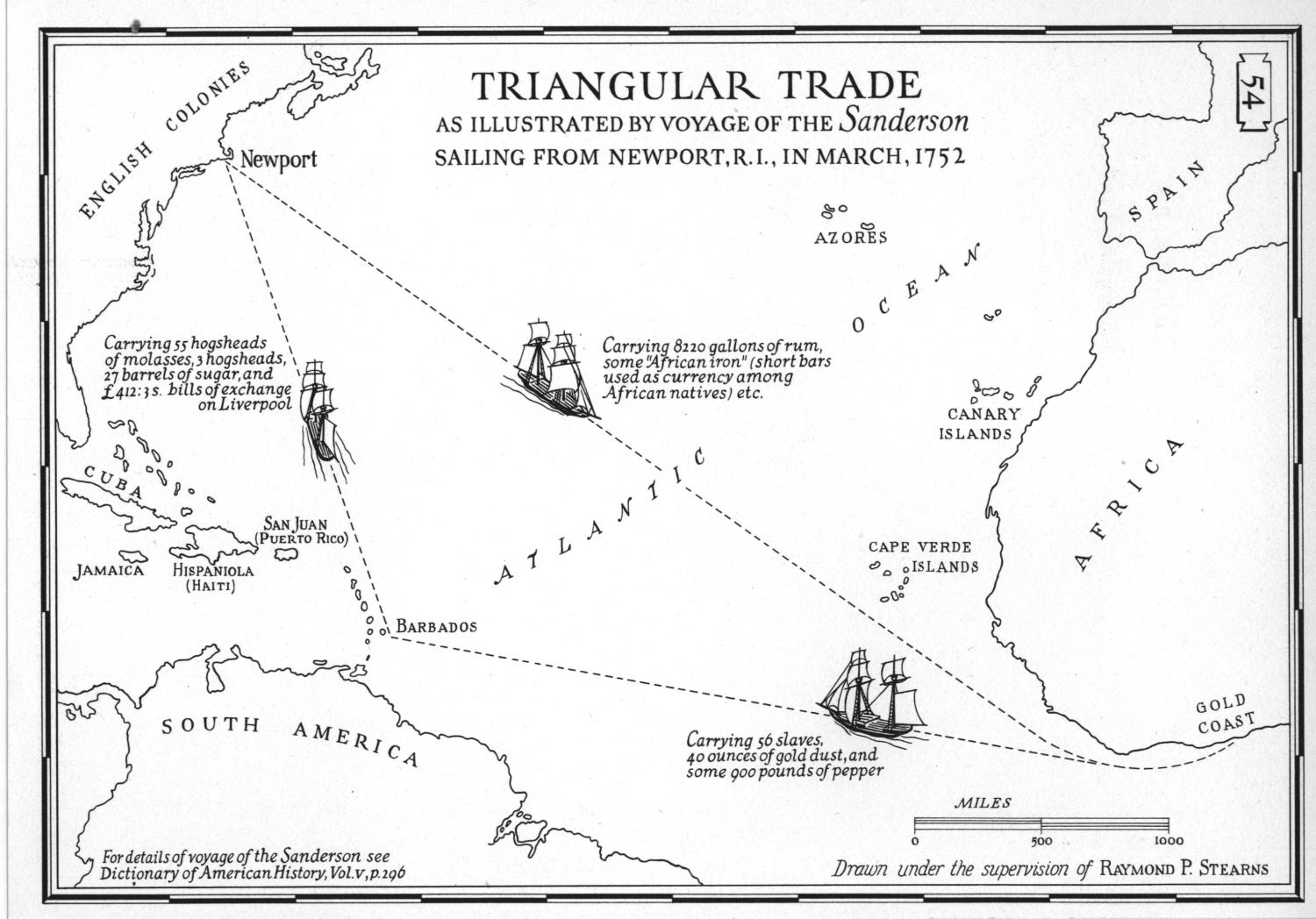
What we now call "rum" was born, and it quickly became associated with the sailors who conducted trade in sugar and slaves during the Colonial period. Rum became a hot commodity in the notorious slave trade that fueled Europe's economic expansion, to the point where the term "rum triangle" became synonymous with the routes. Sugar (along with rum) and other raw materials were shipped to Europe; finished goods like textiles and guns were shipped to Africa; slaves were shipped in horrifying conditions to work the sugar plantations in the Americas, and the whole thing went round again. As the New England colonies grew, a modified route also developed that shipped sugar to New England (to be fermented and distilled), rum and goods to Africa, and slaves back to the West Indies and Caribbean. This isn't exactly the most savory backstory, but it shows you that rum had heft. It was a major export, which together with cotton and tobacco provided an economic engine driving growth in the early American Colonies. Today's world might look very different without it.
Part of the reason for this popularity is that rum was one of the few distillates available at the time. Whiskey was perhaps being produced in small quantities in the rocky Scottish and Irish islands, but in a rough and barely palatable form. The column still used to produce clear spirits like vodka and gin hadn't been invented yet. That left brandy, which was expensive, and more importantly for the British, it was foreign. Rum provided a viable alternative, being made from sugarcane in colonies largely controlled by the British. That in turn provided fuel for a navy full of thirsty sailors.
It seems odd today that a massive military operation could be essentially powered by booze, but it's true. Consider the conditions. Voyages of any kind across the ocean took weeks or months, and you had to bring all your provisions along with enough space left over for cargo. Crewing a ship took dozens of men, which on the ocean meant not only food but hydration. Before the days of effective filtration and storage methods, fresh water could become corrupted and spread disease after a few weeks. Instead, ships carried beer (and wine for the officers) which kept longer due to its alcoholic content, and also provided some nutrition - indeed, a significant portion of the average sailor's daily caloric intake came from beer. But beer was no less bulky than water, and would go off if kept for any length of time in the hot and stuffy hold of a ship.
Eventually, British vessels began to carry spirits as well, which took up less cargo space, kept pretty much indefinitely, and which could be used to supplement stocks of fresh water as available. David Wondrich's Punch! makes a pretty compelling case for punch (the original mixed drink!) being born out of spirits mixed with water to cut down their proof, a concoction known as "grog". Often this was spiked with citrus to combat scurvy, and sweetened for taste. At first grog used a Javanese distillate called arrack, but rum provided a close substitute that was much easier to find on voyages to and from the Americas. Eventually ships were supplied with even cheaper gin, but not before rum became firmly entrenched as a sailor's drink. In other words, rum was a sort of military technology, one that kept sailors hydrated, entertained, and scurvy-free when combined with citrus. It helped to power the single greatest navy on the seas, strengthening the British Empire and shaping the history of the Western world. How's that for heft?
But, back to the modern world. Rum is nowadays produced primarily in the Caribbean islands that hosted the sugar plantations where it was born. Some newer US-based micro-distilleries also make rum, but the producers operating in New England during early colonial days have been supplanted by whiskey distillers. With such extensive history, it's perhaps no big surprise that rum styles have diverged and diffused over the centuries, and just about every island has its own take on the concept. Some use column stills to mass-produce a light, airy product; others stick to older pot stills of unique and arcane design. Some carefully blend different varieties for a smooth, sippable product; others like more spice and bite. Most of what we call "rum" is produced from molasses, but there are variations such as rhum agricole (produced on former French colonies, such as Haiti and Martinique) and cachaça (produced in Brazil) are made from fermented whole sugarcane juice instead, which hasn't been processed to refine out the pure sugar. That stuff is a whole different beast in terms of flavor, and less common here in the US anyway.
Just as there's wide variation in style between American, Scottish, Irish (not to mention Canadian and Japanese) whiskeys, there are many different renditions of rum, and it's instructive to taste them next to each other. Or, at least, that's the conceit that I'm operating under. Hence, here are three different rums from three different islands. All three are produced from molasses, moderately aged, and can be found for $25-35 apiece. I consider them all solid, everyday, multi-purpose rums, but they are far from identical, as we'll see.
Plantation Grande Reserve 5 Year Old
About: Let's start with an easy one, made in the tiny island nation of Barbados. Despite the island's history as a British colony, the rum itself is bottled by Pierre Ferrand, a French cognac producer who also imports one of my favorite white rums and one of my highly prized sipping rums. So I may be biased, but this rum earns points for being a smooth, straightforward product that does very nicely in cocktails while being perfectly enjoyable on its own. It's aged in bourbon barrels in the Caribbean climate, then gets "refined" in French oak casks. The website suggests that the 5 years on the label is all in the bourbon barrels, so I'm not sure what exactly that last part means, but it has a definite impact on the final flavor.
Tasting Notes: Perhaps predictably, this rum has a lot in common with a relatively-young cognac. It's sweet up front, with a solid apple-pie core, but laced with the ineffable haut goût (or "hogo" in rum terms) which is really difficult to define but often sought-after both in older brandies and in rum. There's not a ton here, but it's noticeable, and it opens up the tropical-spicy flavors that begin to dominate the palate. Lots of guava, clove, allspice, vanilla, and a little whiff of coconut too. The finish ends just a little bit spicy, which is enough to draw you in and take another breath of the guava-apple-allspice nose again and start the process all over. This is a bit too smooth for Tiki-style drinks or anything with a lot of citrus, since those are basically designed to compensate for rougher rums, but it's a really good choice for off-beat mixing in stirred drinks (like a rum old-fashioned) and it's a solid sipping rum if you don't want to break the bank.
Pyrat XO Reserve
About: Pyrat is bottled by Patrón (a company you may have heard of) and is sourced from Guyana. No, not the French one, the other one; did you know there were two Guyanas in South America? The distillate is undoubtedly a modern product, as seen below; the bottle, as seen to the left, is a squat pirate fantasy not designed with bartenders in mind. Also pay no attention to the "XO" on the bottle; the use of such grading terms is traditional for brandy, but totally unregulated outside of the French tradition, perhaps doubly so in a former British colony. So there's a lot of questionable branding going on here, but it's not a bad entry-level product inside.
Tasting Notes: This is a less subtle beast than the Plantation, but it has lots of the same sweetness up front. The nose is somewhere between root beer and ginger ale, with a strong whiff of lime peel. It tastes unsurprisingly of molasses, loaded with nutmeg, star anise, allspice, and ginger, which gets sweeter as it sits on the palate. Gradually this develops into a strong sweet orange quality, reminiscent of orange liqueur, with some tropical fruit (papaya?) and funky hogo in the background. Notice a pattern? The sweetness is really overwhelming by the end, but that actually makes it a decent dessert rum, possibly very nice for a rum cake or other confectionery. Pyrat also fits nicely into a Tiki cocktail blend; I'd definitely like this offset with another dry, overproof rum and plenty of citrus.
Matusalem Gran Reserva
About: Although this one says "Cuba" on the bottle, it's actually made in the Dominican Republic, Cuban imports being embargoed until recently. As it turns out, a number of Cuban rum producers left the country after the revolution (you've heard of Bacardi, right?) and set up shop in neighboring countries to continue their trade. The "15 years" on the bottle isn't the same minimum age that you'll find on whiskey; it's an estimated average, as this is produced using the solera system. Also used for sherry, madiera, and other dessert wines, this is a method by which the product is fed from barrel to barrel and continuously blended; because the barrels are never fully drained, this means that some fraction of the distillate could be much older than the date on the bottle, though none is exactly as old as stated.
Tasting Notes: My initial impression is that this tastes older than either of the preceding rums. It's restrained, with a noticeable presence of oak, or cigar box maybe. The nose has little bits of coffee, vanilla, raisin, nutmeg, and orange peel, without any one overwhelming the whole. On the palate, it's the driest rum here, with only a little residual raisin and toffee sweetness not quite balancing things out and leaving the texture little thin. The flavor is as complex as the nose; dried orange, allspice, and vanilla start out, with coffee, tobacco, and oak following but not predominating. The allspice builds toward the finish and the bitter toffee quality returns too, leading things out nicely. The only thing really missing is hogo, which makes this less appropriate as a traditional Tiki rum, but the smoothness is great for mixing in simple cocktails. I particularly like a rum Boulevardier variation* which lets the bitter qualities shine while reinforcing with sweetness.
*2 oz aged rum, 1 oz Campari (or similar), 1 oz (good) sweet vermouth, 1 dash orange bitters, assembled over a large ice cube. Let's call this one a Privateer, though I'm sure there are plenty other cocktails with that name.
So: rum is pretty variable stuff! Keep in mind that this is just one moderately-aged subset of rums; there's much more variation between categories than displayed here. I'm looking forward to talking about it, among many other things.
One of the best old-fashioneds I've had in recent memory is a rum variant, and I decided that I'd do my own as part of the lineup for this event. It's a great place to dive in, because it allows for some context around the history and ultimate simplicity of the old-fashioned format. It also provides for a springboard into rum, showing off its historical pedigree, the amazing quality that's available today, and how it can be superbly applied in cocktails. That's what I want to get into with this intro, which will be much longer than what I'd ultimately deliver live (don't worry, Mystery Friend, I'm not planning an extended lecture here) but the written format gives me a chance to structure and lay out my history. Stick with me, we'll get to some tasting soon too.
So: Rum. The origin of the name is unknown and sports many colorful theories (as with so many boozy terms) but the term starts appearing in the 1600s, often alongside the even more delightful "kill-devil". This gives a clue for how it was perceived: rough, fiery, potent, and unsavory, a stigma that clings to it even today.
Rum is, by definition, a distillate made from sugarcane, usually from molasses (we'll talk about exceptions later). As it turns out, since yeast eats sugar, sugarcane will ferment very nicely, and that's been known for thousands of years; a fermented sugarcane drink called brum has been produced by the Malay people for ages. But more relevant to us, the same fact was re-discovered on early American colonial sugar plantations. Somebody noticed that the molasses (produced as a byproduct of sugar refining) fermented nicely if allowed to sit in the tropical heat; somebody else then had the genius idea to distill the resulting alcohol, concentrating and preserving it.
What we now call "rum" was born, and it quickly became associated with the sailors who conducted trade in sugar and slaves during the Colonial period. Rum became a hot commodity in the notorious slave trade that fueled Europe's economic expansion, to the point where the term "rum triangle" became synonymous with the routes. Sugar (along with rum) and other raw materials were shipped to Europe; finished goods like textiles and guns were shipped to Africa; slaves were shipped in horrifying conditions to work the sugar plantations in the Americas, and the whole thing went round again. As the New England colonies grew, a modified route also developed that shipped sugar to New England (to be fermented and distilled), rum and goods to Africa, and slaves back to the West Indies and Caribbean. This isn't exactly the most savory backstory, but it shows you that rum had heft. It was a major export, which together with cotton and tobacco provided an economic engine driving growth in the early American Colonies. Today's world might look very different without it.Part of the reason for this popularity is that rum was one of the few distillates available at the time. Whiskey was perhaps being produced in small quantities in the rocky Scottish and Irish islands, but in a rough and barely palatable form. The column still used to produce clear spirits like vodka and gin hadn't been invented yet. That left brandy, which was expensive, and more importantly for the British, it was foreign. Rum provided a viable alternative, being made from sugarcane in colonies largely controlled by the British. That in turn provided fuel for a navy full of thirsty sailors.
It seems odd today that a massive military operation could be essentially powered by booze, but it's true. Consider the conditions. Voyages of any kind across the ocean took weeks or months, and you had to bring all your provisions along with enough space left over for cargo. Crewing a ship took dozens of men, which on the ocean meant not only food but hydration. Before the days of effective filtration and storage methods, fresh water could become corrupted and spread disease after a few weeks. Instead, ships carried beer (and wine for the officers) which kept longer due to its alcoholic content, and also provided some nutrition - indeed, a significant portion of the average sailor's daily caloric intake came from beer. But beer was no less bulky than water, and would go off if kept for any length of time in the hot and stuffy hold of a ship.
Eventually, British vessels began to carry spirits as well, which took up less cargo space, kept pretty much indefinitely, and which could be used to supplement stocks of fresh water as available. David Wondrich's Punch! makes a pretty compelling case for punch (the original mixed drink!) being born out of spirits mixed with water to cut down their proof, a concoction known as "grog". Often this was spiked with citrus to combat scurvy, and sweetened for taste. At first grog used a Javanese distillate called arrack, but rum provided a close substitute that was much easier to find on voyages to and from the Americas. Eventually ships were supplied with even cheaper gin, but not before rum became firmly entrenched as a sailor's drink. In other words, rum was a sort of military technology, one that kept sailors hydrated, entertained, and scurvy-free when combined with citrus. It helped to power the single greatest navy on the seas, strengthening the British Empire and shaping the history of the Western world. How's that for heft?
But, back to the modern world. Rum is nowadays produced primarily in the Caribbean islands that hosted the sugar plantations where it was born. Some newer US-based micro-distilleries also make rum, but the producers operating in New England during early colonial days have been supplanted by whiskey distillers. With such extensive history, it's perhaps no big surprise that rum styles have diverged and diffused over the centuries, and just about every island has its own take on the concept. Some use column stills to mass-produce a light, airy product; others stick to older pot stills of unique and arcane design. Some carefully blend different varieties for a smooth, sippable product; others like more spice and bite. Most of what we call "rum" is produced from molasses, but there are variations such as rhum agricole (produced on former French colonies, such as Haiti and Martinique) and cachaça (produced in Brazil) are made from fermented whole sugarcane juice instead, which hasn't been processed to refine out the pure sugar. That stuff is a whole different beast in terms of flavor, and less common here in the US anyway.
Just as there's wide variation in style between American, Scottish, Irish (not to mention Canadian and Japanese) whiskeys, there are many different renditions of rum, and it's instructive to taste them next to each other. Or, at least, that's the conceit that I'm operating under. Hence, here are three different rums from three different islands. All three are produced from molasses, moderately aged, and can be found for $25-35 apiece. I consider them all solid, everyday, multi-purpose rums, but they are far from identical, as we'll see.
Plantation Grande Reserve 5 Year Old
About: Let's start with an easy one, made in the tiny island nation of Barbados. Despite the island's history as a British colony, the rum itself is bottled by Pierre Ferrand, a French cognac producer who also imports one of my favorite white rums and one of my highly prized sipping rums. So I may be biased, but this rum earns points for being a smooth, straightforward product that does very nicely in cocktails while being perfectly enjoyable on its own. It's aged in bourbon barrels in the Caribbean climate, then gets "refined" in French oak casks. The website suggests that the 5 years on the label is all in the bourbon barrels, so I'm not sure what exactly that last part means, but it has a definite impact on the final flavor.
Tasting Notes: Perhaps predictably, this rum has a lot in common with a relatively-young cognac. It's sweet up front, with a solid apple-pie core, but laced with the ineffable haut goût (or "hogo" in rum terms) which is really difficult to define but often sought-after both in older brandies and in rum. There's not a ton here, but it's noticeable, and it opens up the tropical-spicy flavors that begin to dominate the palate. Lots of guava, clove, allspice, vanilla, and a little whiff of coconut too. The finish ends just a little bit spicy, which is enough to draw you in and take another breath of the guava-apple-allspice nose again and start the process all over. This is a bit too smooth for Tiki-style drinks or anything with a lot of citrus, since those are basically designed to compensate for rougher rums, but it's a really good choice for off-beat mixing in stirred drinks (like a rum old-fashioned) and it's a solid sipping rum if you don't want to break the bank.
Pyrat XO Reserve
About: Pyrat is bottled by Patrón (a company you may have heard of) and is sourced from Guyana. No, not the French one, the other one; did you know there were two Guyanas in South America? The distillate is undoubtedly a modern product, as seen below; the bottle, as seen to the left, is a squat pirate fantasy not designed with bartenders in mind. Also pay no attention to the "XO" on the bottle; the use of such grading terms is traditional for brandy, but totally unregulated outside of the French tradition, perhaps doubly so in a former British colony. So there's a lot of questionable branding going on here, but it's not a bad entry-level product inside.
Tasting Notes: This is a less subtle beast than the Plantation, but it has lots of the same sweetness up front. The nose is somewhere between root beer and ginger ale, with a strong whiff of lime peel. It tastes unsurprisingly of molasses, loaded with nutmeg, star anise, allspice, and ginger, which gets sweeter as it sits on the palate. Gradually this develops into a strong sweet orange quality, reminiscent of orange liqueur, with some tropical fruit (papaya?) and funky hogo in the background. Notice a pattern? The sweetness is really overwhelming by the end, but that actually makes it a decent dessert rum, possibly very nice for a rum cake or other confectionery. Pyrat also fits nicely into a Tiki cocktail blend; I'd definitely like this offset with another dry, overproof rum and plenty of citrus.
Matusalem Gran Reserva
About: Although this one says "Cuba" on the bottle, it's actually made in the Dominican Republic, Cuban imports being embargoed until recently. As it turns out, a number of Cuban rum producers left the country after the revolution (you've heard of Bacardi, right?) and set up shop in neighboring countries to continue their trade. The "15 years" on the bottle isn't the same minimum age that you'll find on whiskey; it's an estimated average, as this is produced using the solera system. Also used for sherry, madiera, and other dessert wines, this is a method by which the product is fed from barrel to barrel and continuously blended; because the barrels are never fully drained, this means that some fraction of the distillate could be much older than the date on the bottle, though none is exactly as old as stated.
Tasting Notes: My initial impression is that this tastes older than either of the preceding rums. It's restrained, with a noticeable presence of oak, or cigar box maybe. The nose has little bits of coffee, vanilla, raisin, nutmeg, and orange peel, without any one overwhelming the whole. On the palate, it's the driest rum here, with only a little residual raisin and toffee sweetness not quite balancing things out and leaving the texture little thin. The flavor is as complex as the nose; dried orange, allspice, and vanilla start out, with coffee, tobacco, and oak following but not predominating. The allspice builds toward the finish and the bitter toffee quality returns too, leading things out nicely. The only thing really missing is hogo, which makes this less appropriate as a traditional Tiki rum, but the smoothness is great for mixing in simple cocktails. I particularly like a rum Boulevardier variation* which lets the bitter qualities shine while reinforcing with sweetness.
*2 oz aged rum, 1 oz Campari (or similar), 1 oz (good) sweet vermouth, 1 dash orange bitters, assembled over a large ice cube. Let's call this one a Privateer, though I'm sure there are plenty other cocktails with that name.
So: rum is pretty variable stuff! Keep in mind that this is just one moderately-aged subset of rums; there's much more variation between categories than displayed here. I'm looking forward to talking about it, among many other things.
Thursday, November 5, 2015
Sour Grapes
It's been a while since I've written up an actual drink! Feels a little... nostalgic. Lately I've been making relatively simple cocktails, and it's not too often that one jumps out and grabs my attention. This is a very welcome exception, so much so that I had to get it down.
1 1/2 oz G'Vine Nouaison gin (we'll do a writeup on this soon too)
3/4 oz red wine
3/4 oz tamarind syrup (I'd have loved to use a sour grape syrup, but this is close enough)
3/4 oz lime juice
Shake and strain into a cocktail glass.
Yum. A really nice, simple take on a gin sour that also tastes shockingly of grape.
1 1/2 oz G'Vine Nouaison gin (we'll do a writeup on this soon too)
3/4 oz red wine
3/4 oz tamarind syrup (I'd have loved to use a sour grape syrup, but this is close enough)
3/4 oz lime juice
Shake and strain into a cocktail glass.
Yum. A really nice, simple take on a gin sour that also tastes shockingly of grape.
Tuesday, November 3, 2015
Spirits: Koval Distillery Whiskeys
In August, the wife and I took a trip to Chicago for our anniversary. I had every intention of writing up the entire trip, I swear, but somehow life intervened and that post simply never happened. But, I did manage to bring a couple souvenirs home from our final stop just before skipping town: the distillery and sampling room at Koval Distillery.
I've talked about a couple of Koval's unusual products before, but the visit was a real education in just how odd their stuff is. The distillery was founded by a wife-husband duo who hail from Austrian families with a history of distilling brandy, which in Europe generally means trying to capture the nuances of a specific fruit in their distillate. I love such unaged European brandies, and it's really interesting to see how the approach translates to distilling whiskey from grain.
Practically, what this means is that Koval uses only 60% of the total output of their still to make each batch of whiskey, using what's known as the "heart". (It's probably worth noting that their main still is much bigger than the display model seen to the left.) The 10% toxic "heads" which come out first get used to clean the floors, and the 30% largely flavorless "tails" that come last get collected and re-distilled into vodka. Thrifty! Their barrels are smaller than the 55 gallon model used by most domestic bourbon distillers. Instead Koval ages for about 2 years in smaller 30 gallon barrels (made in Minnesota) with a variety of finishes.
And that finish, I'd say, is one of the things that makes Koval's product so interesting. They distill using a variety of interesting grains, all of them carefully sources and certified organic, but in the tasting room you get to try differently-aged samples: the same whiskey, from the same grain, in three totally different expressions.
This color difference gives you a preview of what's to come. The white whiskey on the left is aged for a single day (apparently legally required to label it "whiskey") and no more; the other two are aged for about two years. In the middle is a "toasted" barrel expression, with no char on the inside of the barrel; on the right a bourbon barrel with a classically charred interior. This makes for a shocking difference in the finished product.
I've talked about a couple of Koval's unusual products before, but the visit was a real education in just how odd their stuff is. The distillery was founded by a wife-husband duo who hail from Austrian families with a history of distilling brandy, which in Europe generally means trying to capture the nuances of a specific fruit in their distillate. I love such unaged European brandies, and it's really interesting to see how the approach translates to distilling whiskey from grain.
Practically, what this means is that Koval uses only 60% of the total output of their still to make each batch of whiskey, using what's known as the "heart". (It's probably worth noting that their main still is much bigger than the display model seen to the left.) The 10% toxic "heads" which come out first get used to clean the floors, and the 30% largely flavorless "tails" that come last get collected and re-distilled into vodka. Thrifty! Their barrels are smaller than the 55 gallon model used by most domestic bourbon distillers. Instead Koval ages for about 2 years in smaller 30 gallon barrels (made in Minnesota) with a variety of finishes.And that finish, I'd say, is one of the things that makes Koval's product so interesting. They distill using a variety of interesting grains, all of them carefully sources and certified organic, but in the tasting room you get to try differently-aged samples: the same whiskey, from the same grain, in three totally different expressions.
This color difference gives you a preview of what's to come. The white whiskey on the left is aged for a single day (apparently legally required to label it "whiskey") and no more; the other two are aged for about two years. In the middle is a "toasted" barrel expression, with no char on the inside of the barrel; on the right a bourbon barrel with a classically charred interior. This makes for a shocking difference in the finished product.
Now, these are also distilled from different grains, but having sampled practically every combination available at the tasting room (at the encouragement of my long-suffering wife) I can tell you that the finish makes just as much difference than the source grain. Let's not belabor this with the format that I've kept to in other spirit reviews, because the different styles that these represent are as interesting as the specific whiskies I brought home.
First, the white whiskey. I'm usually suspicious of white whiskeys, since they have a reputation for roughness thanks to the infamous poor quality of moonshine. In truth, there are a surprising and growing number of quality minimally-aged whiskies out there (High West calls them "silver whiskey" in a superb branding move) and Koval's are easily the best I've ever tried. These are essentially fresh off the still, having been aged only in barrel for a single day, which is apparently legally required in order to label them with the term "whiskey". Essentially, they're the pure stuff, as close to a straight expression of the grain as it's possible to get.
The Oat version that I brought home is sweeter on the nose than other new-make whiskies, bordering on the round sweetness of a classic eau-de-vie, only... tropical, somehow. The body is beautifully smooth and creamy, without a hint of burn; the grain is a predominant flavor, providing a persistent sweet quality reminiscent of oatmeal (duh). As it sits on your palate there are little pops of maple, vanilla, apple pie, guava, and a growing spicy character (think allspice and white pepper) that lingers into an extended finish. From what I recall of the other white whiskies, they differ mostly in the details; the rye is unsurprisingly spicier, for example, but shares the same impeccably smooth, silky-sweet palate. Every single one is amazingly smooth and delicate for such fresh spirit, a great testament to Koval's distilling practices.
Second, we've got Koval's Toasted Barrel expressions, which were the most exciting find for me. This whiskey is distilled just like the others, then decanted and aged in barrels whose oak staves are briefly heated to "open up" the wood grain without developing the char characteristic of bourbon barrels. It's instructive because even though it's produced in the same fashion and aged for the same length of time, the result is totally different from the other styles. That's easily seen in the pale gold color, which resembles scotch or a delicate Irish whiskey more than it does most caramel-brown American whiskey.
Out of the available options, I chose the Spelt to take home (made from a subspecies of wheat) because it was the most unique of the available grains and also because it edged most into complex, delicate scotch whiskey territory. As with all of Koval's products, it's a little sweet and grainy on the nose, but also carries a pleasantly sawdusty aroma like fresh-cut wood. That's reflected on the palate, which is delicately sweet at first with notes of nougat like a good Irish whiskey, touched up with a vaguely floral note, like a very subtle chamomile. A spicy presence grows and grows, with intensely peppery notes and the drying presence of the wood tannins, all against a backdrop of honey, wheat, and a bitter-herbal character that puts me in mind of absinthe. It's one of the sweeter toasted barrel versions, less spicy than the rye, less floral than the millet, and I can't think of a single other whiskey I've tried made from spelt, so it gets points for uniqueness too. The only problem is that it's a very limited release, quite possibly sold only at the Koval distillery, and I've been unable to find it anywhere locally.
Finally, though by no means last, are the more traditionally styled whiskies aged in charred oak barrels, in the same fashion as bourbon (in fact, bourbon is included among them, but distinguishes itself by using millet in the mash). Again, these are aged in small barrels for a shorter amount of time than larger producers. The size of the barrel, and the resulting increase in surface contact, is partly what produces the classic rich caramel color despite only about two years in oak. But don't worry - the flavor is still distinctively Koval.
My selection of these was the Four Grains whiskey, made from a combined mash of oat, barley, rye, and wheat (what proportion of each isn't specified). This strikes an intriguing balance between the qualities of all those constituent grains. It's spicy and fruity on the nose from the rye, with big hints of orange peel and malt. Sweetness is immediately evident on the palate, in a fruity/floral combination that reminds me a lot of maraschino liqueur with some honeyish acidity. It grows increasingly grainy in a breakfast-cereal sort of way, with the airy quality that I always associate with wheated whiskies, and a light undercurrent of char. Eventually it turns to cinnamon and nutmeg, and winds up in an intensely peppery and lingering finish with a hint of licorice. It's one hell of a whiskey with a lot going on, though it maintains the sweet fruitiness consistent with Koval's other expressions. This bottling, fortunately, is one of the easier versions to find, and well worth hunting down!
All three of these (and the expressions that they represent) are excellent products, and Koval a very welcoming distillery. I highly recommend visiting! You can taste to your heart's content, view the workings of a true craft distillery, and pick up products that can't be found anywhere else. For us, it was the perfect endcap to our vacation.
The Oat version that I brought home is sweeter on the nose than other new-make whiskies, bordering on the round sweetness of a classic eau-de-vie, only... tropical, somehow. The body is beautifully smooth and creamy, without a hint of burn; the grain is a predominant flavor, providing a persistent sweet quality reminiscent of oatmeal (duh). As it sits on your palate there are little pops of maple, vanilla, apple pie, guava, and a growing spicy character (think allspice and white pepper) that lingers into an extended finish. From what I recall of the other white whiskies, they differ mostly in the details; the rye is unsurprisingly spicier, for example, but shares the same impeccably smooth, silky-sweet palate. Every single one is amazingly smooth and delicate for such fresh spirit, a great testament to Koval's distilling practices.
Second, we've got Koval's Toasted Barrel expressions, which were the most exciting find for me. This whiskey is distilled just like the others, then decanted and aged in barrels whose oak staves are briefly heated to "open up" the wood grain without developing the char characteristic of bourbon barrels. It's instructive because even though it's produced in the same fashion and aged for the same length of time, the result is totally different from the other styles. That's easily seen in the pale gold color, which resembles scotch or a delicate Irish whiskey more than it does most caramel-brown American whiskey.Out of the available options, I chose the Spelt to take home (made from a subspecies of wheat) because it was the most unique of the available grains and also because it edged most into complex, delicate scotch whiskey territory. As with all of Koval's products, it's a little sweet and grainy on the nose, but also carries a pleasantly sawdusty aroma like fresh-cut wood. That's reflected on the palate, which is delicately sweet at first with notes of nougat like a good Irish whiskey, touched up with a vaguely floral note, like a very subtle chamomile. A spicy presence grows and grows, with intensely peppery notes and the drying presence of the wood tannins, all against a backdrop of honey, wheat, and a bitter-herbal character that puts me in mind of absinthe. It's one of the sweeter toasted barrel versions, less spicy than the rye, less floral than the millet, and I can't think of a single other whiskey I've tried made from spelt, so it gets points for uniqueness too. The only problem is that it's a very limited release, quite possibly sold only at the Koval distillery, and I've been unable to find it anywhere locally.
Finally, though by no means last, are the more traditionally styled whiskies aged in charred oak barrels, in the same fashion as bourbon (in fact, bourbon is included among them, but distinguishes itself by using millet in the mash). Again, these are aged in small barrels for a shorter amount of time than larger producers. The size of the barrel, and the resulting increase in surface contact, is partly what produces the classic rich caramel color despite only about two years in oak. But don't worry - the flavor is still distinctively Koval.
My selection of these was the Four Grains whiskey, made from a combined mash of oat, barley, rye, and wheat (what proportion of each isn't specified). This strikes an intriguing balance between the qualities of all those constituent grains. It's spicy and fruity on the nose from the rye, with big hints of orange peel and malt. Sweetness is immediately evident on the palate, in a fruity/floral combination that reminds me a lot of maraschino liqueur with some honeyish acidity. It grows increasingly grainy in a breakfast-cereal sort of way, with the airy quality that I always associate with wheated whiskies, and a light undercurrent of char. Eventually it turns to cinnamon and nutmeg, and winds up in an intensely peppery and lingering finish with a hint of licorice. It's one hell of a whiskey with a lot going on, though it maintains the sweet fruitiness consistent with Koval's other expressions. This bottling, fortunately, is one of the easier versions to find, and well worth hunting down!
All three of these (and the expressions that they represent) are excellent products, and Koval a very welcoming distillery. I highly recommend visiting! You can taste to your heart's content, view the workings of a true craft distillery, and pick up products that can't be found anywhere else. For us, it was the perfect endcap to our vacation.
Tuesday, October 6, 2015
Spirits: Flavorful Vodkas
I'm on record as something of a vodka hater; despite my always-rotating spirit collection, I rarely keep vodka around, and I admit to usually turning up my nose at vodka cocktails. Part of that might be rooted in good old nerd snobbiness, but if you think of spirits as a core element of flavor in cocktails (as I do) then vodka starts to seem a bit silly. Most mass-produced vodkas are designed for and advertised by a complete lack of flavor. They'll use terms like "clarity" and "smoothness", but what producers really mean is that it will get you drunk without tasting boozy. Combine it with a mixer, and you'll just taste the mixer.
So, vodka doesn't add anything other than punch, and with a little experimentation I've found that just about any vodka drink can be enhanced flavor-wise using another white spirit. Gin can readily replace vodka in just about anything; light white rum is a good choice in fruity drinks; blanco tequila or pisco can make interesting substitutions too. All of these will bring something distinct to the mix beyond the alcohol.
Let's not even discuss the scourge of flavored vodkas, okay? They're generally heinous, almost always lower-proof and created using disgustingly artificial extracts. There are a handful of craft producers making good product, but the more readily found stuff is shit. And the flavor arms race between those big makers is reaching satirical levels of absurdity. I mean, whipped cream? Salted watermelon? Fucking Cinnabon vodka? Awful. (For the record, I have tried the salted watermelon stuff, and it is easily the worst spirit I've ever sampled. It's undrinkable. Do not buy it, not even as a gag.)
But, if you look carefully, there are diamonds in the rough. In among the mass-produced vodkas are a few spirits that distinguish themselves by actually tasting like something. Yes! Vodka can have a distinctive flavor when it's not filtered down to nothing. It can taste subtly of the grains (or potatoes) used to produce it, with a flinty and vaguely alkaline character. It can have notes of vanilla or lemon peel or spice; it can be sharp and medicinal or soft and creamy; it can taste of something more than just the filtered-down essence of ethanol. Yes please. Let's try some good stuff.
Luksusowa
About: There's a long-running and vigorous argument between Poles and Russians over the exact origin of vodka. Personally, I haven't done enough research to say one way or the other, but I do know that Russians have a prejudice against potato vodka. On that point alone, my vote's with the Polish. Luksusowa (which translates to "luxury") is a triple-distilled potato vodka, reasonably popular in Poland, and despite some questionable marketing I can understand why. This stuff is tasty, and moreover it's very reasonably priced, usually coming in under $15 per bottle. I initially picked this up as a value brand, but now I think of it as one of the best values to be found.
Tasting Notes: Luksusowa is intensely medicinal and mineral on the note, which makes you think it'll be a lot rougher than it is. On tasting, it develops a creamy and rich texture, with distinct flavors of cocoa, vanilla, and fresh cream. That turns into a somewhat oily, peppery character with more mineral, fading into an extended medicinal finish with a gentle alcohol burn. At this price point it's a great mixing vodka with whatever you've got. I like it with tonic, cola, ginger beer, passionfruit juice... practically anything, really.
Reyka
About: Reyka is a unique product, the only spirit I've ever seen that's produced in Iceland. Hell, I can't even think of any other product imported from the tiny, picturesque island nation. It's also unusually produced, using volcanic activity at multiple points in the production process. The vodka is distilled from grain through an interesting hybrid design called a Carter still, then filtered through lava rocks. It's further cut with glacier water naturally filtered through volcanic springs, and the whole operation is run on geothermal power. Neat! Green! Also pretty dang tasty.
Tasting Notes: This is also a bit medicinal on the nose, but it's also got kind of a dried-herb, floral character; think herbes de provence, maybe with some white pepper. That herb character carries over to the palate, along with a slightly flinty quality, but mostly it's stony, a bit sweet, and clean with a creamy texture. The finish develops subtle notes of vanilla bean and lemon oil, then develops into a lingering peppery quality. I like this one straight out of the freezer, where the stony texture gets reinforced by cold temperatures, and the subtle flavors all come into alignment.
Tito's
About: Produced by a fellow with the unlikely name of Tito Beveridge at the first microdistillery in Texas (or so goes the marketing copy) this vodka is the only domestic product represented here, and it's got a hell of a backstory. More to the point, the bottle says that it's produced in pot stills, which produces a spirit with more character than the modern column stills used for mass-produced vodkas. That's probably why I like it so much, and why I'm not alone; this won a unanimous Double Gold Medal at the World Spirits Competition when it debuted.
Tasting Notes: This has a lightly medicinal nose with hints of orange oil and wet stone. On the palate, it's lightly sweet (kind of a lightly acidic honey character) with some candied orange notes, a grainy bourbon-esque quality, spicy cinnamon, and bitter licorice. The finish is lightly peppery, with a mild burn reminiscent of young whiskey that I really enjoy on its own. Mostly though, I like this in a Vesper, where the sweetness and the spice get along beautifully with gin and Cocchi Americano.
So there you have them! Some weirdo vodkas that I (also a weirdo) actually enjoy. All of these sell at a reasonable price point, by the way, because I think it's ridiculous to pay any more than $25 for a spirit marketed for its lack of flavor. These examples break both those rules, and for that I think they deserve a shot in your home bar.
So, vodka doesn't add anything other than punch, and with a little experimentation I've found that just about any vodka drink can be enhanced flavor-wise using another white spirit. Gin can readily replace vodka in just about anything; light white rum is a good choice in fruity drinks; blanco tequila or pisco can make interesting substitutions too. All of these will bring something distinct to the mix beyond the alcohol.
Let's not even discuss the scourge of flavored vodkas, okay? They're generally heinous, almost always lower-proof and created using disgustingly artificial extracts. There are a handful of craft producers making good product, but the more readily found stuff is shit. And the flavor arms race between those big makers is reaching satirical levels of absurdity. I mean, whipped cream? Salted watermelon? Fucking Cinnabon vodka? Awful. (For the record, I have tried the salted watermelon stuff, and it is easily the worst spirit I've ever sampled. It's undrinkable. Do not buy it, not even as a gag.)
But, if you look carefully, there are diamonds in the rough. In among the mass-produced vodkas are a few spirits that distinguish themselves by actually tasting like something. Yes! Vodka can have a distinctive flavor when it's not filtered down to nothing. It can taste subtly of the grains (or potatoes) used to produce it, with a flinty and vaguely alkaline character. It can have notes of vanilla or lemon peel or spice; it can be sharp and medicinal or soft and creamy; it can taste of something more than just the filtered-down essence of ethanol. Yes please. Let's try some good stuff.
Luksusowa
About: There's a long-running and vigorous argument between Poles and Russians over the exact origin of vodka. Personally, I haven't done enough research to say one way or the other, but I do know that Russians have a prejudice against potato vodka. On that point alone, my vote's with the Polish. Luksusowa (which translates to "luxury") is a triple-distilled potato vodka, reasonably popular in Poland, and despite some questionable marketing I can understand why. This stuff is tasty, and moreover it's very reasonably priced, usually coming in under $15 per bottle. I initially picked this up as a value brand, but now I think of it as one of the best values to be found.
Tasting Notes: Luksusowa is intensely medicinal and mineral on the note, which makes you think it'll be a lot rougher than it is. On tasting, it develops a creamy and rich texture, with distinct flavors of cocoa, vanilla, and fresh cream. That turns into a somewhat oily, peppery character with more mineral, fading into an extended medicinal finish with a gentle alcohol burn. At this price point it's a great mixing vodka with whatever you've got. I like it with tonic, cola, ginger beer, passionfruit juice... practically anything, really.
Reyka
About: Reyka is a unique product, the only spirit I've ever seen that's produced in Iceland. Hell, I can't even think of any other product imported from the tiny, picturesque island nation. It's also unusually produced, using volcanic activity at multiple points in the production process. The vodka is distilled from grain through an interesting hybrid design called a Carter still, then filtered through lava rocks. It's further cut with glacier water naturally filtered through volcanic springs, and the whole operation is run on geothermal power. Neat! Green! Also pretty dang tasty.
Tasting Notes: This is also a bit medicinal on the nose, but it's also got kind of a dried-herb, floral character; think herbes de provence, maybe with some white pepper. That herb character carries over to the palate, along with a slightly flinty quality, but mostly it's stony, a bit sweet, and clean with a creamy texture. The finish develops subtle notes of vanilla bean and lemon oil, then develops into a lingering peppery quality. I like this one straight out of the freezer, where the stony texture gets reinforced by cold temperatures, and the subtle flavors all come into alignment.
Tito's
About: Produced by a fellow with the unlikely name of Tito Beveridge at the first microdistillery in Texas (or so goes the marketing copy) this vodka is the only domestic product represented here, and it's got a hell of a backstory. More to the point, the bottle says that it's produced in pot stills, which produces a spirit with more character than the modern column stills used for mass-produced vodkas. That's probably why I like it so much, and why I'm not alone; this won a unanimous Double Gold Medal at the World Spirits Competition when it debuted.
Tasting Notes: This has a lightly medicinal nose with hints of orange oil and wet stone. On the palate, it's lightly sweet (kind of a lightly acidic honey character) with some candied orange notes, a grainy bourbon-esque quality, spicy cinnamon, and bitter licorice. The finish is lightly peppery, with a mild burn reminiscent of young whiskey that I really enjoy on its own. Mostly though, I like this in a Vesper, where the sweetness and the spice get along beautifully with gin and Cocchi Americano.
So there you have them! Some weirdo vodkas that I (also a weirdo) actually enjoy. All of these sell at a reasonable price point, by the way, because I think it's ridiculous to pay any more than $25 for a spirit marketed for its lack of flavor. These examples break both those rules, and for that I think they deserve a shot in your home bar.
Sunday, September 27, 2015
Blood Moon Panic
This kind of one-off cocktail post is becoming a rarity! Still, tonight's a special occasion: a super-cool lunar eclipse, which as a space nerd I just had to watch. I joked to my wife that I should make a drink to celebrate the occasion, then demurred when she agreed, and rapidly changed my tune again.I'll list this in slightly weird order, because I made a non-alcoholic version for my wife that excluded the rum:
1 oz lemon juice
3/4 oz sour cherry syrup (made from preserves)
3/4 oz apricot nectar
3 dashes Bitter Truth Jerry Thomas' Own Decanter bitters
3 dashes Peychaud's bitters
(2 oz aged rum, specifically Ron Methusela)
Shake and strain into a large glass over a frozen watermelon cube, then top with 2 oz (with booze) to 4 oz (without booze) soda water and stir gently.
I wanted something with the deep brownish-red color of the lunar eclipse, and in this I succeeded, though in retrospect I might have made this a beer cocktail with a dark stout of some kind. It's pretty tasty as is, though, and I like having a booze-free variant available.
The name, by the way, refers to a particular brand of apocalyptic idiocy that I find entertaining, if completely wrong. The so-called "blood moon" is cool, and rare to see, but an entirely predictable phenomenon!
Wednesday, September 23, 2015
Spirits: Local Gins
"More gins?" I can hear you asking already. You're damn right, more gins. I won't be stopped.These particular gins are all unique in that they hail from distilleries located near my hometown of St. Paul, Minnesota. There's been a boom in local distilling lately, and it's a curious fact that the first products turned out by most of them are various takes on gin. The reason's simple: gin doesn't have to be aged to develop flavor the way that whiskey does, so you can ship product out the door and start recouping your investment immediately, rather than having to sit on barrels for a year or more. Gin's just a smart start-up booze.
The thing about gin is that you have to find a way to distinguish yourself in order to sell it. Clever marketing will only get you so far; with so many other distilleries pumping out product, producers have to make the booze itself unique in order to attract attention. These, friends, are some dang unique gins. They sure caught my eye, and I am only too happy to share.
Bent Brewstillery Gunner Ghost
About: Starting off strong is a gin distinguished by its proof. The dramatically rendered ship on the label ought to be a dead giveaway that this is navy-strength product, the stuff that sailors used to slop all over their gunpowder. (Not intentionally, it just happens after having a few, or when enemy fire fucks up a barrel.) Bent Brewstillery is also my most local of the distillers featured here; heck, our bank is located right across the street from their taproom. They produce a number of unique beers, and the brewery does double time producing mashes for their stills. Hardworking fellows over there.
Tasting: No surprise that this is pretty potent stuff from the nose on up. The botanical mix features some surprises, but the first whiff is full of classic juniper, dark herbs, and an intriguing maltiness. Lighter, grassier elements (hello apricot, lemongrass... and hops?) take over on the palate at first, but the alcohol makes itself known pretty quickly. The swallow is full of malt and spice and a rounded sweetness, plus a sort of cola flavor that's weird to encounter in gin. It's different from other navy-strength bottlings in the same way that American gins are different from London Dry versions: a bit sweeter, a bit more robust, less focused on juniper. I like it, particularly in shaken drinks.
Norseman Strawberry Rhubarb Gin
About: Norseman is a micro-scale distillery run out of the hipster-heavy northeast Minneapolis neighborhood, with a strong focus on local sourcing. Even though it appears to be run by two guys and their dogs, they've really ramped up production and their products can be found at many local liquor stores (including bigger chains that will let you order product online). Those products span a few different spirits and they're starting to release aged whiskies and rum, but this is a seasonal release of their gin, one version of a few. I'm guessing that the strawberry and rhubarb are distilled in with the botanicals; I keep meaning to email the distillery for clarification on that, but haven't gotten around to it. Heck, at this point they might not even remember, this being a rather limited-edition summer edition that you might now be hard-pressed to find.
Tasting: This is a rather sweet gin, and it starts from the nose, which is filled with candied strawberry. On the palate, it's pretty one-note, but it's a complex note: think good strawberry-rhubarb pie, filled with both of those plus lemon peel and vanilla. After the swallow, a bit of white pepper hangs around, but there's really not much juniper presence here; good for the novice gin drinker. On the other hand, it's nowhere close to the artificial sweetness that you might expect from the name, and it makes for a fantastic gin & tonic on a hot day.
J. Carver Barrel Gin
About: The J. Carver distillery is a bit further afield, located in the outlying city/exurb of Waconia, not quite in what I'd consider the Twin Cities metro area but close enough that I'm considering an afternoon trip to their tasting room. They make a few "premium" gins and vodkas, but this is the odd duck of the bunch, a gin distilled with local botanicals, grains, and wild rice (definitively Minnesotan, if a bit unusual) then briefly aged in also-local newly charred bourbon barrels. Making a barrel-aged gin is a bit of a gutsy move, but it paid off. I actually first learned about this spirit from Robb Jones of Spoon and Stable, a man I trust in all matters spiritous, who liked it so much that he bought an entire barrel of the stuff for his bar. Smart move.
Tasting: It shouldn't be surprising that this is an atypical gin, with a nose more redolent of star anise and orange peel than juniper. I get a little whiff of the juniper right at first tasting, but that rapidly gets layered with licorice, vanilla, dark spices, and a building bourbon-barrel char character. The finish is a bit tannic and drying, with more of that oaky finish, a wash of black pepper, and a sort of sweet dried-herb background. It's complex, nicely aged, and a little bit rough but still sippable. With the oak presence and sweetness, this makes one hell of a Martinez.
So there you go, more weird gins! I love the motley collection that I've assembled, and you can be certain that I'll keep on adding to it in future.
Thursday, September 17, 2015
Spirits: Crooked Water Bourbon
Been deficient around here, friends! I can't claim that tonight's post will be that lengthy, long in coming as it is. I just realized that I've been meaning to do so a post on this stuff for months now, and since the bottle is nearly gone it's go time.
This is a rare whiskey that I didn't hunt down myself! A few weeks ago we hosted a cocktail night, I asked a couple friends to bring a bottle of bourbon, and they showed up with this stuff. As the story goes, they'd tried the first batch of this before it sold out within a week, and were lucky enough to try the first version of a similar sherry-finished product. After trying this, I'm not so surprised that it went quickly.
Crooked Water appears to be a fairly new producer based around Lake Minnetonka, making only a handful of unique products for now. This one is a young bourbon, finished for a relatively long time (6+ months for a less than 2-year-old bourbon) in ex-port barrels.
Personally, I don't normally favor port-finished whiskeys (notably Angel's Envy, which despite being very highly rated I don't actually like much) but the young, sweet character here gets along really well with the raisiny character that the port contributes. It's still got a bit of hot, marshmallowy, congener character that indicates a young spirit, but not to an overwhelming degree. Balancing that out is a really nice spice level with a rounded, sweet mouthfeel; the only thing that really mars the flavor is a rather peppery and hot finish, but it's not overwhelming. Really surprisingly sippable for a whiskey of such a young pedigree, and as we discovered during our cocktail bonanza, it mixes really nicely too. Those hotter spicy notes stand up well to stirred cocktails and the port character makes for a really tasty Manhattan in particular.
I'll have to keep an eye out for some other Crooked Water products!
This is a rare whiskey that I didn't hunt down myself! A few weeks ago we hosted a cocktail night, I asked a couple friends to bring a bottle of bourbon, and they showed up with this stuff. As the story goes, they'd tried the first batch of this before it sold out within a week, and were lucky enough to try the first version of a similar sherry-finished product. After trying this, I'm not so surprised that it went quickly.
Crooked Water appears to be a fairly new producer based around Lake Minnetonka, making only a handful of unique products for now. This one is a young bourbon, finished for a relatively long time (6+ months for a less than 2-year-old bourbon) in ex-port barrels.
Personally, I don't normally favor port-finished whiskeys (notably Angel's Envy, which despite being very highly rated I don't actually like much) but the young, sweet character here gets along really well with the raisiny character that the port contributes. It's still got a bit of hot, marshmallowy, congener character that indicates a young spirit, but not to an overwhelming degree. Balancing that out is a really nice spice level with a rounded, sweet mouthfeel; the only thing that really mars the flavor is a rather peppery and hot finish, but it's not overwhelming. Really surprisingly sippable for a whiskey of such a young pedigree, and as we discovered during our cocktail bonanza, it mixes really nicely too. Those hotter spicy notes stand up well to stirred cocktails and the port character makes for a really tasty Manhattan in particular.
I'll have to keep an eye out for some other Crooked Water products!
Friday, August 21, 2015
Negroati
I had to write this one down immediately.
1 1/2 oz Koval White Oat Whiskey
3/4 oz Casoni 1814
3/4 sweet vermouth
Stir and strain into a cocktail glass over a large cube.
Really, this is more of a Boulevardier, but the unaged whiskey makes it something else. Yum.
1 1/2 oz Koval White Oat Whiskey
3/4 oz Casoni 1814
3/4 sweet vermouth
Stir and strain into a cocktail glass over a large cube.
Really, this is more of a Boulevardier, but the unaged whiskey makes it something else. Yum.
Saturday, August 15, 2015
Hemingway Variations
I make no secret of my love for the Hemingway Daquiri, a variation on a classic that has become a well-known recipe all its own. Though everybody agrees that the drink was named after Ernest Hemingway, and that it was born at the El Floridita bar in Havana, Cuba, the history is otherwise a bit muddled. What seems clear is that Hemingway's original drink was made with double the alcohol and far less sugar than a typical Daquiri, nowhere close to the version with grapefruit and maraschino that we've got today. I prefer using the name Papa Doble for the original drink, which was also typically blended or served over shaved ice, where today you often see Hemingway Daquiris served up in a cocktail glass. Where all those differences emerged is a real mystery, but I'm pretty happy with the end result.
After doing some research I was also surprised that my personal version seems to feature a lot more sugar than most published recipes, many of which feature at most 1/2 oz of maraschino for sweetness. Fortunately, when I cracked open Speakeasy, the proportions were a lot closer to those I provide here. Personally, I like nodding to Hemingway with a strong cocktail, but prefer a somewhat sweeter drink.
The other fun thing you can easily do with this recipe is swap out simple syrup (which actually doesn't appear in many recipes) for a flavored syrup. While dicking around a couple weeks ago, I also tried swapping out the normal white rum for other spirits, resulting in the concoctions below.
#1
2 oz aged rum (Scarlet Ibis for me; you want something moderately aged and funky)
1/2 oz maraschino liqueur (Luxardo)
1/2 oz spiced syrup
1/2 oz grapefruit juice
3/4 oz lime juice
#2
2 oz blanco tequila (El Mayor)
1/2 oz maraschino liqueur (Luxardo, obviously)
1/2 oz grenadine
1/2 oz grapefruit juice
3/4 oz lime juice
#3
2 oz pisco (Macchu)
1/2 oz maraschino liqueur (I said Luxardo)
1/2 oz thyme syrup
1/2 oz grapefruit juice
3/4 oz lime juice
For all of the above, shake vigorously and strain into a chilled cocktail glass; garnish if you wish, or do what I did (a move pilfered from the excellent Marvel Bar) and lower in a single cube from the shaker with a barspoon, to keep the drink cool without diluting it much further.
After doing some research I was also surprised that my personal version seems to feature a lot more sugar than most published recipes, many of which feature at most 1/2 oz of maraschino for sweetness. Fortunately, when I cracked open Speakeasy, the proportions were a lot closer to those I provide here. Personally, I like nodding to Hemingway with a strong cocktail, but prefer a somewhat sweeter drink.
The other fun thing you can easily do with this recipe is swap out simple syrup (which actually doesn't appear in many recipes) for a flavored syrup. While dicking around a couple weeks ago, I also tried swapping out the normal white rum for other spirits, resulting in the concoctions below.
#1
2 oz aged rum (Scarlet Ibis for me; you want something moderately aged and funky)
1/2 oz maraschino liqueur (Luxardo)
1/2 oz spiced syrup
1/2 oz grapefruit juice
3/4 oz lime juice
#2
2 oz blanco tequila (El Mayor)
1/2 oz maraschino liqueur (Luxardo, obviously)
1/2 oz grenadine
1/2 oz grapefruit juice
3/4 oz lime juice
#3
2 oz pisco (Macchu)
1/2 oz maraschino liqueur (I said Luxardo)
1/2 oz thyme syrup
1/2 oz grapefruit juice
3/4 oz lime juice
For all of the above, shake vigorously and strain into a chilled cocktail glass; garnish if you wish, or do what I did (a move pilfered from the excellent Marvel Bar) and lower in a single cube from the shaker with a barspoon, to keep the drink cool without diluting it much further.
Labels:
grapefruit,
lime,
maraschino,
pisco,
rum,
tequila
Tuesday, August 4, 2015
Salers Substitutions
A few weeks ago, rummaging around my favorite liquor store for finding unusual products, I came across a bottle of Salers Gentiane, which I'd heard mentioned on cocktail blogs but had never found in person. Did I buy it? How is that even a question?
In all fairness, I brought it home not having much idea what I was getting into. I knew it was similar to other bitter aperitif liqueurs, namely Suze and Aveze, which I'd tried before in drinks like the White Negroni and in a drink or two at the esteemed Pouring Ribbons. What I didn't understand was how distinct these gentian liqueurs were from other aperitifs that I've known and loved.
Salers, as it turns out, is a different beast because of what's used to make it bitter: gentian root. A post on Fred Yarm's excellent blog, recapping a talk at this year's Tales of the Cocktail, first helped me get a handle on this difference. Gentian is a distinct bittering agent from either wormwood (used principally in vermouth, and more famously in absinthe) or cinchona bark (the bittering agent in tonic water and in other favorites like Cocchi Americano*). Like vermouths and other aperitifs, gentian liqueurs are fortified wines, starting life as relatively-bland white wine that's then boosted with sugar and spirits to add flavor and shelf life.
*This is actually a little weird, because Fred's post points out that gentian is generally used in "americanos" but Cocchi is indeed flavored with cinchona. Because this sort of linguistic confusion is everywhere in the world of food and spirits.
What makes gentian different is the quality of its bitteress, which sits between wormwood and cinchona on a continuum. Wormwood is intensely herbal and sharply bitter; cinchona is flat, sweeter, and woodier; gentian falls in the complex territory between. It's like taking a deep whiff of wild brushes. Trying my newly acquired Salers on its own, the flavor was intensely vegetal, bitter like a green pepper, brighter and more herbal than the citrus notes I'm used to in Cocchi Americano or Campari. Still, I reasoned, the formulation, alcohol level, and sweet/bitter balance are all roughly comparable to other liqueurs in the category. Why not give it a spin in recipes that call for other bitter liqueurs?
Pink Negroni
A Negroni riff seemed an obvious first move, the White Negroni already having been established as a good use of gentian liqueur. However, I'd purchased my Salers in lieu of other white fortified wines, so I decided to use up the last of my Aperol instead. Glad I did, too, because what a pretty color!
1 1/4 oz gin (using the last of my Bombay Sapphire East)
1 oz Aperol
1 oz Salers
Stir and strain over a large ice cube in a rocks glass; garnish with a broad strip of grapefruit peel.
This went down way too easily. It didn't have quite the richness of a traditional Negroni made with sweet vermouth, but the sweetness was on-point and the orange-rhubarb notes from the Aperol balanced the vegetal-lemon flavor of the Salers beautifully. I would happily add this into a regular rotation if I had such a thing.
Poison Ivy
Given the multiple comparisons I've already made to Cocchi Americano, not doing a Vesper riff would have been stupid. I tried plugging Salers into my standard Vesper recipe, but the final version took a little tweaking to get right.
1 1/2 oz gin (Beefeater this time)
1/2 oz vodka (Lususkowa, a vodka I hope to cover in a near-future post)
1/3 oz Salers
2 dashes Regan's No. 6 Orange Bitters
Stir very, very well and strain into a chilled cocktail glass; garnish with a lemon twist expressed over the top of the glass. Next time I might try discarding the peel and adding a basil leaf, just to nail home the look.
I normally use about 1/2 oz of Cocchi (about twice what Ian Fleming's original recipe calls for) because I like the flavor, but Salers was a bit overwhelming at that level. Backing off and supplementing with orange bitters lent a better balance of citrus and greenery.
In conclusion: like so much I've talked about here, Salers is funky stuff. But if you've got a hankering for something unusual to try in spirits-focused cocktails, it might just be worth seeking out.
In all fairness, I brought it home not having much idea what I was getting into. I knew it was similar to other bitter aperitif liqueurs, namely Suze and Aveze, which I'd tried before in drinks like the White Negroni and in a drink or two at the esteemed Pouring Ribbons. What I didn't understand was how distinct these gentian liqueurs were from other aperitifs that I've known and loved.
Salers, as it turns out, is a different beast because of what's used to make it bitter: gentian root. A post on Fred Yarm's excellent blog, recapping a talk at this year's Tales of the Cocktail, first helped me get a handle on this difference. Gentian is a distinct bittering agent from either wormwood (used principally in vermouth, and more famously in absinthe) or cinchona bark (the bittering agent in tonic water and in other favorites like Cocchi Americano*). Like vermouths and other aperitifs, gentian liqueurs are fortified wines, starting life as relatively-bland white wine that's then boosted with sugar and spirits to add flavor and shelf life.
*This is actually a little weird, because Fred's post points out that gentian is generally used in "americanos" but Cocchi is indeed flavored with cinchona. Because this sort of linguistic confusion is everywhere in the world of food and spirits.
What makes gentian different is the quality of its bitteress, which sits between wormwood and cinchona on a continuum. Wormwood is intensely herbal and sharply bitter; cinchona is flat, sweeter, and woodier; gentian falls in the complex territory between. It's like taking a deep whiff of wild brushes. Trying my newly acquired Salers on its own, the flavor was intensely vegetal, bitter like a green pepper, brighter and more herbal than the citrus notes I'm used to in Cocchi Americano or Campari. Still, I reasoned, the formulation, alcohol level, and sweet/bitter balance are all roughly comparable to other liqueurs in the category. Why not give it a spin in recipes that call for other bitter liqueurs?
Pink Negroni
A Negroni riff seemed an obvious first move, the White Negroni already having been established as a good use of gentian liqueur. However, I'd purchased my Salers in lieu of other white fortified wines, so I decided to use up the last of my Aperol instead. Glad I did, too, because what a pretty color!
1 1/4 oz gin (using the last of my Bombay Sapphire East)
1 oz Aperol
1 oz Salers
Stir and strain over a large ice cube in a rocks glass; garnish with a broad strip of grapefruit peel.
This went down way too easily. It didn't have quite the richness of a traditional Negroni made with sweet vermouth, but the sweetness was on-point and the orange-rhubarb notes from the Aperol balanced the vegetal-lemon flavor of the Salers beautifully. I would happily add this into a regular rotation if I had such a thing.
Poison Ivy
Given the multiple comparisons I've already made to Cocchi Americano, not doing a Vesper riff would have been stupid. I tried plugging Salers into my standard Vesper recipe, but the final version took a little tweaking to get right.
1 1/2 oz gin (Beefeater this time)
1/2 oz vodka (Lususkowa, a vodka I hope to cover in a near-future post)
1/3 oz Salers
2 dashes Regan's No. 6 Orange Bitters
Stir very, very well and strain into a chilled cocktail glass; garnish with a lemon twist expressed over the top of the glass. Next time I might try discarding the peel and adding a basil leaf, just to nail home the look.
I normally use about 1/2 oz of Cocchi (about twice what Ian Fleming's original recipe calls for) because I like the flavor, but Salers was a bit overwhelming at that level. Backing off and supplementing with orange bitters lent a better balance of citrus and greenery.
In conclusion: like so much I've talked about here, Salers is funky stuff. But if you've got a hankering for something unusual to try in spirits-focused cocktails, it might just be worth seeking out.
Subscribe to:
Comments (Atom)