Showing posts with label history. Show all posts

Friday, March 18, 2016

MxMo CVII: Bahia Cocktail

A full year after my first participation in Mixology Monday, I finally managed to catch another round with a few days to go before the deadline! The fact that this took a year should tell you everything you need to know about my knack for timing.

Fortunately, this one is a doozy. Dagreb of the Nihil Utopia blog explains his choice for this month's theme as follows:
My theme this time is overproof. Or rather how you utilize overproofs.  Do you sub them into your standards? Save them for accents in particular recipes? Pour them into ceramic volcanoes and set them on fire? Reserve them only for making liqueres? Whatever it be I'm looking for your recipes that use overproofs as base or as modifier in a noticeable-
      -WAIT-
"What's an overproof," you ask? "Well, uh, yeah..."
First let's decide what is proof. It's my party so I say 50% abv is proof. Above that is overproof. You disagree? Host your own party! (No really host a MxMo it'll be fun.) So BIB liquors are exempt this month but lots of bottles are fair game! Whether it boldly proclaims its strength on the label or nonchalantly lets you discover its strength for yourself use that bottle that packs a punch in a drink this month. 
Astute readers may recall a rather ludicrous number of navy-strength gins rattling around my growing, eclectic collection of gin samplings. So while I could have selected a high-test rum or whiskey, gin is nearest and dearest to my heart, and was the only logical choice when organizing my thoughts on "overproof".

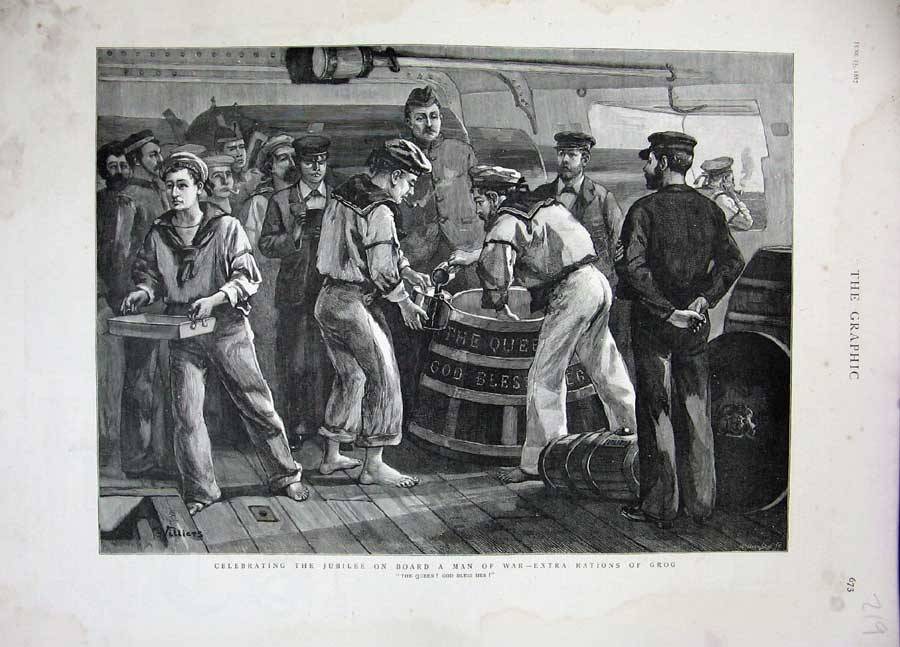
Frequent MxMo participants (MxMites? MxMolians?) will most likely know this already, but whence the term "navy strength"? Well: like rum before it, gin was popularized by the sailors who drank it. In the days before refrigeration, pasteurization, or filtration, spirits were some of the few beverages that would remain potable on long ocean crossings. Combined with citrus to make grog, they also helped to combat scurvy. Naval ships had one additional requirement: in the event of a burst barrel or clumsy sailor, the spirits had to contain enough alcohol that soaked gunpowder would still ignite. That takes at least 114 proof (57% ABV) which then became the benchmark for spirits suited for naval use. (The picture shown here is obviously more recent, but demonstrates how this tradition carried on even into the Second World War.) Such navy strength gins fell out of favor for a while, but they've come roaring back in recent years; nowadays it seems that just about every gin producer makes an overproof product, though they're often harder to find than the standard editions.

My usual inclination with these is probably a dangerous one, though I'm sure sailors would approve: I just sub them in for a typical London Dry in whatever I'm making. Some people like to increase the amount of gin in their Negroni, but I'll stick to the equal-parts ratio and just use a stronger gin. If it's been a long day, I've been known to make a Martinez or other gin-base cocktail with navy-strength product. This is usually an experience that's equal parts rough, bracing, and deeply satisfying.

Which leads us into my submission. While considering recipes for overproof substitution, I hit on the Bijou Cocktail, which is perfect because it also utilizes green Chartreuse, another overproof product by Dagreb's standards at 110 proof (55% ABV) and one of my perennial favorites.

Now, a traditional equal-parts Bijou is a reasonably burly cocktail to start with, so replacing the gin with a navy-strength version is gilding the lily a bit. But hey, I finally caught a MxMo; we'll call that a special occasion, worthy of a strong drink. It's probably a good thing that no appropriate overproof substitution for the sweet vermouth comes immediately to mind, or this post would never make its way out of draft status in a readable form.

For the gin, I defaulted to a product I've been obsessed with lately: Far North Spirits' Gustaf Navy Strength Gin. It's produced from rye, which gives a faintly sweet-spicy character, and it's then infused with botanicals that edge into vegetal territory reminiscent of Scandinavian aquavit. The focus is less on sharp juniper, more on a very rounded profile that blends spice, herb, and sweet citrus. Pairing it with Chartreuse seemed like an obvious slam dunk. I really wanted to try this with Punt e Mes, thinking that some additional bitterness would balance the sweeter notes of the gin, but it was out of stock at the couple liquor stores I visited. I tried a couple of vermouth alternates (including Dolin Blanc, which was tasty but a little too light, and Cynar which was too herbal and rooty) but settled back on good old Cocchi Torino, which was the closest match in my mind to the absent Punt e Mes. (I'd still really like to attempt that version, but we've got a deadline to hit.)

The normal construction for a Bijou is an ounce of each ingredient, which is already pretty sweet and assertive; using the Gustaf, it simply became overwhelming. The recipe I linked above also provides a more "modern" version with three parts gin to one part Chartreuse and vermouth. With that ratio the Gustaf just took over. I landed on a middle ground of 2:1:1, which curiously enough is how I usually recall the Bijou recipe. Perhaps there's a reason for that, because it worked brilliantly here. I started with orange bitters as called for in the original recipe, but the drink really hit its stride when I subbed a large dose of a homemade cinnamon-orange bitters instead.

Here, the result:

1 1/2 oz Gustaf Navy Strength gin
3/4 oz green Chartreuse
3/4 oz Cocchi Torino (or Punt e Mes...)
1 eyedropper homemade cinnamon-orange bitters (call it 4 dashes of orange bitters, supplemented by 2 dashes of a spice-laden aromatic bitters like Fee Brothers)

Stir and strain into a chilled cocktail glass; garnish with a lemon twist, or if you feel like showing off, score a lime peel into a jewel-like shape and drop into the drink.

Since the original French name "bijou" translates to "jewel" I decided to name this one after the much-disputed world's largest emerald, known as the Bahia Emerald. Its contested history seems a good fit for a drink that took a couple iterations to get right, and which still stuns with its weight.

I had a lot of fun putting this together, so I'd like to thank Dagreb for coming up with this month's theme, the geniuses behind MxMo for keeping this event alive and well, and my wife for tolerating my cocktail mixing even with a new baby boy at home. Cheers!

Here's the accompanying roundup post from Dagreb, which features quite a few tasty-looking drinks. I can't wait to try some of these, and their photography game puts my own to shame. Nicely done, everybody!

Monday, November 23, 2015

Spirits: Widely Varied Rums

This is a post that I've been wanting to do for a while, in part because it celebrates a spirit that I think is under-appreciated by the drinking public at large, and in part as a rehearsal. After a year's hiatus, a good friend (most of those reading this will know exactly who, but this is the internet, so let's keep things comfortably anonymous) has invited me back to run another holiday party drink extravaganza! I am wildly excited, given what a blast I've had doing these events to date.

One of the best old-fashioneds I've had in recent memory is a rum variant, and I decided that I'd do my own as part of the lineup for this event. It's a great place to dive in, because it allows for some context around the history and ultimate simplicity of the old-fashioned format. It also provides for a springboard into rum, showing off its historical pedigree, the amazing quality that's available today, and how it can be superbly applied in cocktails. That's what I want to get into with this intro, which will be much longer than what I'd ultimately deliver live (don't worry, Mystery Friend, I'm not planning an extended lecture here) but the written format gives me a chance to structure and lay out my history. Stick with me, we'll get to some tasting soon too.

So: Rum. The origin of the name is unknown and sports many colorful theories (as with so many boozy terms) but the term starts appearing in the 1600s, often alongside the even more delightful "kill-devil". This gives a clue for how it was perceived: rough, fiery, potent, and unsavory, a stigma that clings to it even today.

Rum is, by definition, a distillate made from sugarcane, usually from molasses (we'll talk about exceptions later). As it turns out, since yeast eats sugar, sugarcane will ferment very nicely, and that's been known for thousands of years; a fermented sugarcane drink called brum has been produced by the Malay people for ages. But more relevant to us, the same fact was re-discovered on early American colonial sugar plantations. Somebody noticed that the molasses (produced as a byproduct of sugar refining) fermented nicely if allowed to sit in the tropical heat; somebody else then had the genius idea to distill the resulting alcohol, concentrating and preserving it.

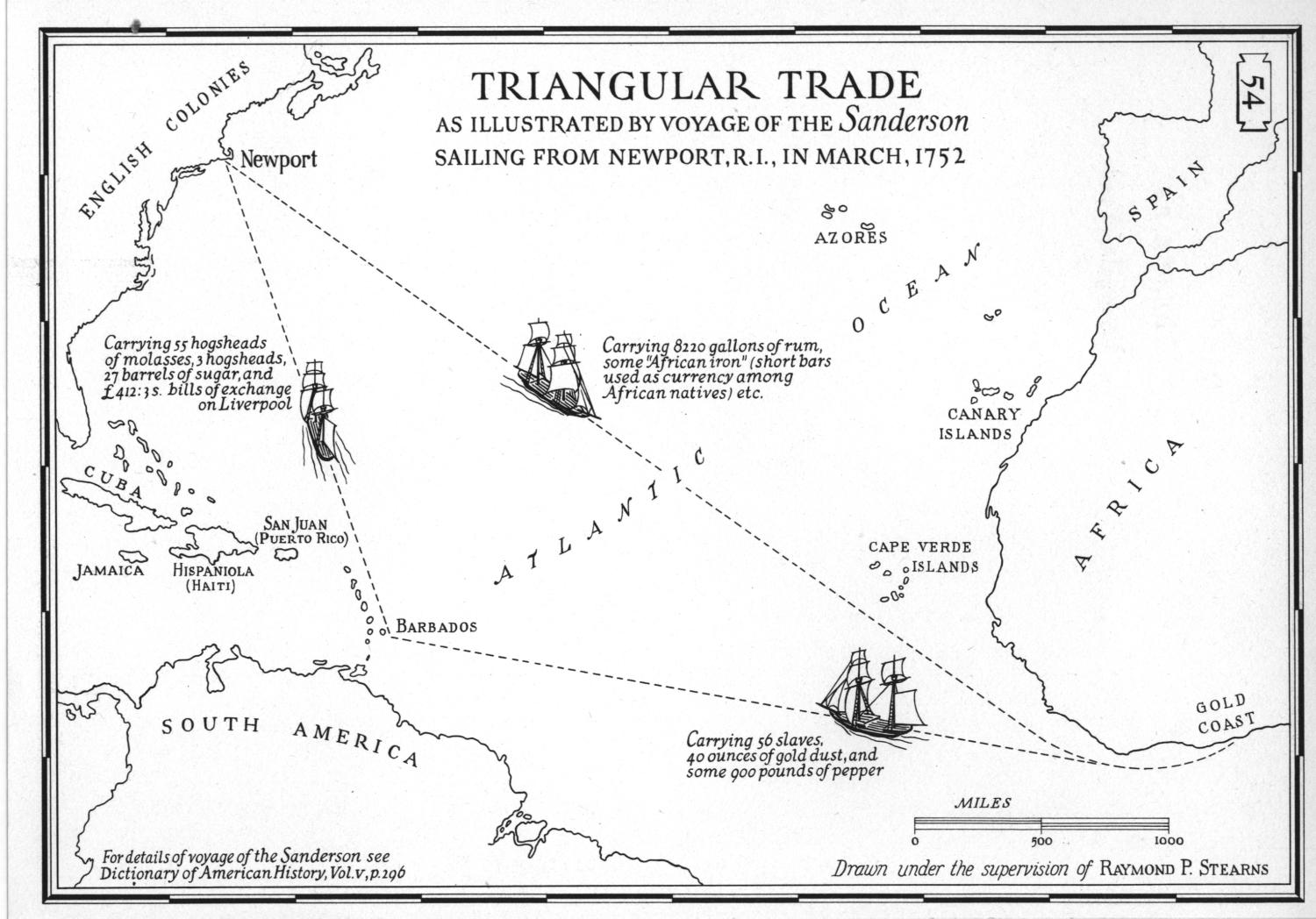
What we now call "rum" was born, and it quickly became associated with the sailors who conducted trade in sugar and slaves during the Colonial period. Rum became a hot commodity in the notorious slave trade that fueled Europe's economic expansion, to the point where the term "rum triangle" became synonymous with the routes. Sugar (along with rum) and other raw materials were shipped to Europe; finished goods like textiles and guns were shipped to Africa; slaves were shipped in horrifying conditions to work the sugar plantations in the Americas, and the whole thing went round again. As the New England colonies grew, a modified route also developed that shipped sugar to New England (to be fermented and distilled), rum and goods to Africa, and slaves back to the West Indies and Caribbean. This isn't exactly the most savory backstory, but it shows you that rum had heft. It was a major export, which together with cotton and tobacco provided an economic engine driving growth in the early American Colonies.  Today's world might look very different without it.

Part of the reason for this popularity is that rum was one of the few distillates available at the time. Whiskey was perhaps being produced in small quantities in the rocky Scottish and Irish islands, but in a rough and barely palatable form. The column still used to produce clear spirits like vodka and gin hadn't been invented yet. That left brandy, which was expensive, and more importantly for the British, it was foreign. Rum provided a viable alternative, being made from sugarcane in colonies largely controlled by the British. That in turn provided fuel for a navy full of thirsty sailors.

It seems odd today that a massive military operation could be essentially powered by booze, but it's true. Consider the conditions. Voyages of any kind across the ocean took weeks or months, and you had to bring all your provisions along with enough space left over for cargo. Crewing a ship took dozens of men, which on the ocean meant not only food but hydration. Before the days of effective filtration and storage methods, fresh water could become corrupted and spread disease after a few weeks. Instead, ships carried beer (and wine for the officers) which kept longer due to its alcoholic content, and also provided some nutrition - indeed, a significant portion of the average sailor's daily caloric intake came from beer. But beer was no less bulky than water, and would go off if kept for any length of time in the hot and stuffy hold of a ship.

Eventually, British vessels began to carry spirits as well, which took up less cargo space, kept pretty much indefinitely, and which could be used to supplement stocks of fresh water as available. David Wondrich's Punch! makes a pretty compelling case for punch (the original mixed drink!) being born out of spirits mixed with water to cut down their proof, a concoction known as "grog". Often this was spiked with citrus to combat scurvy, and sweetened for taste. At first grog used a Javanese distillate called arrack, but rum provided a close substitute that was much easier to find on voyages to and from the Americas. Eventually ships were supplied with even cheaper gin, but not before rum became firmly entrenched as a sailor's drink. In other words, rum was a sort of military technology, one that kept sailors hydrated, entertained, and scurvy-free when combined with citrus. It helped to power the single greatest navy on the seas, strengthening the British Empire and shaping the history of the Western world. How's that for heft?

But, back to the modern world. Rum is nowadays produced primarily in the Caribbean islands that hosted the sugar plantations where it was born. Some newer US-based micro-distilleries also make rum, but the producers operating in New England during early colonial days have been supplanted by whiskey distillers. With such extensive history, it's perhaps no big surprise that rum styles have diverged and diffused over the centuries, and just about every island has its own take on the concept. Some use column stills to mass-produce a light, airy product; others stick to older pot stills of unique and arcane design. Some carefully blend different varieties for a smooth, sippable product; others like more spice and bite. Most of what we call "rum" is produced from molasses, but there are variations such as rhum agricole (produced on former French colonies, such as Haiti and Martinique) and cachaça (produced in Brazil) are made from fermented whole sugarcane juice instead, which hasn't been processed to refine out the pure sugar. That stuff is a whole different beast in terms of flavor, and less common here in the US anyway.

Just as there's wide variation in style between American, Scottish, Irish (not to mention Canadian and Japanese) whiskeys, there are many different renditions of rum, and it's instructive to taste them next to each other. Or, at least, that's the conceit that I'm operating under. Hence, here are three different rums from three different islands. All three are produced from molasses, moderately aged, and can be found for $25-35 apiece. I consider them all solid, everyday, multi-purpose rums, but they are far from identical, as we'll see.


Plantation Grande Reserve 5 Year Old

About: Let's start with an easy one, made in the tiny island nation of Barbados. Despite the island's history as a British colony, the rum itself is bottled by Pierre Ferrand, a French cognac producer who also imports one of my favorite white rums and one of my highly prized sipping rums. So I may be biased, but this rum earns points for being a smooth, straightforward product that does very nicely in cocktails while being perfectly enjoyable on its own. It's aged in bourbon barrels in the Caribbean climate, then gets "refined" in French oak casks. The website suggests that the 5 years on the label is all in the bourbon barrels, so I'm not sure what exactly that last part means, but it has a definite impact on the final flavor.

Tasting Notes: Perhaps predictably, this rum has a lot in common with a relatively-young cognac. It's sweet up front, with a solid apple-pie core, but laced with the ineffable haut goût (or "hogo" in rum terms) which is really difficult to define but often sought-after both in older brandies and in rum. There's not a ton here, but it's noticeable, and it opens up the tropical-spicy flavors that begin to dominate the palate. Lots of guava, clove, allspice, vanilla, and a little whiff of coconut too. The finish ends just a little bit spicy, which is enough to draw you in and take another breath of the guava-apple-allspice nose again and start the process all over. This is a bit too smooth for Tiki-style drinks or anything with a lot of citrus, since those are basically designed to compensate for rougher rums, but it's a really good choice for off-beat mixing in stirred drinks (like a rum old-fashioned) and it's a solid sipping rum if you don't want to break the bank.


Pyrat XO Reserve

About: Pyrat is bottled by Patrón (a company you may have heard of) and is sourced from Guyana. No, not the French one, the other one; did you know there were two Guyanas in South America? The distillate is undoubtedly a modern product, as seen below; the bottle, as seen to the left, is a squat pirate fantasy not designed with bartenders in mind. Also pay no attention to the "XO" on the bottle; the use of such grading terms is traditional for brandy, but totally unregulated outside of the French tradition, perhaps doubly so in a former British colony. So there's a lot of questionable branding going on here, but it's not a bad entry-level product inside.

Tasting Notes: This is a less subtle beast than the Plantation, but it has lots of the same sweetness up front. The nose is somewhere between root beer and ginger ale, with a strong whiff of lime peel. It tastes unsurprisingly of molasses, loaded with nutmeg, star anise, allspice, and ginger, which gets sweeter as it sits on the palate. Gradually this develops into a strong sweet orange quality, reminiscent of orange liqueur, with some tropical fruit (papaya?) and funky hogo in the background. Notice a pattern? The sweetness is really overwhelming by the end, but that actually makes it a decent dessert rum, possibly very nice for a rum cake or other confectionery. Pyrat also fits nicely into a Tiki cocktail blend; I'd definitely like this offset with another dry, overproof rum and plenty of citrus.


Matusalem Gran Reserva

About: Although this one says "Cuba" on the bottle, it's actually made in the Dominican Republic, Cuban imports being embargoed until recently. As it turns out, a number of Cuban rum producers left the country after the revolution (you've heard of Bacardi, right?) and set up shop in neighboring countries to continue their trade. The "15 years" on the bottle isn't the same minimum age that you'll find on whiskey; it's an estimated average, as this is produced using the solera system. Also used for sherry, madiera, and other dessert wines, this is a method by which the product is fed from barrel to barrel and continuously blended; because the barrels are never fully drained, this means that some fraction of the distillate could be much older than the date on the bottle, though none is exactly as old as stated.

Tasting Notes: My initial impression is that this tastes older than either of the preceding rums. It's restrained, with a noticeable presence of oak, or cigar box maybe. The nose has little bits of coffee, vanilla, raisin, nutmeg, and orange peel, without any one overwhelming the whole. On the palate, it's the driest rum here, with only a little residual raisin and toffee sweetness not quite balancing things out and leaving the texture little thin. The flavor is as complex as the nose; dried orange, allspice, and vanilla start out, with coffee, tobacco, and oak following but not predominating. The allspice builds toward the finish and the bitter toffee quality returns too, leading things out nicely. The only thing really missing is hogo, which makes this less appropriate as a traditional Tiki rum, but the smoothness is great for mixing in simple cocktails. I particularly like a rum Boulevardier variation* which lets the bitter qualities shine while reinforcing with sweetness.

*2 oz aged rum, 1 oz Campari (or similar), 1 oz (good) sweet vermouth, 1 dash orange bitters, assembled over a large ice cube. Let's call this one a Privateer, though I'm sure there are plenty other cocktails with that name.

So: rum is pretty variable stuff! Keep in mind that this is just one moderately-aged subset of rums; there's much more variation between categories than displayed here. I'm looking forward to talking about it, among many other things.