Showing posts with label whiskey. Show all posts

Thursday, May 5, 2016

Spirits: Two Nikka Whiskies

I've been meaning to do this post for a while, not least because I need to make room in my bar, but also because it covers a unique variety of whiskey that I think deserves consideration. A couple months ago, I overheard a couple guys wondering aloud about the Japanese labels up on the bar whiskey shelf, and immediately had to jump in for color commentary, much to my wife's dismay. I hope some of that enthusiasm comes through here.

Japanese whiskey is kind of a funny thing. (Yes, for the pedantic, that's often spelled "whisky", which is a stupid and pointless convention that I refuse to follow.)  It's a relatively new practice in Japan, one which has already established a bit of a core style but which culls influences from other, older traditions. Japan has an astounding talent for mimicry, and often when I taste Japanese whiskey I'm reminded of other styles that are being given a deep nod. That's definitely the case with these two.

Both of these are produced by the Nikka Whisky Distilling Company (I'll respect the convention here because it's part of a formal name, nerds) which was one of the first distillers to set up shop in the Japanese islands. Its founder, Masataka Taketsuru (for whom one of the whiskies below is named) came from a family of sake brewers, and enrolled at the University of Glasgow to study chemistry during the brief decades when Japan was open to the West before World War II. He became enamored with the Scottish whiskey-making tradition, apprenticed to a few distillers, married a young Scotswoman, and returned to Japan. After working for an established distiller (now owned by the giant Suntory) he went independent and established his first distillery in Yoichi on the northern island of Hokkaido, following highly traditional Scottish whiskeymaking practices. Later on, the company added further distilling operations, including a Coffey or column still imported from Scotland, and now oversees a whole range of distilling and bottling operations all over the Japanese islands. These folks have carried on their founder's legacy of traditional methods taken very seriously, and it shows in the end product available on our shores.


Taketsuru Pure Malt

About: A blended malt, meaning that it's a combination of multiple single malts. There's no age statement on this, so while I hear that various 12-year, 17-year, 21-year, and so on versions are available, we can't be sure that this isn't mostly much younger. Ah well, we must be content with what we're given. According to what sources I can find, it's partially aged in sherry casks, which explains some of its similarity to scotch, which is often treated in the same way.

Tasting Notes: There's a wisp of smoke on the nose of this one that immediately brings to mind scotch, possibly even one of the intense island editions that tastes like moss and sea. Yet it's also pretty and lightly floral, with hints of ripe fruit. The palate is smooth and beautiful, with all kinds of balanced flavors. There's spicy grain and more of that smoke; there's stewed apple, toasted almonds, and cherry blossom; there's orange peel and a curiously buttery quality. I keep wanting to taste it over and over again to catch new hints. The presence of peat builds as it sits on your tongue and is notably present on the long finish, along with repeats of the savory flavors in the palate. Really tasty, and while it occupies a similar niche of flavors as an island scotch (Scapa, maybe?) it seems to strike off in its own, highly refined direction.


Coffey Grain Whisky (again, it's in the name)

About: Being a "grain whiskey", this isn't made from just malted barley but also contains corn and wheat, bringing it a bit closer to bourbon than scotch. Surprisingly (at least to me) it's produced on the same stills that produce the Taketsuru, which are located in the Miyagikyo distillery. Again, there's no age statement, and there's not much information available that I can find about the aging process, but I won't argue too much when the end product is this good.

Tasting Notes: To me this is much more reminiscent of Irish whiskey than scotch. It smells sweet and richly fruity on the nose, with a bit of toasted grain background. On the palate it shares a marshmallow-y sweetness with Irish whiskies, along with a core of rich grain. There are accents of orange peel and cherry blossom throughout, echoing the Taketsuru, but it has a much richer, denser texture. The peat here is a subtle backing only, and the finish is mostly one of lingering spicy grain. It's a markedly different product, and while I think it's less subtle and layered than the Taketsuru it's also deeply satisfying. Anybody who likes a good Irish whiskey like Redbreast would dig this too.


For the curious, there are other Japanese whiskies available on our shores, notably the excellent Suntory-owned Hibiki, and I fully intend to give them a rotating spot in my bar. They may be somewhat uncommon in the US but are worth seeking out, and the Nikka editions above are excellent entry points.

Sunday, February 28, 2016

Tommy's Old Fashioned

Recently, I bought myself a nice-looking decanter set, so of course I had to come up with a pre-mixed cocktail to fill it. Such concoctions, much like my now-standard mix-it-yourself party punch trick, are great for gatherings (or laziness) because they can be self-served, freeing up yourself as the host to mingle and partake yourself. This sort of thing is arguably even better because it can sit on the bar indefinitely and be simply poured to serve.

This one is named after my newborn son, because it's based on the three-part blend of spirits that I packed away in a flask for our stay in the hospital (because fold-out couches are horrifically uncomfortable and I needed some help getting to sleep after the first night). The liqueurs and bitters are bolt-on additions, but solid ones that I stand by.

The following will just about fill up a clean 750 mL bottle of your choice, because I'm assuming that you have such a bottle available. Dig an empty wine bottle out of the recycling and rinse it out if you don't. That will make for somewhere between 10 and 16 drinks depending on how liberally you pour them.

8 oz Cabin Still bourbon (another basic bourbon of your choice would be acceptable)
8 oz Laird's Straight Apple Brandy (no substitutions)
8 oz Mellow Corn (ditto)
1/2 oz maraschino (Luxardo, naturally)
1/2 oz Casoni 1814
1/2 oz cinnamon syrup
12 dashes Regan's No. 6 Orange bitters
12 dashes Angostura bitters

Combine in a decanter or empty bottle of your choice, stopper, and store on your bar indefinitely. To serve, pour over a large ice cube and stir to your desired dilution and temperature.

And yes: twenty-one years from now, I'll gladly serve him one of these, assuming that both I and the recipe survive to that day. At this point, that seems quite a long way off.


Tuesday, November 3, 2015

Spirits: Koval Distillery Whiskeys

In August, the wife and I took a trip to Chicago for our anniversary. I had every intention of writing up the entire trip, I swear, but somehow life intervened and that post simply never happened. But, I did manage to bring a couple souvenirs home from our final stop just before skipping town: the distillery and sampling room at Koval Distillery.

I've talked about a couple of Koval's unusual products before, but the visit was a real education in just how odd their stuff is. The distillery was founded by a wife-husband duo who hail from Austrian families with a history of distilling brandy, which in Europe generally means trying to capture the nuances of a specific fruit in their distillate. I love such unaged European brandies, and it's really interesting to see how the approach translates to distilling whiskey from grain.

Practically, what this means is that Koval uses only 60% of the total output of their still to make each batch of whiskey, using what's known as the "heart". (It's probably worth noting that their main still is much bigger than the display model seen to the left.) The 10% toxic "heads" which come out first get used to clean the floors, and the 30% largely flavorless "tails" that come last get collected and re-distilled into vodka. Thrifty! Their barrels are smaller than the 55 gallon model used by most domestic bourbon distillers. Instead Koval ages for about 2 years in smaller 30 gallon barrels (made in Minnesota) with a variety of finishes.

And that finish, I'd say, is one of the things that makes Koval's product so interesting. They distill using a variety of interesting grains, all of them carefully sources and certified organic, but in the tasting room you get to try differently-aged samples: the same whiskey, from the same grain, in three totally different expressions.

This color difference gives you a preview of what's to come. The white whiskey on the left is aged for a single day (apparently legally required to label it "whiskey") and no more; the other two are aged for about two years. In the middle is a "toasted" barrel expression, with no char on the inside of the barrel; on the right a bourbon barrel with a classically charred interior. This makes for a shocking difference in the finished product.

Now, these are also distilled from different grains, but having sampled practically every combination available at the tasting room (at the encouragement of my long-suffering wife) I can tell you that the finish makes just as much difference than the source grain. Let's not belabor this with the format that I've kept to in other spirit reviews, because the different styles that these represent are as interesting as the specific whiskies I brought home.

First, the white whiskey. I'm usually suspicious of white whiskeys, since they have a reputation for roughness thanks to the infamous poor quality of moonshine. In truth, there are a surprising and growing number of quality minimally-aged whiskies out there (High West calls them "silver whiskey" in a superb branding move) and Koval's are easily the best I've ever tried. These are essentially fresh off the still, having been aged only in barrel for a single day, which is apparently legally required in order to label them with the term "whiskey". Essentially, they're the pure stuff, as close to a straight expression of the grain as it's possible to get.

The Oat version that I brought home is sweeter on the nose than other new-make whiskies, bordering on the round sweetness of a classic eau-de-vie, only... tropical, somehow. The body is beautifully smooth and creamy, without a hint of burn; the grain is a predominant flavor, providing a persistent sweet quality reminiscent of oatmeal (duh). As it sits on your palate there are little pops of maple, vanilla, apple pie, guava, and a growing spicy character (think allspice and white pepper) that lingers into an extended finish. From what I recall of the other white whiskies, they differ mostly in the details; the rye is unsurprisingly spicier, for example, but shares the same impeccably smooth, silky-sweet palate. Every single one is amazingly smooth and delicate for such fresh spirit, a great testament to Koval's distilling practices.

Second, we've got Koval's Toasted Barrel expressions, which were the most exciting find for me. This whiskey is distilled just like the others, then decanted and aged in barrels whose oak staves are briefly heated to "open up" the wood grain without developing the char characteristic of bourbon barrels. It's instructive because even though it's produced in the same fashion and aged for the same length of time, the result is totally different from the other styles. That's easily seen in the pale gold color, which resembles scotch or a delicate Irish whiskey more than it does most caramel-brown American whiskey.

Out of the available options, I chose the Spelt to take home (made from a subspecies of wheat) because it was the most unique of the available grains and also because it edged most into complex, delicate scotch whiskey territory. As with all of Koval's products, it's a little sweet and grainy on the nose, but also carries a pleasantly sawdusty aroma like fresh-cut wood. That's reflected on the palate, which is delicately sweet at first with notes of nougat like a good Irish whiskey, touched up with a vaguely floral note, like a very subtle chamomile. A spicy presence grows and grows, with intensely peppery notes and the drying presence of the wood tannins, all against a backdrop of honey, wheat, and a bitter-herbal character that puts me in mind of absinthe. It's one of the sweeter toasted barrel versions, less spicy than the rye, less floral than the millet, and I can't think of a single other whiskey I've tried made from spelt, so it gets points for uniqueness too. The only problem is that it's a very limited release, quite possibly sold only at the Koval distillery, and I've been unable to find it anywhere locally.

Finally, though by no means last, are the more traditionally styled whiskies aged in charred oak barrels, in the same fashion as bourbon (in fact, bourbon is included among them, but distinguishes itself by using millet in the mash). Again, these are aged in small barrels for a shorter amount of time than larger producers. The size of the barrel, and the resulting increase in surface contact, is partly what produces the classic rich caramel color despite only about two years in oak. But don't worry - the flavor is still distinctively Koval.

My selection of these was the Four Grains whiskey, made from a combined mash of oat, barley, rye, and wheat (what proportion of each isn't specified). This strikes an intriguing balance between the qualities of all those constituent grains. It's spicy and fruity on the nose from the rye, with big hints of orange peel and malt. Sweetness is immediately evident on the palate, in a fruity/floral combination that reminds me a lot of maraschino liqueur with some honeyish acidity. It grows increasingly grainy in a breakfast-cereal sort of way, with the airy quality that I always associate with wheated whiskies, and a light undercurrent of char. Eventually it turns to cinnamon and nutmeg, and winds up in an intensely peppery and lingering finish with a hint of licorice. It's one hell of a whiskey with a lot going on, though it maintains the sweet fruitiness consistent with Koval's other expressions. This bottling, fortunately, is one of the easier versions to find, and well worth hunting down!

All three of these (and the expressions that they represent) are excellent products, and Koval a very welcoming distillery. I highly recommend visiting! You can taste to your heart's content, view the workings of a true craft distillery, and pick up products that can't be found anywhere else. For us, it was the perfect endcap to our vacation.

Friday, August 21, 2015

Negroati

I had to write this one down immediately.

1 1/2 oz Koval White Oat Whiskey
3/4 oz Casoni 1814
3/4 sweet vermouth

Stir and strain into a cocktail glass over a large cube.

Really, this is more of a Boulevardier, but the unaged whiskey makes it something else. Yum.

Tuesday, June 23, 2015

A Few Random Old-Fashioneds

I find it hard to resist an old-fashioned. Here I'm talking about the simplest classic cocktail. Booze, syrup, bitters; full stop. For a "fancy" version, add a dash or two of something flavorful.

Simplicity is a virtue here. Made well, a classic bourbon- or rye-based old-fashioned is a perfect and uncluttered masterpiece. You've got a delicate sweetness, an accenting punch of spice, a rich mouthfeel, all taming the base spirit but never letting you forget it's there.

Flexibility is another core aspect of the old-fashioned. A traditional version is made with whiskey, but it doesn't have to be. Any spirit that you wouldn't mind drinking straight will do. Likewise syrup; there's no need to stick to plain old simple when you've got variously flavored varieties. And there are a million different craft bitters out there today. Grab some of each, and combine them over a large ice cube. Boom: old-fashioned.

Here are a couple good combinations I've stumbled into recently.

Japan
2 1/4 oz Nikka Taketsuru Pure Malt whiskey
1/4 oz lemon syrup
4 dashes Bitter Truth Jerry Thomas' Own Decanter bitters

Mexico
2 1/4 oz Mezcal Sacrificio Reposado
1/4 oz honey-ginger syrup
2 dashes Bitter Truth Xocolatl Mole bitters
2 dashes Regan's No. 6 Orange bitters

Mpls
2 1/4 oz Norseman Strawberry Rhubarb Gin
1/4 oz cinnamon spice syrup
2 dashes Bitter Truth Tonic bitters
2 dashes Angostura bitters

For all of the above, stir briefly and strain over a large ice cube. Don't even think about garnishing.

What? No mention of hiatus? Shhhh what hiatus, what silliness is this?

Monday, May 4, 2015

Spirits: Bizarre Booze Roundup

Woohoo! Having finally escaped the clutches of Mocktail Month, we can get back to serious drinking! Sipping. Sampling. Analysis. Whatever.


It was a good month, and certainly a helpful way to recalibrate, but now it's been a while since we did some spirits review. Heck, it's been a while since I went out and bought a bunch of booze based on whatever caught my eye - but that was exactly what happened the other evening.  It started as an innocent stop (honestly) with the notion of grabbing a bottle of wine, and ended with whatever you'd call this motley collection. God-damned strange is what I'd call them. Some very appealingly, others... less so, but still interesting. Let's have a taste, shall we?


St. George California Agricole Rum

About: The wizards of St. George Spirits feature prominently in one of my favorite recent non-fiction books, Adam Rogers' Proof. They make one of my absolute favorite gins, plus a California single malt, plus a great domestic absinthe, so I tend to trust their judgement. This is, according to the bottle, their rendition of an agricole-style rum (and, to be fair, if I'm going to blatantly ignore the whiskey/whisky debate, it seems pedantic of me to point out that it should be spelled "rhum" here) and is pot-distilled from fresh sugarcane. The label also includes the word "audacious", which... yes. That is a positive term for it.

Notes: The instant I opened this it smelled familiar, but impossible to place. I had to enlist my wife's help (she has a much better sense of smell than I) and she nailed it immediately. Olives: this stuff absolutely reeks of olives, specifically buttery little castelvetranos for some reason. The nose is so one-note and intense that it's really offputting; it's overwhelming even from a few inches above the glass. After a few minutes to sit it starts releasing some rhum-y notes of rubber and gunpowder, which is good because damned if I want to drink it before then. On the palate, those olive notes mercifully take a backseat; it's a more traditional rhum character, with fresh grassy sugarcane, intense vegetal notes, more petroleum (sounds like a bad thing, but it's very central to the style) and a little bit of melon. Then, god-dammit, the olives take over the finish with their vague brininess, backed up with modest congener funk that lingers for a while. A little lump of ice actually brings out the brine much more than I would have thought. I'm going to have to reserve this one for cocktails, where the saline character might bring some intriguing depth; I fucking love olives, but apparently not in my rum. Gotta say, I'm pretty disappointed in St. George right now. Either I got a poor batch of this, or they're being very "audacious" indeed.


Fidelitas Obstler

About: The name, and the origin, is extremely German. It looks to be an unaged brandy, and the label tells me it's a blend of 20% pear and 80% apple brandy, though it doesn't say whether they're combined before or after distillation. This delightfully translated page tells me that the distiller makes a number of other products, some of which I think I've tried, notably a raspberry brandy. However, my favorite part is this:
Especially the pear brandy is popular and well known among friends of the fruit moth. He is sorted fired from the Williams Christian pear, which has a particularly strong flavor.
Indeed. I have no idea who these "friends of the fruit moth" might be.

Notes: Very ripe and delicate compared to a lot of unaged brandies I've had; the nose smells like nothing so much as smelling the outside of a ripe, sweet Bartlett pear. Interesting, given that it's only about 20% pear brandy. Creamy pear predominates on the palate too, though there are some sweet apple notes present, with boatloads of vanilla and a little amaretto-ish sweet almond flavor for backing. Really dig the sweet, smooth body of this one. The finish is quite gentle too relative to similar spirits, just a little tickle of white pepper and a touch of lingering heat. This would be a really nice dessert sipper, but I'm looking forward to a trial run in some cocktails too.


Espolòn Añejo Tequila

About: This one may not look like an oddity at first, but it definitely is for two reasons. First, it's a relatively cheap yet high-quality añejo tequila! That's neat, but not a big shock given how much I enjoy Espolòn's reposado product. After spending about a year aging in classic white oak, this older edition is also finished in ex-bourbon barrels, ones from the Wild Turkey distillery, no less (yum). This has a subtle but definite effect on the final flavor, adding a bit of charred bourbon character to an already complex spirit. Here is a decent interview with a more detailed description of the process and product. I am totally on board, especially given that I found it for less than $30, at which price I really should have grabbed another half-dozen bottles before they realized their terrible mistake.

Notes: All classic, aged tequila on the nose. Rich, vegetal, full of ripe pineapple and oxidized notes reminiscent of a medium sherry. That's a pretty apt description of the palate, too. There's definitely a lot of rich caramel, pineapple, and guava. Some grassy and red-pepper notes provide a bit of backup, but the interesting part is a very dry-sherry-like saline character, with even a little bit of the iodine notes that Islay scotch is famous for. The bourbon finish takes hold in an oaky flush towards the end, with some dark spicy notes and more of that oxidized sherry flavor. Tequila that reminds me of scotch? Yeah, actually, and it's awesome!


Koval Millet Whiskey

About: Remember when we talked about Koval's oat whiskey and I off-handedly joked that they had a millet variety too? Well, I fucking found it! Right next to the oat product, and a "four grains" variety; not too surprising, I wouldn't have known where to shelve this either. Looking at this induces a kind of vertigo for me, as my most personal experience with millet is when I fed it to my childhood pet parakeets as a treat. Since it's gluten-free, and has a protein content very similar to wheat, it does appear to have had a slight resurgence in health-food circles as an alternative grain, but I don't know if I'll ever see it as anything other than birdseed. And here's some whiskey made from the stuff. God damn, don't we live in strange and exciting times?

Notes: Another very unusual nose for the category, this one like nothing so much as bubble gum. There's some woody scent behind that, and a sort of amaretto character, thankfully; this isn't a repeat of where we started. It's just a very odd scent to encounter floating atop what appears to be a fairly standard American whiskey. Unsurprisingly, that floral sweetness carries over into the palate, which is mostly inoffensive; very perfume-y, to be sure, but with a bit of rye-like bite and a good caramel presence that keeps things from being one-note. I'd describe the spice as being heavy on nutmeg and clove; maybe a bit like apple pie, complete with the apple. The finish delivers much the same but ends on that very floral character, kind of like rose water. Not sure I like this one as much as the Oat Whiskey, but it's still fascinating in its own way, and the flowery notes might make a good match for summer.


Those, my friends, are some strange spirits. I'm still figuring out what to do with them (aside from the tequila; it's Cinco de Mayo tomorrow, after all) but I will gladly report my findings.

Monday, March 30, 2015

Ronin

I'll admit: this is nothing more than a Jerry Thomas-style Improved Cocktail as applied to a Japanese whiskey. But damn if it isn't one of the most suitable spirits I've performed this treatment on. It's smoky and light and floral; a perfect match for the accenting liqueurs.

2 oz Japanese whiskey (Akashi White Oak)
1/4 oz citrus syrup
1 dash maraschino liqueur (Luxardo, duh)
1 dash absinthe (4-5 squirts from an atomizer)
2 dashes orange bitters
2 dashes Peychaud's bitters

Stir and strain in a cocktail glass over a large ice cube; garnish with a large strip of lemon peel.


Saturday, March 14, 2015

MxMo XCV: Oat-Fashioned

I've been thinking for a while about throwing in on a Mixology Monday as a way to challenge myself. Well, folks, the time has arrived! I only just spotted this month's theme via Cocktail Virgin Slut's submission, but since the old-fashioned is my hands-down favorite cocktail category, I knew I had to give it a go.

This theme was picked by Laura of the Sass & Gin blog (what a name!) whose announcement summed it up like so:
The Old Fashioned is the original "cock tail," dating to the early 1800's. In this humble bartender's opinion, it is the pater familias of all other drinks, and it has taken its place as such in the recent cocktail revival. We have seen many variations of the Old Fashioned (i.e. Mayahuel's Oaxaca Old Fashioned, PDT's Benton's Old Fashioned) and the resurgence of similar cocktails (i.e. the Sazerac). The bitter's market has exploded over the last decade, with more flavor profiles than ever before, and with a more health-conscious public, your local grocery store is likely to carry a selection of sugars to play with (agave, coconut sugar, turbinado, etc).

So, here's the challenge: We will be sticking to the traditional ratios of spirit, bitters and sugar, but I'm challenging you to step outside the box with your selections. In addition, how will it be chilled or garnished? Do you want to add a secondary spirit or rinse? Go to town!
Since I've had a few odd whiskeys rattling around lately, I figured I'd give one of those a shot in an old-fashioned rendition. We've had a (relative) heat wave here in MN over the last week, and I was feeling oddly nostalgic for winter today, so I also wanted to stick with some really robust, dark flavors as a send-off. Koval Oat was the immediate choice of spirit for its deep, distinctive grain character, and to emphasize that further I added in a small splash of the darkest liqueur I had on the shelf: the pitch-black Sicilian amaro Averna, which has a great licorice-and-orange flavor, serving as both a backup sweetener and secondary bitters here. As for syrup, I had a bit of a beautifully rich squash syrup hanging around that seemed the only logical selection.

2 oz Koval Oat Whiskey
1/3 oz brown sugar-butternut squash simple syrup (1:1)
1 dash Averna (call it 1/6 oz, or a barspoon)
1 dash Bitter Truth Jerry Thomas' Own Decanter bitters

Build over a large ice cube in a double old-fashioned glass and stir to chill. Garnish for once with a prettily cut strip of orange peel; sometimes it pays to be presentable.

I really dig the oat presence that hangs around from start to finish here, backed up by the buttery notes from the squash syrup, the richness of the brown sugar, and the licorice twang of the Averna. Koval Oat isn't an especially spicy whiskey, so it might also be fun to bring more dark-spice notes in with something like an allspice dram. I suppose that'll have to wait for another day, since we're on a deadline here...

So, kudos to Laura for picking a theme that dragged me off the fence, and cheers to the Mixology Monday folks for running this fun event. Hopefully I'll have more submissions to come!

p.s. Here's the roundup post if you're looking for the other entries. Lots of tasty-looking stuff...

Friday, March 13, 2015

Spirits: Weird Whiskey

This time I don't have to argue about my spelling of whiskey. These are strictly American products, but they are funky samples of the lot. Or maybe they're just showing the range of the term; after all, "whiskey" can be made of just about any grain that can be fermented and distilled. Most of the big categories have some definition about what grain that can be. Scotch, for instance, is (primarily) malted barley; bourbon must be at least 51% corn. Others have strict requirements around how the spirit can be aged (bourbon, again, must be aged in fresh charred oak barrels). But just because something falls outside those boundaries doesn't make it bad, just different.

There are a lot of good craft distilleries popping up, and many are taking advantage of the room for experimentation when working on a smaller scale. This means more products popping up that skirt the boundaries of traditionally defined spirits. I like this maverick approach, because I think it's laudable to support small businesses, I have some pretty esoteric preferences, and sometimes those distillers hit on a real winner. Like the oddities below.


Koval Oat Whiskey

About: Koval Distillery gets bragging rights as the first distiller operating in Chicago in over a hundred years, though there are more recent others whose products I also quite enjoy. They're all about small-batch, single-barrel, hand-produced stuff, which to me defines the term "craft" and which I can solidly get behind. They also seem to like trying out new stuff, hence this whiskey produced from 100% oats. There might be a couple other oat whiskeys out there, but I can't recall seeing any of them on shelves. (That's not even the weirdest product Koval makes; they also produce a whiskey made from millet, a grain which I used to feed to my parakeets, and an eau-de-vie made from sunchokes, which... I mean, what the fuck?)

Tasting Notes: This is different from classic bourbon in the same sense as rye whiskey, only... well, oats. Okay, that's simplistic, but it's also true. There is a hard-to-define robustness about this one which puts me in mind of good, slow-cooked oatmeal, the real deal made from steel-cut oats. It's a little bit musty and off-putting on the nose, but the palate picks up with that oat character, some rich caramel notes, and a little vanilla. The vanilla hangs around and builds up a marshmallow-ish character that reminds me of maraschino liqueur, which carries on into the spicy, lingering finish. I can't wait to try this in an old-fashioned with a touch of maple syrup (and maybe a coffee bitters).


Temperance Trader Chinato Barrel Aged Bourbon

About: Temperance Trader hails from the Bull Run Distillery in Portland, Oregon; or it mostly does, anyway. The base whiskey itself is a fairly high-rye bourbon that's actually distilled in Indiana, but it's aged, bottled, and cut down to proof by Bull Run using the same water that supplies the city of Portland. This particular curiosity (which is experimental enough to not even be listed on Bull Run's website) additionally gets aged in barrels supplied by a local winemaker after being used to age their chinato. This is the Italian term for what I'd normally call a "quina", a fortified wine flavored with cinchona bark, modeled after the well-renowned Barolo Chinato. As soon as I saw that, I didn't care that it was a tiny bottle, I just had to have it.

Tasting Notes: The nose on this is shockingly like smelling a really robust vermouth; rich, herbal, full of caramel. At the end, there's a nice burn and bourbon smokiness to remind you that this is a spirit, after all. On the palate, there's a curious inversion; it tastes initially like a fairly straightforward bourbon, maybe a little sweet for me, stuffed with vanilla and sweet dried fruits, notably dates. But then it starts to pick up the spicy notes of the rye, and with that comes faint tannin and sweet spices from the chinato aging. The finish is a hybrid, smoky and lingering like good bourbon but also strangely flowery (I think of rosehips for some reason). Weird stuff. I'm not sure how much I'd like the base bourbon on its own, but the chinato finishing really puts a unique spin on it.


Dry Fly Straight Triticale Whiskey

About: Dry Fly is a true, small-scale craft distillery based in Spokane, Washington, with a big focus on local sourcing of their ingredients. All the grain, for example, comes from regional farms (which explains their heavy reliance on wheat) and their tasty gin is flavored with local botanicals too. Their products don't typically go too far off the deep end, but this is one of the more interesting, made from a hybrid of wheat and rye. Not a blend of rye and wheat whiskeys, mind you; this is made from 100% triticale, an unusual grain developed in Scotland by crossing wheat and rye strains. Most definitely a unique product! What's more, these guys seem really focused on spreading the gospel of craft distilling; they're the only distiller I've run across that actually offers an in-depth course on starting up a distilling operation. Kudos, gentlemen.

Tasting Notes: A lot like a bourbon on the nose, really; I'd guess they use the same aging process as their classic bourbon and wheat whiskey products. There's a note of intense gingerbread there that I really like. The palate is a funky hybrid (shocking, I know) which starts off with a soft, yeasty bread character, backed up quickly by peppery rye, complemented by notes of dried apple, orange zest, and ginger. The oak comes out as it sits on your palate, but that rye spice carries on into a drawn-out finish, slightly bitter and backed up by the wheat roundness to produce a sort of pumpernickel flavor. My only complaint is that finish is a bit hot and mouth-drying, but that's no surprise given that this only spends about two years in oak. I hope they've got some on reserve, because it would be really cool to see what happens to this after several years in the barrel.


Honestly, kids, this isn't even the beginning; it's weird whiskeys all the way down. Why, not even a day ago we covered a whole series of unusual whiskeys I sampled at Rathskeller. Elsewhere on this blog we've seen Bernheim Wheat Whiskey, which is a solid, readily available bourbon substitute. Most whiskey nerds will already know about Angel's Envy Bourbon, which is finished in port barrels; to be honest, I didn't care for it, but their less common rum-finished rye is fucking incredible. I'll gladly recommend Panther Distillery's Pike Street Bourbon as a great local option, and it doesn't stop there. Weird whiskeys everywhere, and so many good ones to try!

Thursday, March 12, 2015

Adventures: Duluth

I've been a little coy about discussing my location, and honestly, I'm not really sure why. It's not like anyone other than close friends reads this little booze-diary of mine, and it would take a lot more drinking to convince me I'm worthy of stalking. As in, hallucinogenic levels of alcohol.

Hence, this entire post is dedicated to our recent drive up to Duluth, a little jaunt that we mostly planned around teaching my wife to ski. However, as it turns out, skiing's kind of a daytime activity, which left the nighttime to wander around seeking out local watering holes. Fortunately we'd done a little scouting in advance and stayed down on Canal Street, a lively little part of downtown with many a brewpub in walking distance.

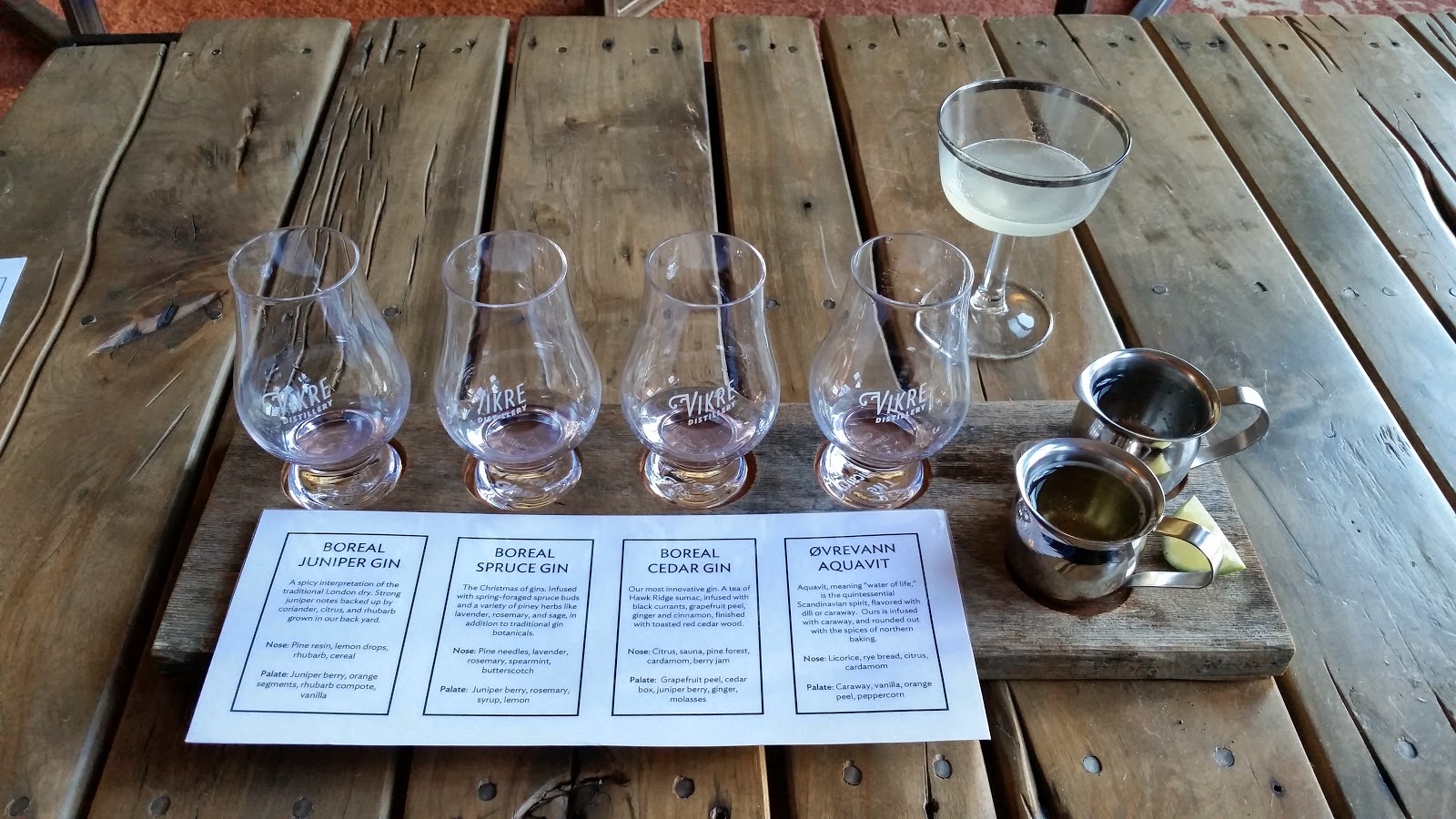
And a craft distillery to boot! One of the first places we visited was Vikre Distillery, whose products I've written about before. They've also got a neat little tasting room out front, outfitted in very chic Scandinavian style; think Bauhaus meets North Woods, which is funky but cool. It's tiny, with a small bar and a lounge area for maybe 20, separated from the actual distillery area only by large sliding-glass panels. This gave me ample opportunity to nerd out on stills while sipping on a couple nicely-executed cocktails and a neat little tasting flight of gins and aquavit. The whole place is homey and comfortable, and I was really surprised by the obvious skill of the bartender (whose name I didn't manage to catch) as he turned out drinks using house-made everything. (Apparently this is a legal requirement of the law that allowed such cocktail tasting rooms.) I also managed to spot a couple big casks stamped with port labels lined up along a wall; I'd bet that Vikre have a port-finished something-or-other in the works, and I'm pretty excited to see the end result! You heard it here first.

Right next to our hotel was the Canal Park Brewing Co., so we pretty much had to stop by and take home a growler. We tried most everything on tap over a couple of visits, and the Greedy Bastard Black IPA was our stand-out favorite. We also popped by the Bent Paddle taproom for an apres-ski beer (and additional growler) one afternoon. But perhaps the best pub we tried was the 7 West Taproom, a really basic-looking place with a surprisingly extensive beer list. They also have a neat sampling method: write your beers directly onto a paddle with dry-erase marker, receive tasting pours of said beer.

Still, nothing held a candle to our favorite place: a beautiful, historic basement bar called the Rathskeller.

I doubt you can appreciate how much I wish this place was located closer to home. We might get into a lot of trouble down there. A bit of explanation: the bar itself is located in the sub-basement of Tycoon's Alehouse, a restaurant situated in Duluth's 1890s-era town hall. The name is a German term for a drinking establishment located in the basement of a city hall (I love such fantastically precise German words) and, true to form, this one is about 20 feet below street level in an old cellar which was apparently once used as a temporary jailhouse. There's no signage; instead, you must weave your way back to an elevator at the back of Tycoon's, and hit the button ominously marked "-1". We only knew about the place thanks to a tip from one of our regular bartenders down at my favorite pub back home.

My god, but this place is cool. The shot above shows about half the lounge area, which is laid out with plush chairs in-between mortared columns with thick arches, with a bar laid out along a wall. On that bar is a well-curated selection of whiskeys, which I did my best to taste through.
No, seriously: I made a pretty good dent. Granted, it took two separate visits (or more accurately, after the first visit, we really wanted to come back for more) but I sampled just about every whiskey on that bar that I hadn't tried before.

Here's just a sample, the highlights of the first evening. First among these, to the left: Bushmills 1608, a blend created to commemorate the distillery's 400th anniversary (yeah). This, frankly, might be the absolute best Irish whiskey I've ever sampled. Rich, spicy, smooth, malty, slightly peaty; absolutely delicious sippin' whiskey, and a really unique Irish blend. In the center: Prichard's Double Chocolate Bourbon, a really nice, rich whiskey with a ton of chocolate on the nose. Despite that, it's very nicely balanced on the palate, with just some touches of bitter chocolate on the finish. On the right is something really cool: a custom Woodford Reserve blend developed specifically for Tycoon's. Apparently, the head brewer at Fitger's Brewhouse (who also has a stake in Rathskeller) regularly visits the Woodford distillery, and on his last trip developed a custom blend from different barrels! Not too far off from the base Woodford formula, but spicier, and not something you're going to find anywhere else.


Honestly, though, the best part of the whole adventure was the company we found. First, the bartender at Rathskeller, a knowledgeable and welcoming barman by the name of Cade. He knew his stuff inside and out, and was happy to accommodate my indecision. When we visited on the second evening, he not only remembered the bottles I'd tried, but my wife's whiskey preference too, and he was happy to pull down all of the bottles so that I could snap pictures. Now that's a good bartender.

Second, in a bizarre coincidence, we ran into the very same dude from the pub who recommended Rathskeller to us in the first place, in addition to our other regular bartender and their lady friends. Kudos to Jeff and Evan for their fine taste, as always. For once, I got to buy them a drink, and we had a hell of a time chilling out. That was most definitely a pleasant surprise!

Overall, it was a hell of a trip. I don't know when we'll make it up to Duluth again, but when we do, you'll very likely find us at one of these spots again.

Sunday, February 22, 2015

Subway Sour

So you followed my recommendation and turned an unimpressive gifted plonk into a syrup. Here's a nice, straightforward way to use the stuff.

Nothing complicated; this is just a streamlined New York Sour, one of my favorite uncomplicated classic cocktails. This version handily integrates the red wine that would be floated on top in the original.

1 1/2 oz rye or high-rye bourbon (I used Wild Turkey 101 myself, if you're forced to use something 80-proof then bump up to 2 oz)
3/4 oz mulled wine syrup
3/4 oz lemon juice

Shake well and strain into a cocktail glass. No, don't garnish - it's pretty enough on its own.

Friday, January 23, 2015

Quiet Spot

Oh, shit - the bar's getting packed with bottles again. I have a feeling we might repeat our semi-regular Friday pattern.

The name of this one is kind of a horrible pun (although as I explained to the wife when I announced it, I think all modern cocktail names are basically puns, or song lyrics). It's a version of a Tipperary cocktail, the original being named after a beautifully green town and county in Ireland. Appropriately, I used the fantastic Green Spot whiskey to make it, and what with all the greenery I couldn't help think of an old concrete bench with inlaid tiles that used to reside on my grandparents' porch. It was a rough, heavy thing, but when they decided to move out of their split-level house to a more reasonable condo, my mother decided to take it in a fit of sentiment. We set it up in our backyard next to an old tire swing, among a line of wild-growing bushes next to her garden, a little patch that we call "Mom's quiet spot" to this day.

1 1/2 oz Green Spot Irish whiskey
1/2 oz sweet vermouth (Cocchi Torino)
1/6 oz Green Chartreuse (basically a barspoon's worth)
1/6 oz Amontillado sherry (ditto)
2 dashes Regan's No. 6 Orange Bitters

Stir and strain over a large ice cube in an old-fashioned glass; garnish with a large lemon coin expressed over the top of the drink. Sip and contemplate.

Monday, December 8, 2014

Best Boulevardier

The picture says it all on this one! The only thing original here is the specific combination of brands, which wound up being such an impressive one that it deserved recording.

The formula here is pretty much a standard Boulevardier, though as with a Negroni I dial up the spirit a bit.

2 oz Bernhein Original wheat whiskey
1 oz Casoni 1814 (think a softer version of Campari)
1 oz sweet vermouth (obviously Noilly Prat here)
7 dashes Bitter Truth Tonic Bitters (the 1814 isn't as bitter as Campari; this helps to fill the gap)

Pour over ice and stir thoroughly. If I'd had some, I would have garnished with a big strip of grapefruit peel.

Friday, September 19, 2014

Classics: The Manhattan

This post was ported over from an aborted second blog; please ignore the highfalutin tone.

I think it only fitting that our exploration of classic cocktails should begin with one of the grand masters: the almighty Manhattan, a drink that anyone with any pretension to mixology ought to know backwards and forwards.  Perhaps second only to the Martini in popularity and name recognition, this is an older and richer formula, one that has spawned many offshoots and variations.  Learn the Manhattan, and you learn whole categories of cocktail.

Legend has it that this drink was originally invented for a banquet hosted by Winston Churchill's mother to celebrate the election of Samuel J. Tilden (who would later run unsuccessfully in the 1876 Presidential election) as governor of New York.  The trustworthy David Wondrich debunks this by noting that Baby Winston was being born and christened across the Atlantic at the time, but it's an interesting story.  It is conceivable that the name derives from the Manhattan Club where this supposed party was held in 1875; that's much harder to disprove and quite reasonable besides.  Regardless of its origin, the eventual marriage of vermouth and whiskey was almost inevitable; whiskey was one of the few spirits commonly available, and "vino vermouth" was becoming quite faddish by about 1870.

It wouldn't have taken much experimentation, either, since the Manhattan can be crafted using a bare handful of ingredients.  Despite its simplicity, one of my favorite aspects of this cocktail is its receptivity to further recombination by swapping out one of its constituents.  Some of these are classics in their own right, and will be discussed further below.  For now, let's stay on task, with one of the easiest examples of high-proof perfection to be had.

Assemble as follows:

2 oz American whiskey
3/4 - 1 oz sweet/red/Italian vermouth
2 dashes bitters

Combine the above over ice, stir briefly, and strain into a cocktail glass.

Now, as with anything so simple, there are a few caveats.  Or maybe we'll call them considerations, since you can combine pretty much any whiskey, sweet vermouth and bitters in the above proportions and have a palatable beverage.  But this is my guide, and I'll be damned if I stop anywhere short of the cream of the crop, the tip-top, the absolutely superlative Manhattan.  So, if you aim for the same, here are a few things to think about when you mix:

Consideration #1: Whiskey

Quite simply, what kind?  I specify "American" above only because this is an entirely different animal with Irish or Scotch whiskeys, which we'll get to later (side note: I take no notice of this "whisky" nonsense, so just deal).  That still leaves the field pretty open.  Indeed, there is considerable variation in the miscellaneous guides I dug through as research; some specify bourbon, others rye.  The aforementioned Mr. Wondrich also offers advice on proof, recommending a 100-proof variety (or 50% alcohol by volume) over more common 80-proof models.  I think this is extremely sound advice, and I also suggest that you use a whiskey worth drinking straight.  There's not enough accent here to cover up cheap flavors, but there is enough to make a great whiskey really sing.  If you're going to mix with the good stuff, this is the cocktail to make.  Higher-end whiskeys also tend to be bottled at higher proof, so that's two birds with a single (if somewhat expensive) stone.

On the question of bourbon versus rye, call me indecisive.  Quality and proof are the more important factors, so if you're faced with a middling 80-proof bourbon against a quality 100-proof rye, take the latter.  The drink is old enough that it was certainly first made with rye, but most modern guides reference bourbon (probably due to the dearth of good rye whiskey over the last 30 years).  Both bring good flavors to the party; bourbon its classic oaky-smoky sweetness, rye an assertive spicy edge.  I like both of these, so all things being equal, I take indecisiveness to a new level and either split the volume between both varieties or use a so-called "high rye" bourbon.  Notable high rye brands include Wild Turkey, Four Roses, Knob Creek, and my personal favorite Bulleit. Top-shelf "single barrel" varieties are available for them all and come highly recommended.

Consideration #2: Vermouth

The next ingredient in line is of course vermouth.  There are a few important points to consider.  For a classic Manhattan, it must be the Italian (red/sweet) style; yes, there are "Dry Manhattans" made with French style (white/dry) vermouth, but that's an entirely different drink.  The Italian variety is almost certainly the kind originally used, since the other type wasn't in widespread circulation on the American continent at the time of the Manhattan's birth.  It's a fortunate combination, since few others have quite the same synergy.

Even more so than with whiskey, quality is key to success with vermouth.  There are plenty of cheap no-name brands, and I encourage you to avoid them in all your mixological ventures.  There's simply no excuse when the good stuff doesn't cost that much more.  Martini & Rossi is a reasonable standby, but the delightful Dolin is my go-to if you can find it.  Should you wish to pull out all the stops, a top-shelf vermouth will be very welcome here; Cocchi Torino is a good choice, and even better is the venerable Carpano Antica (though keep in mind that you'll be spending for the privilege).  Regarding storage, I always keep mine in the fridge, tightly capped.  Remember that vermouth is a fortified wine, and like other wines it will go off if exposed to sufficient light, heat, and oxygen.  Italian vermouth is more protected than French vermouth by a higher sugar content, but it will succumb eventually.  Refrigerated storage will buy you more time and keep your product fresher for longer, avoiding the muted flavors and bitter twang of the dreaded oxidation.

One final point on vermouth is proportion.  You'll notice that I provide a range above.  You want your vermouth to counterpoint the whiskey without overwhelming it; a good Manhattan is all about this lovely dynamic tension.  So it makes sense that using a softer whiskey or a more assertive vermouth means adjusting the ratio.  When using an 80-proof whiskey, dial back the vermouth to about 3/4 oz; to balance a higher proof, use a full ounce.  If you're using a high-end, more aromatic vermouth (Cocchi Americano or Carpano Antica again) you can get away with 3/4 oz no matter your whiskey.  If you've got an 80-proof whiskey and a full-flavored vermouth, you may want to go as low as 2/3 oz, though this combination would really just be wasteful.  As a rule of thumb, I keep the ratio of whiskey-to-vermouth between 2:1 and 3:1, with minor adjustment for your specific brands and personal preference.

Consideration #3: Bitters

It's a testament to the flavor-boosting abilities of bitters that we need to mention them at all.  Even though there are just a couple dashes present, a Manhattan falls completely flat without them.  There are a lot of middling Manhattans mixed every day, but most of the truly terrible ones are the result of missing those key dashes of spicy, aromatic bitters.  Don't make the same mistake.

The standby in 99% of American bars is good old Angostura, easily recognizable by the oversized white paper wrapper (often stained with red-brown smudges of errant elixir) and bright yellow cap.  There is absolutely nothing wrong with this stuff, as proven by its prominence and near-singular survival into the modern age.  It's rich and spicy, and in a Manhattan brings out the same characteristics of your chosen whiskey.

On the other hand, our modern mixological revival has brought a huge number of fine craft bitters into circulation, most of which I won't mention in posts here because most classic cocktails predate them.  One making a comeback is the previously extinct orange bitters, an ingredient found in a surprising number of old recipes but which apparently fell prey to Prohibition.  Before you proceed any further, go make sure you have orange bitters in your arsenal.  My personal favorite is Regan's No. 6, which has a spicy and complex flavor; also common is Fee Brothers' version, which is bright and fresh.  Plenty of others exist; no matter what kind you use, they lend a slightly sweet and citrusy character.  Since vermouth is often flavored with citrus peel, this tends to play very nicely in a Manhattan.  However, you still want that nice rich Angostura character to go with your whiskey, so in the spirit of indecision (yet again) I tend to use a single hearty dash of each.  Because the bitters are an accent (albeit a crucial one) you can do the same, use all Angostura, or pick another aromatic bitters of your choice.  As with vermouth, feel free to add more if that's what it takes to balance your brands at hand.

Consideration #4: Technique

One last very important thing when making a Manhattan is exactly how you assemble it.  Here is a fundamental, non-negotiable principle: this cocktail must always, always be stirred.  If the majority of poor Manhattans are ruined by omitting bitters, the remainder are ruined by shaking them (some bartenders are just shaker-happy, and they are dead wrong, especially here).  There are two reasons for this ironclad rule, both based on preserving the quality of your whiskey.  First, you don't want this drink to be too dilute.  Too much water softens the whiskey's bite, batters the vermouth into a shadow of its former self, and takes away the silky texture of the finished product.  Second, you don't want it to be too cold.  Over-chilling has a way of dampening the pleasant spicy-sweet flavors of good whiskey, which you don't want.  Yes, you could just wait for your drink to warm up, but who wants that?

So, you stir, and you don't stir too much either.  Stirring chills less rapidly and introduces water less quickly than shaking.  It also leaves the final product pleasantly crystal-clear, without any of the hazy air bubbles caused by agitation.  I also suggest that you use the largest ice cubes you can, to chill with minimal surface area and dilute as slowly as possible.  I like 2-inch square cubes (for this and many other applications) but you can use average-size freezer-tray ice too.  Just stay away from those little chips churned out by commercial machines, or the cracked cylinders sold in bags at liquor stores and convenience stores.  Those will dilute way too quickly, throwing off the composition of your Manhattan.  I'm not a man who counts the number of revolutions when I stir, but I'd estimate about 25-30, which is probably about half of that required for a properly chilled Dry Martini.  In general, aim for chilled, not cold.  Don't be afraid to pause every ten rotations or so to check the temperature.

Once you've hit the sweet spot, strain this into a chilled cocktail glass, or a small old-fashioned glass if you prefer.  I've been in some bars that use the latter because it's a "man glass", which seems specious but is fine by me.  You can garnish, if you want; I like a good brandied cherry (not those neon-red orbs of glucose masquerading as "cherries") and a twist of orange peel works too, particularly if you've used an orange bitters.  You also want to leave it untouched by additional ice, for the same reasons that you don't shake.  A single large cube is okay, but I find it brings the temperature down too much.

Thusly assembled, sip slowly; live so rarely affords such perfection, and the universe demands that you enjoy the moment.

Worthy Variations and Substitutions

As I said at the beginning, the Manhattan opens up whole classes of cocktail.  Here are a few close cousins to try:
  • Rob Roy: Swap out the American whiskey for Scotch and assemble as above.  Either single malt or blended is fine, just use something you like and stay away from anything too peaty.  Aromatic bitters such as Angostura are preferable to orange bitters.
  • Dry Manhattan: As mentioned above, swap out the red vermouth for a quality white.  More assertive varieties are good here; I will also sometimes add a little dash of simple syrup to balance things out.
  • Turf Club: This is one unearthed by David Wondrich in Imbibe! as an example of a proto-Martini, probably the result of bartenders plugging varied spirits into a basic recipe.  The original calls for equal parts Old Tom gin and sweet vermouth with a few dashes of aromatic bitters; adjusting for modern proof, I think 2:1 is preferable.  I would identify this as the parent cocktail of both the Martini and the Martinez (which adds a dash of maraschino liqueur to excellent effect).
  • Star Cocktail: Another very easy substitution; simply replace the whiskey with apple brandy.  This would classically be applejack, another American spirit, but French calvados would be nice too.  Aromatic bitters or a creole bitters such as Peychaud's are best; both make for interesting variations, but I wouldn't suggest both at once.
Conspicuously absent from this list is the Martini, but that's a completely different drink and separate post.  Don't worry, we'll get there.  For now, fix yourself a Manhattan and relax.

Thursday, August 14, 2014

The Remington (and sundry derivatives)

I was quite surprised by this relatively simple combination, which seems like it ought to be a well-known classic.  Granted, in proportion and construction, it's basically a Collins, but with some signature ingredients.

2 oz white whiskey (I used the local MN13 - good stuff!)
1 oz peach-brown sugar syrup
3/4 oz lemon juice

Combine in a tall glass over large cubes, stir, top with about 2 oz soda water, and stir again.

This version, the Remington, is quite a good one.  However, the simplicity of this combination makes it easy to swap out the peach for other flavors.  To wit:

For a Derringer, use cinnamon-brown sugar syrup.

For a Palomino, use vanilla-brown sugar syrup.

For a Caballero, use ancho chile-brown sugar syrup (yum).

How that's for a post - not just one cocktail, but 4 in one go!  Don't be silly, it's not cheating at all.

Saturday, August 9, 2014

Right Hook

Remember that Red Hook variation?  It turned out well...

2 oz rye whiskey
1/2 oz Bonal
1/4 oz maraschino liqueur (Luxardo)
1 dash Fee Brothers Jerry Thomas' Own Decanter Bitters

Stir over ice and strain into a chilled cocktail glass.  Garnish with a brandied cherry.

Yes!  Absolutely delicious.


Thursday, March 22, 2012

Flower Power

1 750-ml bottle Powers' Gold Label Whiskey
2 tbsp dried rose petals
1 tbsp chamomile
2 tsp dried elderflower
1 tsp dried lavender
1 tsp dried hibiscus
1 tsp bitter orange peel
2-4 oz honey, to taste

Combine in a large mason jar and let stand for 7-10 days, agitating daily.  Strain through a fine sieve and bottle.

The name is really what does it for me on this one, but this is a wonderful liqueur to sip straight - robust and wonderfully floral.  Fuck St. Germain, I'll take this stuff any day of the week.

Sunday, January 1, 2012

Oveja Negra Fizz

Here's a drink that was even more essential the morning after New Year's.  The name comes from Spanish for "black sheep", and from a bar in Costa Rica that was also a welcome respite in my time of need.

2 oz rye whiskey (I like Bulleit)
3/4 oz blackberry syrup (homemade per the standard process)
1 medium egg (use the smallest you can find)
Juice of 1/2 lemon

Shake very well, strain into a chilled fizz glass, and top up with 2-3 oz of soda water to taste.  Garnish with a lemon twist if you like, or drink straight away if you need.

Yes, this drink makes use of a whole chicken berry - if you're squeamish, use pasteurized eggs.  If all you can find are large or extra-large eggs (as might be the case with pasteurized) then make 2 drinks per whole egg.

Sunday, October 2, 2011

Memphis Cocktail

One of two riffs on the Manhattan:

2 oz Dickel’s Tennessee whiskey
1 oz blanc vermouth (Dolin is excellent)
3 dashes orange bitters (Fee's in this case; would also use their cherry or rhubarb)

Stir well and strain into a... well, a glass.  Rocks are optional with this one, as with the Manhattan.

I'm not a big fan of Jack Daniels, but I do like the only other Tennessee whiskey I've been able to find, which goes by the wonderful name of Dickel's.  It's a lighter, sweeter, and more fragrant whiskey than bourbon, but without the overt spiciness of rye.  You could make a standard Manhattan with it, but I think this is a great opportunity to show off the Dolin Blanc, which pairs the light and floral character of dry vermouth with the mouthfeel and sweetness of red vermouth.